

 GMA Brandtalk
 Tracking
 Archives

ADVERTISEMENT
Filtered By: Lifestyle
Lifestyle
A case in black and white for the rock keyboardist
Let’s face it. Whenever the term “rock band” comes into conversation, we immediately imagine in our heads the sound of screeching guitars, pounding drums, and bellowing bass playing in sync as a singer, who may or may not have the slightest idea about what he’s doing, sings along.
It’s the easiest and most logical picture to paint in our heads. After all, this is the most basic setup your local rock 'n' roll watering hole has for it to be called a band. But, lately, our local music community is seeing an increase in visibility from a kind of instrumentalist who's not the guitarist, bassist or drummer.
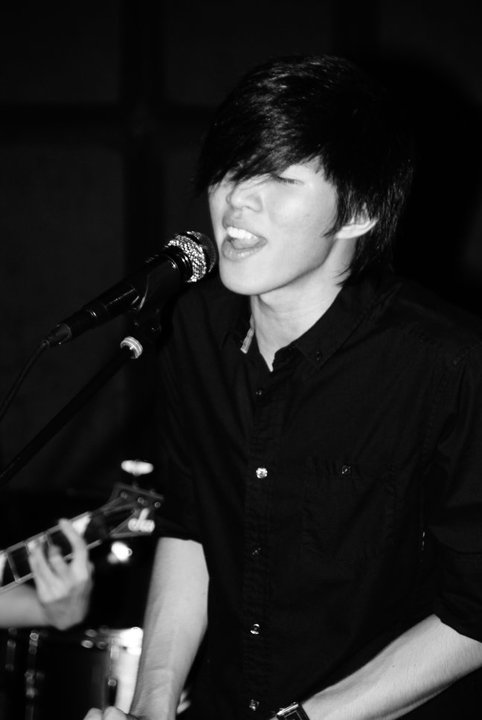
Ace Libre of Never the Strangers.
Enter the keyboardist. Armed with his long, rectangular board of black and white keys, he goes into a gig contributing an additional layer or two of texture to his band’s sound, every boop and steady hnggg his sonic weapon of choice makes closes gaps his cohorts might miss, and ultimately providing to the listener a richer auditory experience.
Three keyboardists took the time off to answer questions about their own experiences playing the keys. They are Ace Libre (who fronts and plays the keys for alternative rock group Never the Strangers), Karl Vito Cruz (of shock rock band Mr. Bones and the Boneyard Circus and post hardcore outfit Neruda) and Japo Anareta (who does synth duties for Paranoid City, The Pin-ups and Tanya Markova; also occasional session work with Pedicab).
What was the first instrument you learned to play?
ACE: A piano. Our Kolski upright piano at home was sent by a family friend from the US. It was way out of tune but I remember how my sister and I would get a kick out of tinkering with the keys years and years ago.
KARL: The piano. I don't think I had a choice back then. We had two acoustic pianos, one church organ and one portasound at home at that time. My grandparents were really good piano players.
JAPO: The first instrument I learned how to play was the piano.
Did you try taking up other instruments? Why did you eventually decide to stick to the keys?
ACE: I took classical piano lessons then moved on to taking guitar lessons when I was in high school. Almost everyone in my batch suddenly got into bands and I joined the bandwagon. Eventually, I learned how to play chords on the piano and began playing keys again. I decided to stick to the keyboard because I was very comfortable with it. It was easier to play and write songs with it.
KARL: After I learned the basics of piano playing, I learned to play the guitar and bass. But my heart always pulled me back to the piano.
JAPO: I tried to learn how to play the guitar, particularly the bass guitar, because I was kind of "discriminated" in high school. This was during the time rap metal was popular. Playing the keyboards then was considered lame and uncool. The keyboards enables me to play songs with ease (which I am having a difficult time doing when using stringed instruments). At first I only knew the generic "piano and strings" sound. But when I grew up, I learned that the keyboards could become a "synthesizer" (meaning: not your basic "piano and strings"-only sound). It made me more versatile and dynamic.
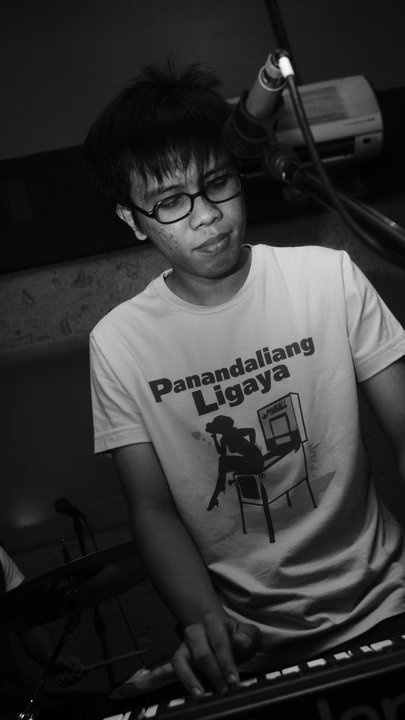
Japo Araneta of Paranoid City and The Pin-ups.
Who are the keyboard players you look up to?
ACE: Chris Martin of Coldplay, Matthew Bellamy of Muse, Tim Rice-Oxley of Keane.
KARL: My grandfather & grandmother (father's side), Ludwig Van Beethoven, Jerry Lee Lewis, Ray Manzarek of The Doors, Otis Spann, Jordan Rudess.
JAPO: Kayo from the Japanese electro-rock band Polysics. She is definitely the one who showed me that playing the keyboards in a band is cool. I discovered her band by accident on NHK and they opened up a new direction for me. She looks like a harmless little girl but that woman can really play. I was also inspired by Raimund Marasigan of Pedicab. He showed that the synthesizer is your friend.
Sonically, what's the biggest difference of bands with keyboards from the rest of the bunch?
ACE: For one, it's richer in texture. You have more varied layers of sound. For example, having pads really fills the soundscape and adds dimension. Arpeggiated notes also help make an arrangement interesting, since they can easily grab the listener's attention. I also like how the piano effortlessly adds emotion to a mellow song.
KARL: The difference between bands with keyboards compared to those without it is obviously the variety of sounds that only a keyboard can produce.
JAPO: In my opinion, bands with keyboards provide a much broader musical range. Some guitar-only-driven bands only occupy a certain range of sound. But when it comes to keyboard/synth-driven bands, they provide the listeners a wide spectrum of sound from the bass to the treble range. And in my humble opinion, a good song maximizes the use of all the areas of the sound spectrum (meaning basses, mids, and highs).
What's the most gratifying part of playing the keyboards in a band?
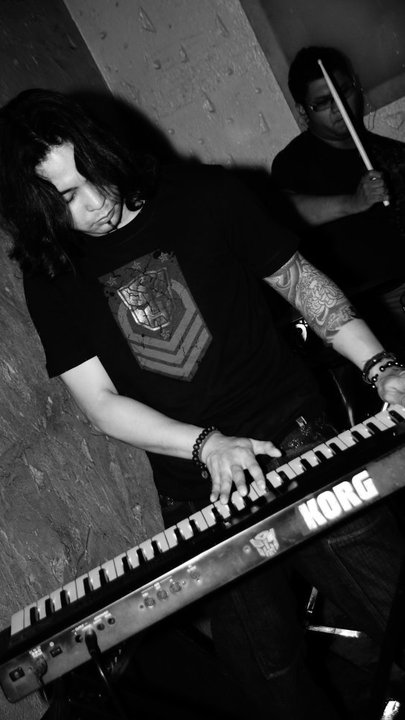
Karl Vito Cruz of Mr. Bones and the Boneyard Circus and Neruda.
ACE: Lots of the time, I feel like the instrument and I are one when I perform live or make music in my room. I guess that feeling of having the musical equivalent of a soulmate is pretty gratifying.
KARL: In the underground rock scene, us keyboardists are "rare" – at least here in the Philippines. I wish more bands come out with keyboard players though. And I wish bar owners will consider putting keyboard amps.
JAPO: The fact that playing the keyboards is now "accepted". When I was in highschool, it was considered to be lame. I was even kicked out of a band (and I don't blame them for that because they will sound really weird if I'm still on board. Haha!). Nowadays, being a keyboardist in a band makes you stand out to an extent.
Any advice you can give to anyone out there who might be interested to take up the keyboards?
ACE: Make sure to take the time and effort to find the keyboard that suits your needs. Don't just buy a keyboard 'cause it's cheap. Read reviews, test units out at shops and always have options. Also, take care of them. Time is not kind to electronic keyboards.
KARL: If you want to learn how to play the piano or keyboards, be sure to pour your heart and soul into it. If you can't do that, there's no point in you learning because all the notes you produce will just be a hollow shell.
JAPO: Eat your vegetables! But, seriously, the world needs more keyboardists (aka "synth operators", as I would call it) like you. Go do it. You'll never know what's in store for you. Defy the norm, experiment, make good music. Don't be afraid of that weird, stringless, black-and-white-looking instrument. As Orchestral Manoeuvers in the Dark used to say: "The synthesizer is your friend." – KDM, GMA News All photos by Kurt Claridades.

