

 GMA Brandtalk
 Tracking
 Archives

Lonely Planet author Greg Bloom shares tips on travel writing
For 10 years now, author Greg Bloom has been writing travel features that are published all over the world. But it was interesting to know that he got his big break while living in Manila in 2005, when he was asked to cover North and Southeast Luzon for the Philippine edition of one of the most famous travel guide books around: the Lonely Planet series.
“I was sort of eyeing travel writing,” he says, “because I thought that it would kind of be cool.” Just after moving here in 2003 with his then-partner, he took a helicopter skiing trip in the Kamchatka Peninsula in Russia’s Far East and wrote about it. “I came back, and sold the article,” he says, “and what do you know? It actually worked.” Around eight publications in four different continents took the story, his first successful foray into travel writing, and since then, it has been his career.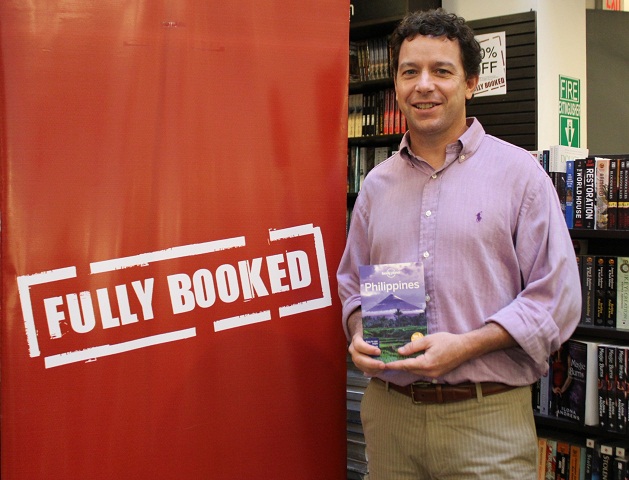 Bloom gave a workshop on travel writing last May 18 that was co-presented by the Lonely Planet Guides, Fully Booked, and Writers’ Block Philippines, an organization that aims to assist budding writers.
In an interview with GMA News Online, the American author recalls his years of wanderlust that eventually took him to Manila.
“I started off in PR in New York, then quit that to wander the world for a year, toward the end of which I landed in Ukraine, where my cousin lived. By that time I wanted to be a writer - I had been keeping detailed journals of my travels for many years,” he says.
Bloom worked with the English-language press in Kiev, where he learned to speak Russian, for five and half years. “It’s a common story among travel writers that you become a journalist before you become a writer,” he says, “but in my case, it was when I moved to Manila.”
Finding that there was little room for foreigners in what he calls a “pretty robust English-language press” in the Philippine capital, he decided to consider other options.
“It was not about the money,” he notes, “but it was more about having a tangible experience so I could get more into travel writing.”
Getting into Lonely Planet
Six months after writing about Kamchatka, Bloom learned that the Lonely Planet Guides was looking for someone based in the Philippines. “A friend of a friend told me this and gave me a contact,” he says, “and basically, everyone has to apply for a job at the Lonely Planet.”
After successfully completing a writing test—which involved a mini-guidebook on a place near where he lived—and an interview, he was asked to write the section of the Lonely Planet guide to the Philippines covering Ilocos, Cagayan, and Bicol.
“It’s important to mention that when I say I was hired by the Lonely Planet,” Bloom notes, “I was accepted as one of their pool of freelancers. There are certain benefits I get, especially when I’m on the road for them, but I don’t have a full-time job.” Members of the writers' pool pitch possible topics for travel guides—then the publication gives assignments to the select group.
The process of getting a Lonely Planet guide together involves pooling contributions from what Bloom describes as “a couple of writers [flown in by the firm] and a couple of others on the ground.” Usually, Lonely Planet hires writers that have had experience in the country, and the language skills to boot.
Bloom's first assignment for the 9th edition of the Philippines guidebook came out in 2006. Since then, he has been part of about 20 other editions of various Lonely Planet guides, including some countries in Southeast Asia and Eastern Europe. “It helps that I speak Russian, obviously,” he says, “so they look for people like me.”
Talk to people
Although the firm sees the need for people with local knowledge, Lonely Planet sometimes brings in an experienced writer who can easily find his or her way around a given place.
“It is hard that you have to get to know the place that fast,” Bloom says, “considering you have to do detailed work.” This includes reviewing hotels, compiling transport schedules, and other related things. The Lonely Planet books, like any other travel guide, rely extensively on research.
But what about writing travel features, especially when one gets into a new place and has to start from scratch?
“The only way you can find out, or get your way around a place, is to talk to people,” Bloom advises, “and whether I’m writing a feature or a guidebook entry, the key is to talk to as many people as possible.” This includes anyone from the cab driver who picks him up from the airport, to the bartender, or people he meets on the street. At one point, his sources included US Peace Corps volunteers.
“You would want to accept guidance from others, but it shouldn’t be your only form of intelligence-gathering,” Bloom emphasizes. “Your instincts are important too. You might run into, say, a restaurant or a bar, or even a site, something that hasn’t been discovered yet.”
These days, with the Internet, the task is made easier, though Bloom does take some sources with a grain of salt. “While it isn’t the bible,” he says, “if you have a few hundred people giving bad reviews [of a place on a trip review site], and it is in the Lonely Planet, I would probably take it out.”
Blookm left Manila in 2008 and is currently based in Phnom Penh, where he's working on a new edition of the Laos guidebook. – YA, GMA News
Photo courtesy of Fully Booked
A freelance writer, Ren Aguila wrote about the province of Isabela for GMA News Online.

