

 GMA Brandtalk
 Tracking
 Archives

Wild, whimsical wheelchairs roll out on Mabini's birthday
From “Happiness” by Lea Salonga: “Happiness is five different crayons, knowing a secret, climbing a tree.”
And now, happiness is an artsy wheelchair—more so if you get to ride it.
This is exactly what several visual artists—the creators of the wheelchairs—and a few disabled patients did at the afternoon wheelchair parade from the Mind Museum and around Burgos Circle in Bonifacio Global City last Saturday, July 20.
One wheelchair, Aba Dalena’s “Anghel Bulilit,” which featured an angel with his arm in a sling and a crescent moon rising behind him, appeared to be pulled by the Chihuahua tied to it.
The parade, which opened the two-week-and-a-half-long exhibit of the wheelchairs at St. Luke’s Medical Center, occurred just in time for two events: Rehabilitation Week, and the July 22 birthday of Apolinario Mabini, also known as the Sublime Paralytic, and a hero of the Philippine Revolution.
“Maganda siya kasi it’s part of the celebration of National Disability Week,” said Suzette, an occupational therapist. It was she who pushed the chair shaped like a winged egg—Plet Bolipata’s “Winged Chariot,” which was made of feathers, crochet, LED lights, and much else besides.
“It’s also inspiring because it truly inspires the patient na hindi ma-depress doon sa condition nila, being wheelchair-bound. Nakita nila yung wheelchair—very attractive—kaya hindi magkakaroon ng stigma.”
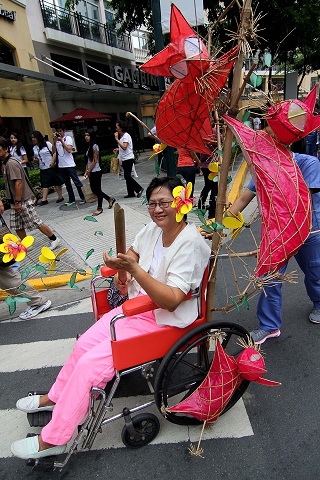
The brainchild of multi-awarded writer and publisher Gilda Cordero-Fernando and St. Luke’s SVP for Medical Affairs and Chief Medical Officer Dr. Joven Cuanang, the sculptural wheelchairs are meant to add color to the lives of St. Luke’s patients.
“The whole purpose was to cheer them up and help in their healing process,” said Cuanang, all smiles. “The theme was ‘happy.’”
What made the wheelchair parade even more novel was that it was not for a fundraiser of any kind, nor did any of the involved earn anything from the making of the wheelchairs. It was pure play.
“There [are] no proceeds because we did not earn a cent,” said Cordero-Fernando. “All the money that was ever raised was not money, it was just enough to pay P25,000 per wheelchair. Yung mga donors, ang mga binigay nila in kind. Yung Bonifacio [Mind Museum], for example, gave this space.
“Because we were just playing around, this was not supposed to be at all for any kind of raising money. Kasi wala naman naka-isip ‘nun, nag-eenjoy lang kami, naglalaro lang kami, enjoy na enjoy. Sabi namin, mag-enjoy yung mga pasyente, mag-enjoy yung mga artists.”
And indeed, it would have been hard to contest the big smiles on the faces of the artists and patients being wheeled around the rotunda.
This writer dares speculate that even the Sublime Paralytic himself would have cracked a smile.
Initial inspiration: the organizers
“I was being brought up to the third floor of Palma Hall by three guards of UP one Sunday,” said Cordero-Fernando. “Sabi ko, ang sarap pala nang inaakyat nang ganito, ‘kala mo kung sinong reyna… pero kailangan niyan, may mga jeepney signs, mga ganun.
“And then, on the same Sunday, I talked to Cuanang because I thought, it shouldn’t be just for me, we can do it with a lot of artists. Sira ulo din ‘yang artists, so enjoy rin.”
Cuanang helped her put it together by organizing the project’s supporters. “It was really among friends and they helped spread the word around when they learned there was a project like that. They were challenged, as the project had never been done before…the chair as a mobile work of art, never.”
“I hope manufacturers will consider making the wheelchair a little bit more colorful,” said Cuanang. “Traditionally, it’s always black, di ba? Para naman masiyahan yung pasyente na sasakay doon.”
Initial inspiration: the artists
Indeed, award-winning writer Vim Nadera looked to be having the time of his life donning a helmet, goggles, and an orange traffic vest dotted with paper cut-outs of skyscrapers as he rode the entry of the Makiling High School for the Arts students—a mountain comprised of brightly-colored buildings for the backrest, and sprouting bird wings on the sides.
“Inspiration namin yung mga building, as in community,” said Camille Kabatingan, one of the Makiling students. “Community tsaka childhood. ‘Di ba, ang city ay cramped and the city life is hard and difficult—so, we symbolized the bird as freedom. There’s freedom even though it’s cramped and everything.”
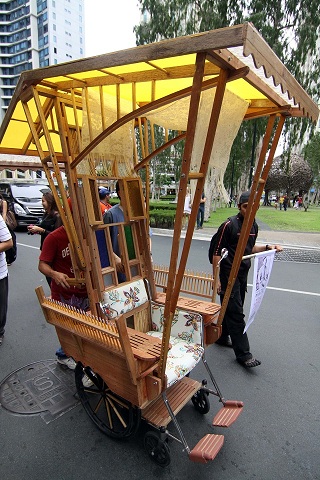
Filmmaker Kidlat Tahimik clearly had a great time alternating between riding the rattan entry comprised of the efforts of four different artists from Baguio and Ifugao (one of whom is the blind Ifugao rattan-weaver Rogelio Ginanoy) and catching the entire thing on his tiny camera. The chair is called “Ang Aking All-weather Guardian Angel Salumpwet.”
“To filmmakers, ang wheelchair is also often a [tool] for making a smooth galley shot,” said the Baguio-born director of “BUBONG! (Roofs of the World! Unite!)” (2006). “Kasi, you can sit down on the wheelchair and with a smooth floor, you can do a galley shot na smooth.
“The inspiration: let’s see how we can combine yung mga strong points of different artists with an idea coming from a crazy guy like me. Pero sila ang mga nag-eexecute ng mga different parts.”
Tahimik also stated that he liked the word “salumpwet.”
“Yung salumpwet, sinasalo yung pwet—that’s what the chair is all about,” he explained. “Pero in this case, this wheelchair, yung parang caregiver, sinasalo rin yung kaluluwa—it’s like giving an inner comfort besides being the salumpwet.”
Coincidentally, his trademark bamboo camera matched his entry.
His son Kawayan de Guia made another chair for the exhibit titled “Bulol,” which is an absorber of malignant spirits. The chair back was done in dark wood.
Favorite chairs
At 3 p.m., the program began, serenaded by a band made up of disabled rhondalla players, Rhondalla on Wheels. The artists were introduced alongside their chairs of art. The parade commenced at a little past 4 p.m., with on-duty hospital staff pushing at the chairs.
Cordero-Fernando was at its head in a wheelchair made by her grandson—a golden-winged affair comprised of rubber slippers glued together, and inspired by the anatomy of a bird.
“When I decided to give it [the wheelchair] wings, it started to look like an angel—but I wanted a bird,” said her grandson. “It was a choice between gold and silver paint.”
The proud lola said it was her favorite wheelchair, her other favorite being “Beast Friends Forever,” the one featuring three pink paper-mache cats done by her daughter Wendy Regalado.
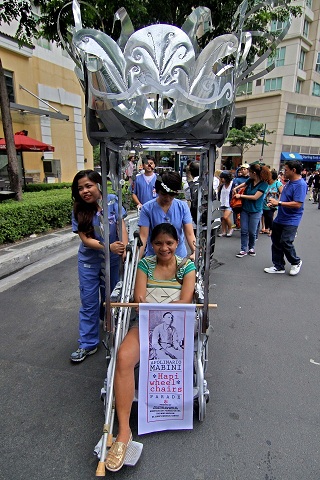
Cuanang believed that the Brains of the Revolution would have loved to be in the kalesa-style wheelchair—“a chariot to the skies!”
Kidlat Tahimik also said there were so many. But his favorite would have to be the elaborate two-seater, Karen Ocampo Flores and Noel Soler Cuizon’s “Primera, Segundo, Tercera.” It features an elaborate bronze frame housing three pictures. All along the frame are red plastic spoons and forks and bronze figures: lizards, robots, an axe, grapes, to name a few.
Other artists included Leeroy New, maker of “Temple for Healing,” an orange affair reminiscent of fire or stag antlers; Agnes Arellano’s “Anti-Stress Wheelchair,” which has rubber breasts lining the arm rests, backrest, and seat of the chair; and Robert Alejandro’s tin-made “Silver Chariot,” which called to mind wings and clouds.
One would think that Mabini would have been delighted to receive such a chair for his birthday.
The wheelchairs will be on display at the lobby of St. Luke’s Medical Center at Bonifacio Global City for two and a half weeks, beginning July 21—at the end of which, they will be auctioned off.
Until then, patients may ride them if they so wish. — BM, GMA News

