

 GMA Brandtalk
 Tracking
 Archives

ADVERTISEMENT
Filtered By: Lifestyle
Lifestyle
Marivi Soliven formally launches 'The Mango Bride' in the Philippines
Marivi Soliven won a Palanca Award in 2011 for “In The Service of Secrets,” a novel about two women of very different circumstances, but each seeking a new life in America. The novel was later published internationally under a new title, "The Mango Bride."

In a Q&A with National Book Store's Xandra Ramos-Padilla, Soliven expressed her satisfaction regarding readers' reactions to her book. Photos courtesy of National Book Store
“Immigration is such an iconic experience,” she said. “Somebody you know is abroad, or you are somebody who’s abroad.”
Aside from her own experiences, Soliven also drew on the stories that she has heard over the years working as an interpreter—an occupation she shares with Amparo, one of the characters in the novel.
“It’s my day job,” she revealed. “It allowed me to talk about different issues and experiences [in the book] because that’s what I hear every day.”
But more than just documenting the immigrant experience, Soliven said that she also wanted to explore how someone’s life situation in the Philippines can affect the way one sees or experiences the United States.
“Their provenance determines or influences what they see and how they react,” she explained.
This aspect of the novel is well-illustrated by the parallel stories of Amparo and Beverly abroad, as well as those of the other colorful side characters. Their fates are also a testament to life in a foreign country not necessarily being as simple or easy as some people might think.
“It’s hard to say that life abroad is better. It’s different,” Soliven said. “It’s a choice that everybody has to make for themselves. You have to have a clear-eyed vision of what you’re up against and what you will have to give up.”
The novel also provides an interesting look at a reverse point of view—how living in the United States affects the way someone sees or looks back on their experiences of home. Soliven thinks that she wouldn’t have been able to write this story if she were still living in the Philippines.
“I wouldn’t have been able to see what was funny or what was wrong or what was quirky about life here,” she said. “But it also helped me have a clear view of what was beautiful about Manila.”
The difference between a sprint and a marathon
Before “The Mango Bride” was published, Soliven already had an impressive body of work consisting mostly of short fiction, essays, poems, and books for children. Despite her experience, the transition from writing shorter material to writing a full-length novel was still quite a challenge for her.
“It’s kind of like the difference between a sprint and a marathon. Nakakapagod,” she confessed. “You really have to care about the characters and what happens to them. You have to pay full attention so that when you look at the big picture, the smaller things also make sense.”
Soliven began writing the framework of the novel as a National Novel Writing Month (NaNoWriMo) project.
“During Thanksgiving, I made turkey and I wrote a novel with 50,000 words,” she recalled. “At the end of that run, I had a not-good novel.”
Despite her own not-so-good product, she encourages budding writers to participate in NaNoWriMo so that they can get used to a writing habit.
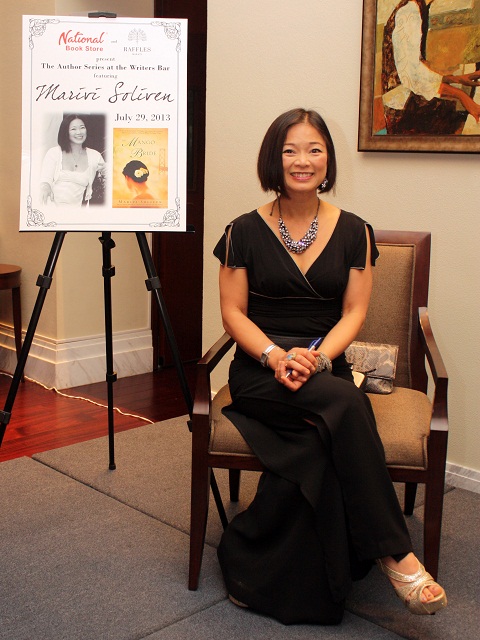
Soliven was also quite firm in saying that there will be no sequel to 'The Mango Bride', insisting that she has already told the story that she set out to tell.
She retained only the first sentence of the NaNoWriMo novel and re-wrote the rest. It eventually became “In The Service of Secrets,” which she submitted for consideration to the Palanca Awards.
After Penguin Books picked up the novel, Soliven re-worked certain sections based on her editor’s suggestions. In particular, she deleted an entire sequence set in Manila in the 1960’s; she re-organized events so that instead of a straight-up chronological narrative, some scenes served as flashbacks; she had to delete many “loving descriptions of food”; and she had to write new scenes with Amparo and Beverly in the United States.
“I’m sure it’s also partly a marketing decision,” she said of some of the changes. “But the way I worked it out actually made it turn out to be a sleeker, more surprising novel. And so in that case, I think it was served well by the intervention of the editor.”
Telenovela adaptation
Many reviewers and readers have commented on how “The Mango Bride” is reminiscent of television dramas. Soliven acknowledged, though, that if asked to cast a hypothetical TV adaptation of her book, she would be hard-pressed to make a list because she doesn’t know many of the local actors and actresses anymore. She did, however, remember a couple of names.
“When I was writing the character of Nanay Marcela, I was thinking bagay na bagay kay Nora Aunor,” she admitted. She also said that Alessandra de Rossi “will be great as one of the women.”
While an adaptation may not be in the works, a new novel is. Soliven is currently working on a historical novel, but would not elaborate about it further because she “didn’t want to jinx it.”
She was also quite firm in saying that there will be no sequel to “The Mango Bride” despite many people telling her that they wanted to know what will happen to the characters next. She insists that she has already told the story that she set out to tell. She was quick to add: “And no spin-offs!” — VC, GMA News

