

 GMA Brandtalk
 Tracking
 Archives

ADVERTISEMENT
Filtered By: Lifestyle
Lifestyle
Movie Review: Hold the snobbery when you watch 'Otso'
It’s arguably a good time for contemporary Filipino cinema.
That is, if we are to consider the seeming co-existence of both commercial and independently-produced films, and the new(er) names that have come to write and make films that are memorable because differently told, if not uniquely so.
That is, if we are to consider the seeming co-existence of both commercial and independently-produced films, and the new(er) names that have come to write and make films that are memorable because differently told, if not uniquely so.
I speak of both mainstream and independent films, given differing modes of production; for independent cinema, the task is now to look at the various modes of production and how these affect the kind of marketing – if not the critical response to – these independent films.
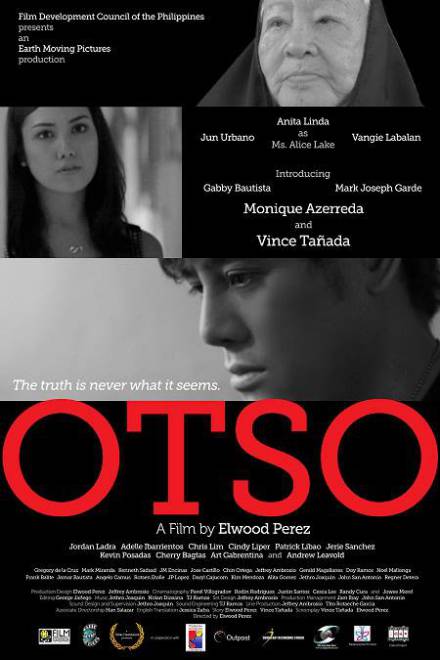
"Otso" is conscious of what it’s doing as a film being written.
Without a doubt, every movie included in the Sineng Pambansa’s All Masters Edition carries with it the weight of its mode of production: that is, being sponsored by government’s Film Development Council of the Philippines (FDCP), and being part of what it calls its flagship project.
But too, one engages with these movies as viewer with everything at stake: these are films labeled “by the masters” of Philippine cinema, at the same time that these are films living off government support.
What I have at stake is that I need to be able to call these mine; a measure of the kind of national cultural production for current times. I hope to take pride in it, too, which is to say that I was ready to be surprised.
As I was by Elwood Perez’s “Otso.” Written by Vince Tañada and Perez, this film is exactly the complexity that one likes to watch in local film, because it is also told tongue-in-cheek. In fact it is so conscious of what it’s doing as a film, that one can’t but be taken for a ride that’s fun and funny, if not absolutely and downright hilarious.
Black and white
Most of the film happens in black and white, and that will barely make sense until one finds that the lead character Lex (Vince Tañada) actually lives in his head – or in the film that he is trying to write, which is all in his head. Once you get in on that premise, and once you’ve dealt with the fact that a camera is trailed on the movie in Lex’s head (which is to say it’s a movie about a movie being written) then you can actually grapple with how this story unfolds.
Or doesn’t. Because in fact all that this film seems to show is the manner in which one writer grapples with the need to churn out a movie script, and as such takes from what is strange and unfamiliar in his new surroundings.
Lex seems uprooted from his context – if not this new building he lives in – which allows for the distance that he keeps with his neighbors. As such he is allowed to pre-judge them for how things seem and not how exactly they are. As such he has the space to fictionalize his surroundings for the sake of writing this movie.
It can of course only be a movie that lives off stereotypes and archetypes, the kind that popular culture and current events – if not tsismis – fuel into becoming.
A woman is seen getting into a car with a politician’s license plate; that is equal to actually being his mistress. A woman offers to help out a neighbor’s wife whose legs are paralyzed; she must be having an affair with the husband. An angry politician’s aid is looking for Lex’s next door neighbor; he must be in on vote buying for the coming elections.
Yes, it seems simplistic. But that is the wonder of the character of Lex, who is a writer without the high drama of it, who is trying to write without going through the middle class rituals of finding a muse, or staying up late at night, or going to some coffee shop in the middle of nowhere. Instead he works out, he steps out of the house to buy pandesal, he talks to his neighbors, he ends up taking care of a young boy – his neighbor’s son.
Of course part of the fun that this film allows is in the fact that one does not know exactly when we are seeing the story Lex is writing, and when we are actually seeing his story as written by Perez and Tañada. And yes, that is part of the fun here. To take things too seriously would mean missing the point entirely.
One fun ride
Everything in this film will tell you as audience to take everything with a grain of salt. That is to go for this ride, instead of getting off and assessing the situation from a distance. Because that distance is what allows Lex to judge his world and create a story out of it; we must know what is wrong with that.
Thirty minutes into the film, I realized that what Lex was treating us to was his creative process yes, but more importantly, here was information overload in his head. Between the unfamiliar surroundings and the strangers around him, and the need to create a film script, Lex’s head was a mess of images and moments, ones that are tied together by the flimsy story that he is creating from scratch.
In fact what is in Lex’s head, is filmmaking at its funniest. It is difficult not to think this a pointed critique at the manner in which films – mainstream and otherwise – fall into the trap of cramming and deadlines. At some point it mentions Brillante Mendoza, as the man who can get films into international film festivals without trying.
“Otso” is also a film; the camera of which is trailed on events from the strangest of angles, the camera of which captures the most unlikely moments, imagined and otherwise. Here, orgies are not exactly that, and sex is a collective activity. Here, the neighbors are complicit in election fraud, if not in electioneering and campaigning.
On this building in Lex’s head, Anita Linda is Alice Lake, the lady who lives at the penthouse, and who is his long lost grandmother, the one who sees all the rooms in the building and knows everything that happens. She is big brother.
Perez holds that camera
In Lex’s head is a camera trailed upon what goes on in his building, as it is trailed on the fiction he is creating from it. At the same time there is Perez’s camera on Lex, Perez being the real director of this film within a film.
The gift is the fact that you can forget and remember Perez’s hand in the telling of this film, and it would barely matter. Because he is neither intrusive, nor is he full of himself. There is no sense here of the director and writer, the creators of “Otso,” insisting on the importance of what it is they’re doing in this film; neither is there a sense that they think the film valuable because of what it does, and how it does it.
Because it can throw around words like metafilm, if not metacritical. And it can sell itself as a complex story about the creative process given this context of nation. But instead all it feels like, all it seems, is a story that turns upon itself, talking about writing a film and laughing at the travesty of creativity in itself.
That Lex is both everyman and the (anti-)hero in this film, is the gift that is Tañada’s skillful portrayal of him. Here Lex is believable even in his discomfiture; he is believable in his strangeness, and you root for him just because. But also you root for this film, because it might have taken you for a ride, but it sure was the kind of fun that was conscious of what it was doing, and it was funny because it laughed at itself.
By the time you get to that ending, you realize exactly the ride you were being taken on, and you might have expected it, but at least it got you there through a different route. – KDM, GMA News
“Otso” is directed by Elwood Perez, written by Perez and Vince Tañada for the Sineng Pambansa All Masters Edition 2013.
Katrina Stuart Santiago writes the essay in its various permutations, from pop culture criticism to art reviews, scholarly papers to creative non-fiction, all always and necessarily bound by Third World Philippines, its tragedies and successes, even more so its silences. She blogs at http://www.radikalchick.com. The views expressed in this article are solely her own.

