

 GMA Brandtalk
 Tracking
 Archives

ADVERTISEMENT
Filtered By: Lifestyle
Lifestyle
Theater review: Solving the 'poverty of happiness' in 'The Bluebird of Happiness'
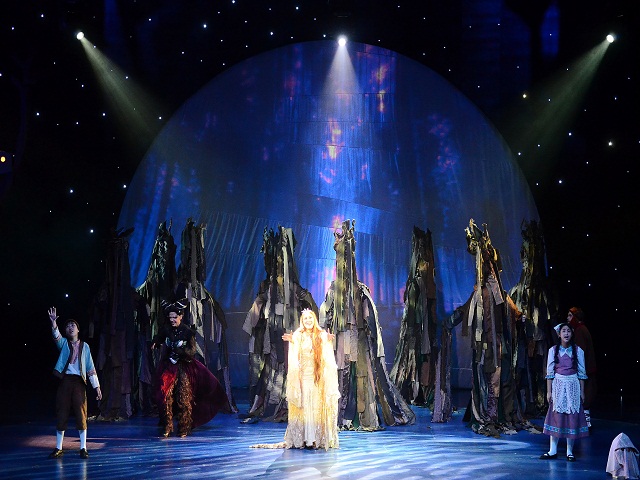
Light (Carla Guevara-Laforteza) guides Tyltyl (Anton Posadas) and Mytyl (Chimmi Kohchet-Chua) on their journey to find the Bluebird of Happiness. All photos courtesy of Trumpets Playshop & Musicademy
One of the greatest ironies of human existence is that scientific progress has enabled mankind to propel itself into outer space, but understanding of the root causes of the scarcity of happiness and the abundance of loneliness has been elusive. Mankind has conquered outer space, but not their inner selves.
Trumpets' latest musical "The Bluebird of Happiness," is in one respect, a significant journey in search of everyday life's gems, although not the glittering diamonds and gold jewels crafted by Tiffany, Cartier, or Lalique.
The message behind "The Bluebird of Happiness" is way beyond and above anything that money can buy, the artificial happiness of possession. It is a meaningful call for the audience to stop the time-consuming daily expedition to attain happiness and instead, begin to appreciate the magic of every moment now and be awed by the mystery of a particular situation one is engaged in.
The musical, with the book and lyrics and direction by Jaime del Mundo, with music by Rony Fortich, and musical arrangement by Mon Faustino, creatively invites the audience to pause once again, think deeply and honestly, and seriously re-assess things that matter most in life.
Worth the wait of 40 years
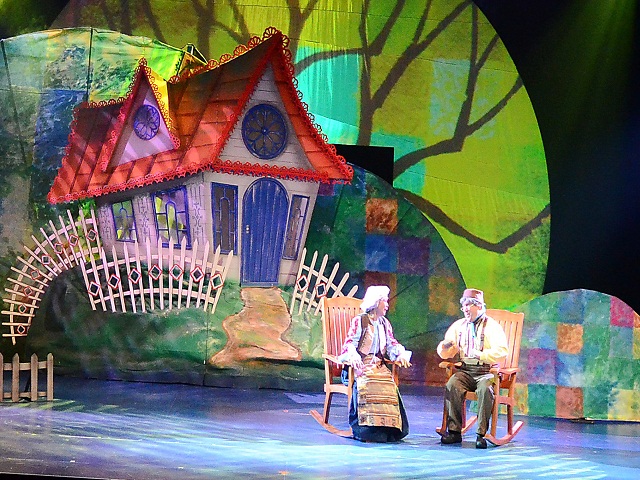
Grandma Tyl (Joy Virata) and Grandpa Tyl (Steve Cadd) have a chat before their charming house.
Trumpets' President Audie Gemora said he had wanted to mount "The Bluebird of Happiness" for more than 40 years. Maybe this particular production is Gemora's contribution in solving the Filipino's perpetual pilgrimage to solving the poverty of happiness.
Gemora's years of waiting were all worth it as the intricate staging, complete with convincingly animated animals and trees, among others, did not hint of any production budget woes.
A talented cast and crew
The production by Del Mundo and Fortich was such a magical and fantastic musical. Together with the scenography by Mio Infante, lighting design by John Batalla, video projection design by GA Fallarme, hair and make-up design by Myrene Santos, and choreography by Nancy Crowe, the production crew gradually metamorphosed the Meralco Theater into an elaborate, elegant, and delectable fairy land.
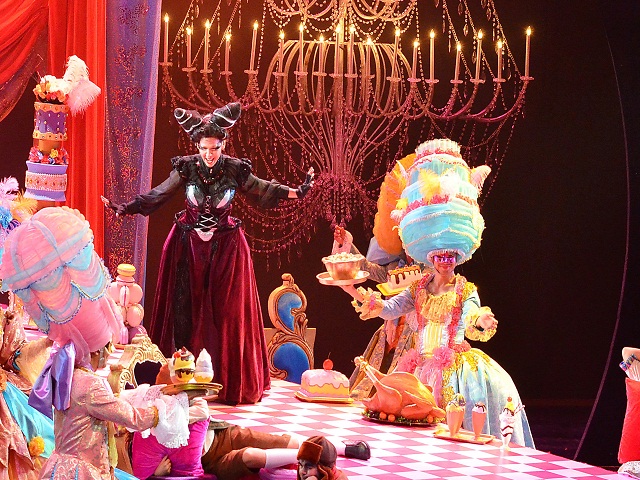
Tylette (Lynn Sherman) was a real show-stopper.
Accompanying Mytyl and Tyltyl on their journey of self-discovery were Mayen Bustamante-Cadd (as Mama Tyl), Jennifer Villegas-dela Cruz (the fairy Berylune), Lynn Shermann (Tylette the cat), Robbie Zialcita (Tylo the dog), Carla Guevara-Lafortesa (a candle named Light), Steve Cadd (Grandpa Tyl), Joy Virata (Grandma Tyl), Joel Trinidad (the villain Night), and Raymund Concepcion (Father Time).
It was no mean feat for the ensemble of adults and children to evenly sustain (for two hours and 30 minutes of singing and dancing) their combined vocal power, proper diction, and correct enunciation. This must be emphatically commended because even seasoned actors delivering lines in non-musical productions in Filipino language sometimes fail in these challenges.
The glittering bravura of the main characters, as evidenced by their brilliant comic skills with perfect timing—despite the heavy but impressive costumes—was not lost on the audience. The child and adult ensembles were evidently noteworthy, too.
Sherman as the cat Tylette and Zialcita as the dog Tylo, faithful guardians of Tyltyl and Mytyl during the expedition, were show stoppers. So were Villegas-dela Cruz as Berylune, Guevarra-Laforteza as Light, and Trinidad as Night.
Some tweaks here and there
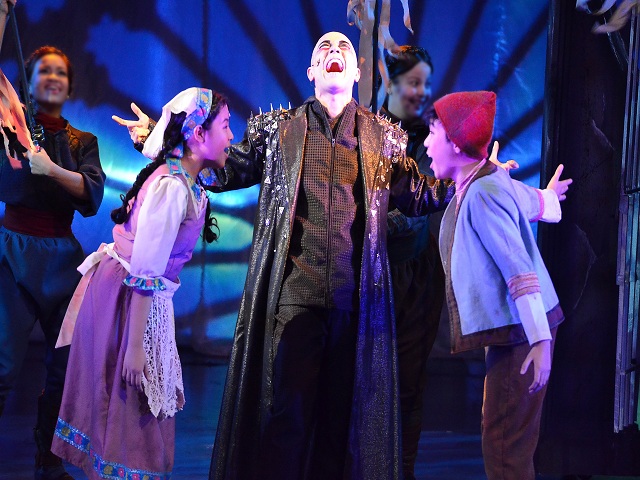
Night (Joel Trinidad) with the children.
In Maeterlinck's original play, the two children encounter characters such as Bread, Milk, Sugar, Fire, Water, the Cat, the Dog, Light, Night, and a whole litany of other characters. In an apparent bid to save on production costs and to be mindful of performance running time, Del Mundo chose to lessen the characters Tyltyl and Mytyl meet along the way. But this move does not in any way affect the integrity and creativity of the Trumpets' version.
The lavishly spectacular scenes in the "Land of Luxury"—do not blink during this sequence—sent children and adults in the audience gasping in amazement.
Scene after scene, in all the sequences, as Tyltyl and Mytyl progress in their search for the bluebird, Del Mundo treats the audience with a grandiose parade of characters who gracefully sing and dance in and out of a magnificent panorama. A fine attention to detail was palpably experienced by the audience throughout the journey of the two children.
Wisdom through song
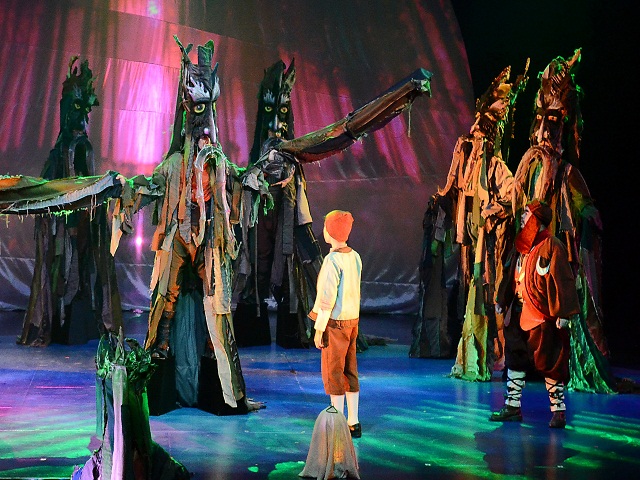
Tyltyl, Tylo, and the Trees singing "Revenge, Revenge."
An understated call to protect the environment was made in "Revenge, Revenge" where Mytyl and Tyltyl conversed with the trees when they got lost in a forest. In the original 1908 Belgian Maeterlinck play, the father was a woodcutter.
Among the extraordinarily memorable scenes and songs were:
- "Much More" and "Never Like Christmas" by Mytyl, Tyltyl, and the chorus (ensemble);
- "Song of the Bluebird" by Berylune;
- "Illumination" by Berylune and Light;
- "Remembering When – Reprise" by Grandma and Grandpa;
- "The Tango of Treachery" and "Catch Every Dream Tango – Reprise" by Night and Tylette;
- "Revenge, Revenge" by the Trees (ensemble);
- "Lap of Luxury" by the Luxuries (ensemble), Tylette, Mytyl, and Tyltyl;
- "The Fight" by Mytyl and Tyltyl;
- "Bluebird of Happiness – Reprise" by Mytyl, Tyltyl, and Tylo;
- "Be Born" by Father Time, Guardians (ensemble), and Children (ensemble);
- "The Graveyard" by Night, Tylette, Mytyl, Tyltyl, Light, and the Nightmares (Ensemble);
- "Christmas Morning" and "A Christmas Carol" by Mytyl, Tyltyl, Father, Mother, and Chorus (Ensemble).
Despite its length, one of the strong points of Trumpets' "The Bluebird of Happiness" is the rapid change of the striking production set.
Another feat of the musical's was its ability to convey the serious verities and painful frailties of life through happy music, which echoed strongly in the children and adults.
Overall, the musical was a triumph in fancifully entertaining an audience of all ages, while at the same time challenging them with eternal questions about happiness, loneliness, and human existence.
Trumpets' "The Bluebird of Happiness" runs until Oct. 20 at the Meralco Theater. For details and inquiries, please call Ticketworld at 891.9999 or Trumpets at 901.4364. — VC, GMA News
Ibarra C. Mateo, a former international wire service correspondent based in Tokyo covering Asian politics, returned to Manila after studying Japanese history and Japanese urban sociology at the Sophia University Graduate School. The views expressed in this article are the author's own.

