

 GMA Brandtalk
 Tracking
 Archives

ADVERTISEMENT
Filtered By: Lifestyle
Lifestyle
High school teacher Onofre Pagsanghan's life lessons
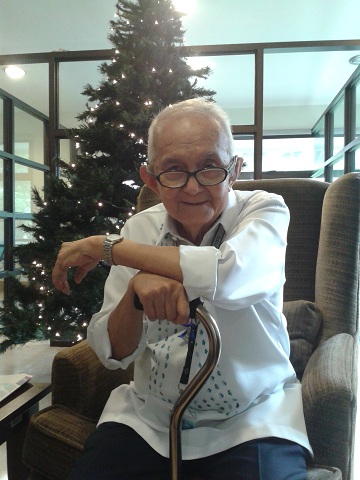
Mr. Pagsi, still hale after all this time, and as sharp as ever.
There were so many things I could have asked the renowned teacher at Ateneo High School upon our first encounter: How did you get your degrees? Why did you translate so many plays into Filipino? Do all of your students give you rights to their plays?
But as he began talking, I found myself mute and dumbstruck. It was as if I were one of his students, pen hovering above a forgotten notebook as I listened to his lecture. I watched the softness in his curiously blue eyes which, when latched onto me, made me believe that he believed in me, as though I will also eventually understand his meaning.
For 45 years, Mr. Pagsi has been a fixture in the lives of each batch of first year honor section students in AHS. But even those whom he did not teach directly have fond memories of him.
“I greeted him with a smile, then he stopped me and said—verbatim 'to, I swear—'Aren't the flowers so beautiful? We should never forget to stop and smell them. What a wonderful morning!'—then he walked away,” shared Guelan Luarca, this year's first place winner of the Palanca Awards' Dulang May Isang Yugto category.
The intensity of Mr. Pagsi's speeches would have been useful in a political career, but for all that, he chose to become a teacher because of his own mentors—among which number his mother, Vicenta Pagsanghan, and Fr. John Delaney, who was his high school principal when he was at the Ateneo. His mother used to tell him, “Wala tayong pag-angat sa kahirapan kung ‘di mo gagamitin ang utak mo.” She also brought him up on the idiom "mangarap, magsumikap."
He entered Ateneo with a scholarship and met Fr. Delaney, who first planted in his young mind the idea of teaching in high school.
And what a teacher he became. He has lectured all over the Philippines on topics pertaining to education (and been awarded many times for his efforts), authored three textbooks, received numerous scholarships abroad, and has won recognition also as translator, playwright, and director. He founded and directed one of the nation's leading high school theater groups, Dulaang Sibol.
His teaching has long broken out of the classroom. Take the annual summer pilgrimage he makes with students to the Chapel of the Holy Sacrifice on the University of the Philippines, Diliman campus.
A pilgrimage like no other
15 to 20 boys arrive at Mr. Pagsi's house at 5:45 one morning in the summertime. He and his students then walk to the Chapel of the Holy Sacrifice in UP, the concept of which was developed by Fr. Delaney.
Mr. Pagsi takes them to this particular chapel because nowhere else can he recall his mentor's teaching more vividly than in this chapel.
“For ten minutes, I say, go around this chapel and observe... After ten minutes, they sit on the grass, we sit and we discuss what they saw in the chapel,” he explained.
And it is through his students' observations that he would teach what Fr. Delaney taught him.
Lesson one: 'What you put in the center of your life is what you value most'
Once seated, a student raised his hand and said, “Sir, ito lang ang simbahang nakita ko na 'yung altar nasa gitna ng bilog.”
Mr. Pagsi smiled. He told them Fr. Delaney would ask his class what the number one thing in their lives were, because whatever it was, it would be what formed the values which they would live by.
He explained, “Core value comes from the Latin word core, which means heart. I can live with only one ear, I can live with only one eye, I can live with only one arm, I can live with only one leg, but I cannot live without the one heart that I have.”
He also said that God should be at the center of people's lives, for people are birthed from Him and will lay with Him in death.
“Because I will not end up in a coffin, I will not end up in an incinerator being burned. When I die, I will face God. And therefore, [as] Fr. Delaney [said], 'That's what we put in the circle of life',” he explained.
Mr. Pagsi warned his students that by putting power or money in the center of their lives, they posit them as their gods.
“If you make money the center of your life, ayan, kaya nagkaroon ng isang-libo't isang kurakot sa gobyerno. Kaya ayan, kapag nakatikim ng presidency, ayaw nang pabayaan. That's why Marcos lasted for how [many years]. Because what do you put in the center of your life?”
Lesson two: 'I serve God by serving people'
Another of the boys quipped, “Kakatuwa itong simbahan na 'to, because there are doorways, but there are no doors.”
The idea of open doorways, Mr. Pagsi explained, came from Fr. Delaney's concept that God was always present in people's lives, and the only way to reciprocate such ever-present love was to offer the same open-palmed reception to others.
“Bukas palad. Kung talagang mahal ko ang Diyos, kung talagang Diyos ang nasa sentro ng buhay ko, ang buhay ko magiging bukas buhay, bukas palad, bukas puso. I should be open to people. The target of my life is to serve as many people as I can,” he said.
He added, “The ten commandments [can be] simplified into two: I'm the Lord, dear God, I should be number one in your life. Number two: love one another as I have loved you. How do I serve God? I serve God by serving people.”
When asked why he continues to teach into his old age and despite his exhaustion, he answered: “Because I get the opportunity to serve people. Because it's not only the stomach that has to be filled; it could be that the stomach is full, but kung kulang dito [points to his heart] at kulang dito [points to his head], baliwala yung pagka-busog ng tiyan,” explained Sir Pagsi.
This generosity, he said, could not, like the doors of the Holy Sacrifice, be closed.
Lesson three: 'The best teacher brings out the best in people'
When one of his students pointed out that Vicente Manansala painted the Stations of the Cross, Mr. Pagsi told him, “Four national artists' work are here in this church built fifty years ago. And fifty years ago, these national artists were students!”
One reason these National Artists were able to become who they are today is their mentors. But Mr. Pagsi explained that mentorship is double-edged, that though good can bring more good, evil will make evil pronounced.
Mr. Pagsi made an example of government today.
“Dahil hindi siya nangungurakot, ang mga tauhan niya hindi nangungurakot. Kung nangungurakot siyang de primera clase, lahat ng mga amuyong niya nangungurakot. E anong nangyayari kapag ganun ang bayan?” he stated. “The best leader, the best teacher, brings out the best in people, and the worst teachers are those who bring out the beast in people.”
Lesson four: 'Life means opening your arms to other people'
Finally, one of the students who noticed the disproportionate length of the arms of the crucified Christ hanging from the chapel's ceiling said, “Napaka-haba nung kamay. Sir, maliit na tao ako, pero proportionate ako. Kapag binaba ko yung kamay ko hanggang dito [sa tuhod] lamang. Pero yung Kristo dun, 'pag binaba yung kamay, sobra! 'Di marunong ng anatomy yung si Napoleon Abueva.”
“My dear boy,” started Mr. Pagsi. “That crucifix is not a lesson in anatomy, it's a lesson on how God loves.”
He told the students of a poster he saw once, where a disciple asked how much Christ loved him. He said, “Christ stretched out his hands in the widest gesture a man could make and said, 'I love this much.' And Christ looks at me and says, 'How about you? How much do you love me?'”
Mr. Pagsi reiterated that life and love should be open-armed and never closed; that this openness could only come if our lives are open for others to enter and be touched by.
“If I have hate in my heart, I cannot even open my fists, much [less] open my heart, my arms. If money is the one I want to grasp, how can I open my arms?” he told his students.
To feel others in one's life, he said, is to feel God.
He said, “When [I am asked] 'Nakita niyo na ba ang Diyos?' Hindi pa. 'But have you felt God?' Yes. You feel God in other people.”
A precipitous exit
“The whole life is very orderly, 'di 'ba hija? So that's why I'm a teacher,” said Mr. Pagsi as he ended his speech.
But before I could ask my volley of questions, he told me that to talk any longer would be to diminish the meaningfulness of our meeting.
In the half hour of our talk—which felt more like four years of dwelling in his words—he was supposed to be in a meeting with other teachers, but chose to meet with me because, he said, I was brought to him by God for a reason.
What could I say to that?
Stuttering, I asked if I could take his picture, and he candidly asked if I wanted to take my pictures somewhere nicer than the small consultation room we were in. He even directed me to take another angle for variety.
One of the country's greatest teachers was again in his element, guiding another wide-eyed youth to a better way of doing things. — VC/BM, GMA News
Mr. Pagsi was one of the first teachers honored by The Many Faces of the Teacher, a program by the Bato Balani Foundation Inc. (BBFI), in cooperation with Diwa Learning Systems Inc. (Diwa) that recognizes the country's most dedicated educators and extols the virtues of teaching.
For the full transcript of the interview, head on over to the author's blog.

