

 GMA Brandtalk
 Tracking
 Archives

ADVERTISEMENT
Filtered By: Lifestyle
Lifestyle
After 19 years of teaching law, CJ Sereno now teaching justice
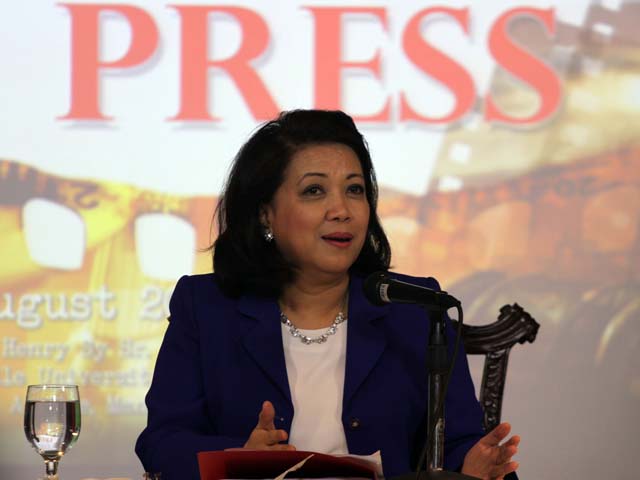
The Chief Justice at her first media briefing last August. Danny Pata
“Bukod sa pagiging abogado, naging guro po ako for more than 19 years,” Sereno said in her keynote address during the World Teachers’ Day celebration at the PhilSports Arena in Pasig City on October 5.
The 53-year-old Sereno, the youngest lawyer to be appointed to the Supreme Court (SC), assumed the post of Chief Justice in August last year, replacing Renato Corona, the first Chief Justice to be impeached in the Philippines.
Before her appointment to the SC, Sereno taught law at the University of the Philippines College of Law in Diliman, Quezon City.
Coming from a family of teachers, she has a high regard for teachers, extolling them as “bayani ng bayan” for their sacrifices to educate the young.
As Chief Justice, Sereno said she continues to be a teacher—this time not a teacher of law, but a teacher of justice, “isang guro araw-araw sa pagpataw ng hustisya.”
“Ang pagiging guro po ay napakalapot ng pagkahalo sa aming dugo,” she said. Both of Sereno's parents and some of her aunts and uncles were public school teachers.
Proud public school alum
Sereno, born in Manila on July 2, 1960, studied in two public schools in Quezon City: the Kamuning Elementary School and Quezon City High School.
In jest, she recounted how she was once asked if she studied in exclusive schools because “ang aking diction ay diction ng ‘Areneo’ [Ateneo].”
She did indeed earn an Economics degree at the Ateneo de Manila University before taking up Bachelor of Laws in UP, where she graduated valedictorian in 1984.
However, Sereno clarified that she owed her “Areneo diction” not to Ateneo but to her mother, a native of Bae, Laguna. “Ang aking nanay ay public school teacher na kaya akong turuan na parang sa ‘Areneo’,” Sereno said.
Her mother’s job as an English teacher once brought her all the way to Zamboanga for a teacher’s summer camp to lecture on advanced teacher’s course in English.
One of her students was a public school teacher from Siasi, Sulu. The two eventually married and settled in Metro Manila.
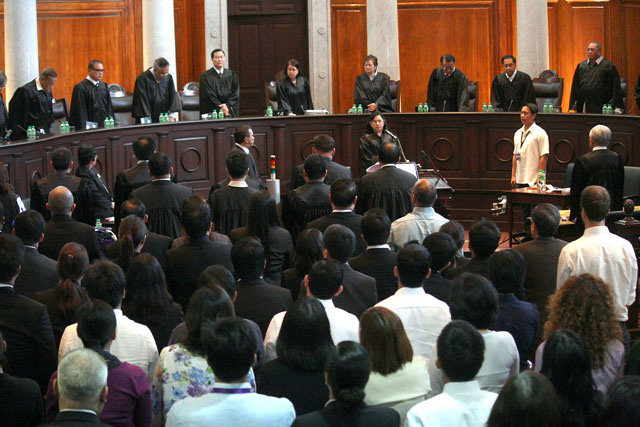
Sereno (center) presides over the oral arguments for the Cybercrime Prevention Act of 2012. Danny Pata
Sereno, who came from humble beginnings, recalled how she was told that being the top graduate in their UP law class would open many opportunities for her.
She remembered being told that by working as a lawyer for top firms, she could easily afford a mansion, designer bags, and European vacations.
While she did work for a top law firm after graduating in 1984, she gave it all up after two years, saying she wanted to devote more time to her husband Mario Jose Sereno and their children, Maria Sophia and Jose Lorenzo.
Sereno also said she wanted to live by the values inculcated in her by her parents. “Inisip ko po na naging napakarangal ng buhay na ibinigay sa akin ng aking mga magulang,” she said.
She then opted for a much lower-paying job as a UP law school teacher.
She admitted that there were times when she questioned her choice to become a teacher, especially when she would hear of her former students being involved in scams or scandals.
She asked herself questions like, “Tama ba ang desisyon naming magturo?”, “Ano ang kabutihang makukuha sa pagtuturo?”
She said she wanted her students to adopt the right values to serve the country as good lawyers.
“Baka binubuwis naming ang aming buhay sa mga lawyers na magiging mandarambong ng bayan,” she added.
Don't lose hope
At the event, Sereno also challenged the audience of about 8,000 teachers to help their students become good and upright citizens.
Amid the political scandals plaguing the country, Sereno said, “nasa inyo pong kamay kung mawawalan sila ng pag-asa at magiging cynical.”
“Sabihan n’yo po sila na huwag tumigil mangarap hindi lang para sa kanilang sarili kundi para sa bayan na matuwid ang tinatahak na daan,” she said.
She mentioned the pork barrel fund scam and how SC justices have the sensitive role of weighing the legality of the Priority Development Assistance Fund (PDAF), allegedly being used by some lawmakers for money laundering.
“Ngayon ang ating bayan ay humaharap sa napakahirap na katanungan ukol sa paggamit ng kaban ng bayan,” she said. “Mas lalo pong kinakailangan na kayo ay manindigan para sa katotohanan at katarungan.”
“Hindi panahon para mawalan ng gana sa paggawa ng kabutihan,” she said. “Dapat ipakita sa buong mundo na may kabutihan ang bayang Pilipino.”
Sereno also praised the teachers for their integrity. “Maaaring may magnanakaw, pero hindi po ang mga gurong Pilipino. Maari pong may mapanlinlang sa kapwa pero hindi po ang gurong Pilipino,” she said.
“Hindi po salapi ang ating hinahanap sa buhay [ng mga guro]. Maraming bagay mas mahalaga kaysa sa salapi,” she added.
Could be longest-serving Chief Justice
With her mandatory retirement set in 2030, Sereno could become the longest-serving Chief Justice.
According to the SC website, Sereno taught Civil and Commercial law in UP while leading two institutions based in the UP Law Center: the Institute of International Legal Studies and the Information and Publication Division.
In 1992, Sereno, on a De Witte Fellowship and a Ford-Rockefeller Scholarship, pursued Masters of Laws at the University of Michigan, Ann Arbor, focusing on law and economics and international trade law.
From 1994 to 2008, Sereno worked as legal counsel for various government agencies: Office of the President, Office of the Solicitor-General, Manila International Airport Authority, Department of Agriculture, Department of Trade and Industry, WTO-AFTA Commission, Philippine Coconut Authority.
In 1998, Sereno was named a TOWNS (Ten Outstanding Women in the Nation’s Service) Awardee for Law. The award is granted to outstanding Filipino women ages 21 to 45 years old who have contributed nation-building.
At that time, she was co-counsel with Justice Florentino P. Feliciano, of two important cases that were resolved in favor of the Republic of the Philippines:
1. the Fraport Case before the International Center for the Settlement of Investment Disputes in Washington, D.C. and
2. the PIATCO Case before the International Chamber of Commerce-International Court of Arbitration, Singapore.
In 1999, Sereno co-founded Accesslaw together with Justice Jose Campos, Commissioner Haydee Yorac, and other professors from the UP College of Law. Accesslaw provided the first annotated electronic research system in Philippine law.
On August 13, 2010, she was appointed by President Benigno Aquino III as Associate Justice of the Supreme Court.
Two years later, on August 24, 2012, she was appointed the country’s 24th Chief Justice, the first woman to occupy the post. — BM, GMA News

