

 GMA Brandtalk
 Tracking
 Archives

ADVERTISEMENT
Filtered By: Lifestyle
Lifestyle
Mañosa architects create 'hidden' residential community in Tagaytay
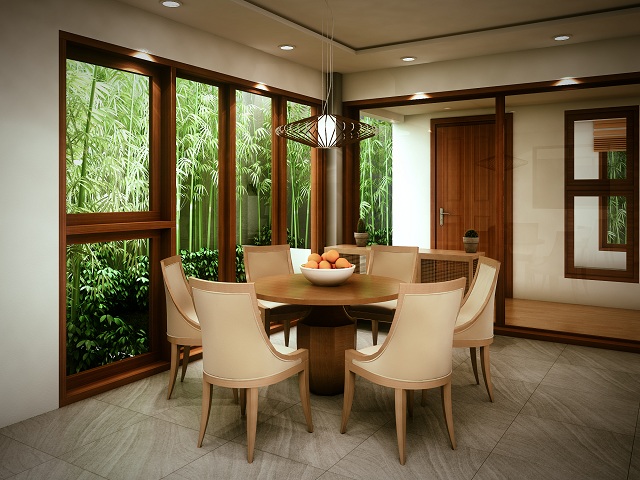
A Tagô dining room. Photos courtesy of MPI
Culture and climate define a country's architecture. And for a house design to work, it has to address the needs of its dwellers. In the Philippines, nothing illustrates these two ideas more than the bahay kubo, perhaps the only sample of Philippine architecture free from foreign influence.
Strongly believing in both the form and function of the nipa hut, siblings Dino, Angelo and Bambi Mañosa founded the real estate company Mañosa Properties, Inc. (MPI), which offers an artisanal brand of real estate that captures the elements of the bahay kubo.
The firm's design philosophy is anchored on that of the siblings' father, Bobby, whose six-decade-long career included the building of landmarks such as the EDSA Shrine, the Coconut Palace, Amanpulo Resort and the Bahay Kubo Mansion.
Following in his footsteps, the second-generation Mañosas are now building and designing Filipino living from the ground up.
MPI first made its mark on the local real estate industry with its residential communities in New Manila, the homes manifesting the epitome of the bahay kubo’ workings. The success of these tucked-away properties has now led to another project, this time in secluded Bonifacio Drive in Tagaytay City.
The development is called Tagô (with the circumflex on the o; the word they want is "hidden"), describing both the location and the exclusivity of the community. Only 52 two-storey homes are available.
 "Apart from the elements of the bahay kubo, the crisp climate intrinsic to Tagaytay City also serves as inspiration for Tagô’s open-plan design," said Dino, who is also MPI president.
"This is why we’ve incorporated green zones, air passages and wide spaces to bring the outdoor setting inside, allowing the homes to breathe."
MPI also embraces the green architecture espoused by Bobby Mañosa. "Being mindful of the environment when designing homes and communities is a requisite to organically achieve 70 to 80 percent of being green. This includes consideration of wind direction and sun paths which guide the placements and sizes of doors, windows and walls," said Dino.
MPI's projects, including Tagô, have received BERDE certifications.
A Tagô home features a split interpretation of the bahay kubo's high-pitched roof, with deep overhangs and sunshades to protect the façade from rain and direct solar radiation. Wide windows, also derived from the traditional nipa hut, provide a clear space at the center as well as allow passive cooling, cross ventilation and light paths to penetrate the living space.
Bamboo, mat-woven ceilings and an araal and adobe wall made of native stones are used to lower the home's carbon footprint and soften its aesthetics. Additionally, the homes have the Mañosa signature staircase with wide and gradual señorita steps, making it easy for multiple generations to traverse the home.
As the beloved traditional song about the bahay kubo goes, "ang halaman doon ay sari-sari," and Tagô has not neglected the greenery either. Vegetation is incorporated in the design, with the soil promoting not just aesthetic horticulture but comestible plants as well.
With Tagô, the Mañosas continue to promote Filipino designs and materials in homes that are accessible and attractive. — BM, GMA News
Strongly believing in both the form and function of the nipa hut, siblings Dino, Angelo and Bambi Mañosa founded the real estate company Mañosa Properties, Inc. (MPI), which offers an artisanal brand of real estate that captures the elements of the bahay kubo.
The firm's design philosophy is anchored on that of the siblings' father, Bobby, whose six-decade-long career included the building of landmarks such as the EDSA Shrine, the Coconut Palace, Amanpulo Resort and the Bahay Kubo Mansion.
Following in his footsteps, the second-generation Mañosas are now building and designing Filipino living from the ground up.
MPI first made its mark on the local real estate industry with its residential communities in New Manila, the homes manifesting the epitome of the bahay kubo’ workings. The success of these tucked-away properties has now led to another project, this time in secluded Bonifacio Drive in Tagaytay City.
The development is called Tagô (with the circumflex on the o; the word they want is "hidden"), describing both the location and the exclusivity of the community. Only 52 two-storey homes are available.
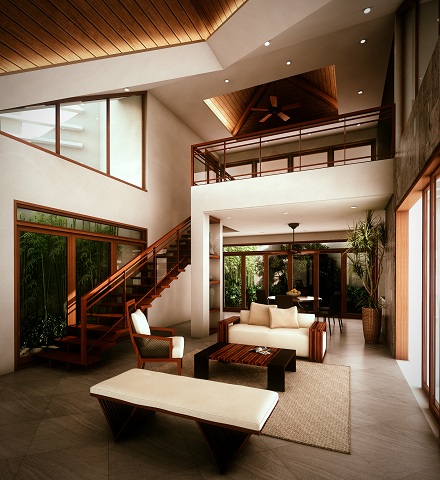
The Tagô living room.
"This is why we’ve incorporated green zones, air passages and wide spaces to bring the outdoor setting inside, allowing the homes to breathe."
MPI also embraces the green architecture espoused by Bobby Mañosa. "Being mindful of the environment when designing homes and communities is a requisite to organically achieve 70 to 80 percent of being green. This includes consideration of wind direction and sun paths which guide the placements and sizes of doors, windows and walls," said Dino.
MPI's projects, including Tagô, have received BERDE certifications.
A Tagô home features a split interpretation of the bahay kubo's high-pitched roof, with deep overhangs and sunshades to protect the façade from rain and direct solar radiation. Wide windows, also derived from the traditional nipa hut, provide a clear space at the center as well as allow passive cooling, cross ventilation and light paths to penetrate the living space.
Bamboo, mat-woven ceilings and an araal and adobe wall made of native stones are used to lower the home's carbon footprint and soften its aesthetics. Additionally, the homes have the Mañosa signature staircase with wide and gradual señorita steps, making it easy for multiple generations to traverse the home.
As the beloved traditional song about the bahay kubo goes, "ang halaman doon ay sari-sari," and Tagô has not neglected the greenery either. Vegetation is incorporated in the design, with the soil promoting not just aesthetic horticulture but comestible plants as well.
With Tagô, the Mañosas continue to promote Filipino designs and materials in homes that are accessible and attractive. — BM, GMA News

