

 GMA Brandtalk
 Tracking
 Archives

ADVERTISEMENT
Filtered By: Lifestyle
Lifestyle
The business of bestsellers and why these help the Philippine lit scene thrive

Bestsellers and the City took place at the Ateneo de Manila University's Rizal Library on November 13. All photos by Sebb Borja
"It feels very surreal... life [right now] is equivalent to living in the Twilight Zone," she said, laughing.
The author said that writers should share the story they want to tell, and not tales with plot points derived from trendy books. She is also a staunch proponent of self-initiative at marketing one's books.
Publishing bestsellers was just one of the topics brought up at the Ateneo de Manila University leg of the 4th Philippine International Festival's "Best Sellers and the City," held at Rizal Library on November 13. The speakers for this talk shared their experiences in publishing, as well as piecing together what bestsellers might mean for both publishers and readers.
The meaning of 'bestseller'

Samantha Sotto at the "Bestsellers" talk of the Ateneo de Manila University leg of the 4th Philippine International Literary Festival.
Jurilla, who was part of a different talk earlier in the program, explained that the Western definition of best sellers—the rapid and mass consumption of books—couldn't, and shouldn't, be upheld by the Philippines, since the consumption of books here differs from the consumption of books in Western countries.
"These systems—in the Philippines—do not exist. But this is not to say that in our own small scale, we do not have our fair share of books that sell in large quantities during short periods of time," she explained.
Padilla, in her talk, espoused the feasibility of sales as a necessity for booksellers to even consider novels to publish.
"The business of books is actually the business now of best sellers, fortunately or unfortunately. Kung hindi mabebebenta yung book, malulugi yung publisher at bookseller. It has really no place," said Padilla in a matter-of-fact tone.
This practical outlook of Padilla may turn off some aspiring, especially those who ascribe to Sotto's "tell your own stories" principle. But then again, literature and its industry is made up of all kinds of stripes.
Leg up for risky titles, translations
However, revenue from best sellers may actually help riskier titles make it onto shelves, rather than let these moulder in the slush pile of literary agencies and publishers everywhere.
"Best sellers allow publishers to produce other books that they believe in or value in even if they do not sell in massive numbers. Books that people may not necessarily want to read, but actually need to read, as far as the publisher is concerned," said Jurilla.

Segundo Matias Jr. at the "Bestsellers" talk of the Ateneo de Manila University leg of the 4th Philippine International Literary Festival.
The owner of Precious Pages, known for its Filipino romance pocketbooks, was able to acquire rights to several known novels, including the Harry Potter series and even Paulo Coehlo's "The Alchemist," and translate them into Filipino.
"When I went to Paris [for the Frankfurt Book Fair], sabi ko, 'They speak English, the German speak English, we speak English, they have these translated books—ba't sa Pilipinas wala?" he shared.
The lack of translations led to Lampara Books, a subsidiary of Precious Pages, to translate many classic literature to Filipino.
"I want people to tell or sabihin rin niyo na Tagalog kayo. Na itong tinatranslate ko o trinanslate namin may karapatan siya," he said.
Despite his good intentions, he admits that his company's translations have not always been well-received, especially by students. Matias tells his employees to ignore the jeering. "May nagbabasa nama ng Tagalog," he said, but pointed out the hypocrisy in people saying "eww" to Lampara Books's translations.
"There's no reason why we should hate it... English is a global language. You need it. And Tagalog—don't tell me you don't speak Tagalog sa bahay," he joked.
On a more serious note, he said that people want to read in their own language, either as a novelty or as a need to understand concepts that they could not completely grasp in other languages. He pointed at the sales enjoyed by his company as an indicator that there is, indeed, a market for Filipino-language stories.
Bottom line on the bestsellers
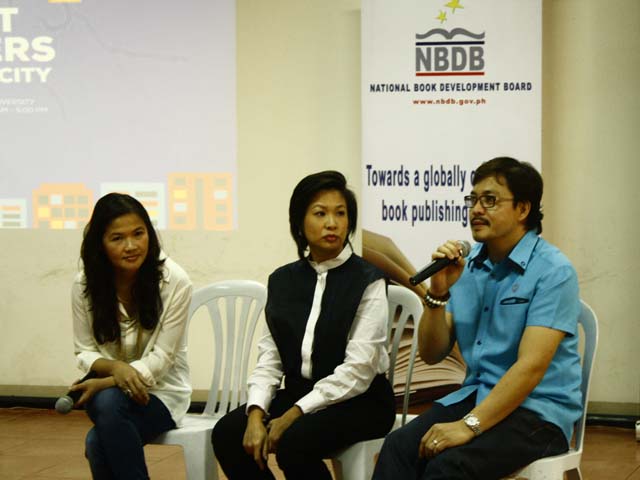
R to L: Samantha Sotto, Patricia May Jurilla, and Segundo Matias discuss all about the business of best sellers.
The enormity of the data they gathered could only point to another function of the bestseller: best sellers offer insight, patterns, or trends in consuming literature. As Jurilla puts it, best sellers could be seen as cultural markers, showing the mood of the populace during the time these books became popular.
Digesting all the implications that bestsellers entail is long, hard process. But before any aspiring writer can even begin to dabble in the complexities that pave the road to being a bestseller, there must first be a book.
Sotto's advice to those dallying in their work on what may be the next big thing?
"Don't make any excuses... We have pockets of time in our day, and it's just a matter of choosing 'am I gonna do Facebook in this time?' or 'am I going to write one paragraph today?'... If you wanna write, write." — VC, GMA News

