

 GMA Brandtalk
 Tracking
 Archives

ADVERTISEMENT
Filtered By: Lifestyle
Lifestyle
Dance review: Surviving the moment in ‘Nga-nga’
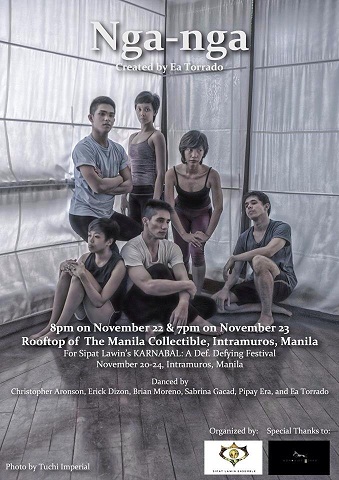 There’s a haunting randomness and a pervasive mood of boredom enmeshed in the universe concocted in the contemporary performance "Nga-nga". Choreographed by independent dancer Ea Torrado with five dancers and performed on the rooftop of The Manila Collectible in Intramuros, this hour-length show was premised on the question posited by the choreographer in the program notes: “What happens when you live life doing what you have to do rather than what your body and soul yearn for? What happens when you live life on the world's terms rather than your own?”
The venue itself seemed an informal and unconventional set-up—a rooftop behind the Manila Cathedral on a dreary November evening. There was a foreboding of rain that night, but thankfully it was just a short-lived drizzle, allowing the open-space performance to push through. Audiences were guided to sit on monobloc chairs in the covered side of the space, and the dancers used the rest of the roof deck as their stage.
The dancers were clothed in grey apparel, and we readily imagine them to be yuppies caught up in the machinations of corporate culture. Torrado walks from one side of the space to the other with a bunch of papers in her arms, and suddenly drops them as if in sudden rebellious abandon. And so the performance begins, set to a mixture of ambient sounds: "Pu Ert Jorðin" by Ólafur Arnalds, "Ruthless" by Amon Tobin and "Glósóli" by Sigur Rós.
The dancers scattered around the space, where entrances with two glass doors jut out: these became perfect and natural props for the movements, for the choreography very much engaged itself in the building’s elements to execute its movement agenda. Dancers leaned on, peeped through and slid up and down the glass windows, their catatonic gazes heightening the sense of stupor embedded in the dance’s mood. They also engaged the balustrade, using it as a barre, a movement support, or sometimes simply as a prop to show their encasement in a prison-like existence. We are reminded of how site-specific performances like this are now crucial facets in contemporary dance theater, breaking through traditional proscenium spaces that tend to distance and separate the audience from the performance and the performers.
The bunch of white papers first carried by Torrado also figured prominently in the dance. They were strewn across the space, picked up and then thrown repeatedly by different dancers at various point of the show. It gave us the idea of what it feels like to be drowned in paperwork—reminiscent of the routine of corporate existence.
Each dancer also had their respective solos, and the ones that stood out were Brian Moreno and Erick Dizon, both stocky and firm male dancers who executed their parts with a clear hold of their technical prowess coupled with an emotion-powered mien. Sabrina Gacad also had an expressive stint, especially in her arm flailing and writhing movements. The pas de deux between Torrado and Dizon also provided interesting moments, with Torrado appearing to move as a puppet-like machine that Dizon, with much effort and frustration, wanted to give life to.
Besides the seeming random executions of movements and solos, the group also performed dances in unison. The group running in one place was one of them, which showed how people may appear to move in life without really reaching their desired destination.
The title “Nga-nga” is of interest, as it was culled from popular Pinoy culture, a colloquial term that has recently emerged with the connotation “hoping for something aimlessly.” Or even “hoping for nothing.”
Nga-nga was one of the performances under the banner Karnabal, staged by Sipat Lawin Ensemble, a theater community founded by alumni of the Philippine High School for the Arts. Torrado and her group of dancers are all independent dance and theater practitioners. Some of the other artists that performed in Karnabal’s five-day event were Shaharazade Theater Company, Eisa Jocson, Kolab Co. and Anino Shadow Play Collective—all teeming with various permutations of bringing theater and its public outside the box of established traditions.
The tone of "Nga-nga", after all, was of soul-searching, which is what today’s generation is enmeshed in amidst our hopeless case of "instant culture"—thanks to our digitized, gadget-crazy, consumerist age. It seems that we are now high-wired to become robotic objects in the service of the dictums of the global age.
But as that deep yearning to be free from our self-created prisons continues to stir us from inside, ours is the hope that we will survive beyond the moment. — BM, GMA News
"Nga-nga" was performed on Nov. 22 and 23 at the Manila Collectible, Intramuros, Manila as part of a performance series by Sipat Lawin’s Karnabal from Nov. 20 to 24.
Rina Angela Corpus is an assistant professor at the Department of Art Studies, University of the Philippines. Her research interests include feminist aesthetics, dance history and alternative spiritualities. She trained with the Quezon City Ballet and Limon Dance Institute in New York. You may visit her writings at Dance of Stillness. The views expressed in this article are her own.

