

 GMA Brandtalk
 Tracking
 Archives

ADVERTISEMENT
Filtered By: Lifestyle
Lifestyle
Movie review: The problem with burying your dead in ‘As I Lay Dying’
Addie Bundren (Beth Grant) is on her deathbed.
As the matriarch of the Bundren family, her final wish is to be buried in the town of Jefferson. This movie is about how her children and husband try to fulfil that wish as many calamities, including familial betrayals and misdirections, befall them during the transport of her coffin.
There’s no shortage of ambition in bringing to screen a novel as explosive in narrative as William Faulkner’s “As I Lay Dying.” With 15 different characters written in a dense and stream-of-consciousness technique with multiple narrators and varying chapter lengths, the novel is a beast to adapt.
It’s arguable that you’re setting yourself up to fail because of the obscurantist nature and resistance to filmability of the source material. In many ways as well, the trying is the main thing – or the only thing. And the crew spearheaded by Franco achieves success in so many ways and in places shines with the glimmering prose of Faulkner’s tale of a family in the throes of grief and change, thereby giving justice to it.

James Franco, who stars as Darl Bundren, also directed the film and co-wrote the screenplay.
With visual done in the novel’s same crisp prose, the first thing that strikes you is the great color grading and attention to detail shot in HD. The backwaters of the American south look very rural and very, very poor. The destitution of the Bundrens is apparent in the grime on their faces, their clothes and house. Dirt poor, they say, and it shows from the family patriarch down to the youngest kid in muddy overalls.
Speaking of the father, Tim Blake Nelson (whom we also saw in “O, Brother Where At Thou?”) as Anse Bundren offers a deliciously sly portrayal of the bull-headed, self-righteous patriarch with his teeth gone but for a horrid mess of dented molars and about three of his front teeth.
This deformity foreshadows a lot of his character’s stubbornness and his emotional callouses. “I can finally get them teeth,” he mumbles after Addie dies. With the thick hick drawl it also makes him nigh incomprehensible. Some subtitles might not go amiss, especially at the start of the movie.
Franco worked on his movie even as he was studying for his Ph.D. in English. In the process he assembled a fine cast: Danny McBride as Vernon Tull, Ahna O'Reilly as Dewey Dell Bundren, Jim Parrack as Cash Bundren, and Jesse Heiman as Jody.
Logan Marshall-Green is a dead ringer for a thin Tom Hardy (and he’s got an awesome stoner metal beard here) and his portrayal of Jewel Bundren who’s normally hard as ice with a macho swagger becoming undone by their mother’s death is a great study in how the Southern man’s stoicism unravels.
It’s a great collection of characters that, in a narrative this limited, can’t help but be excerpted and truncated. I would have preferred to hear more about Jewel’s relationship with the bronco horse, or how Dewey came to be afflicted with her mystery “problem”, or even why Darl is giving his siblings, but especially Dewey, so much grief and ball-busting.
Prickly, unwieldy, and decidedly for a niche audience who want to challenge their smarts or English lit cred, Franco’s movie is an adorable, gloom-and-doom misfit underdog that you can’t help but root for. One thing’s for sure, this movie is more entertaining than it has any right to be.
There’s a lot of arthouse gambits employed in this movie to help convey the mental atmosphere of each character as reflected in the novel; split screens, fourth wall monologues, speaking tracks for each character superimposed over head shots of them not saying a damn thing.
They achieve varying degrees of success in various parts. Good thing they’re tied together by a very apt score. The violins and occasional piano are like metaphor for the Bundrens’ anxiety and emotional shudders. The atonal notes and harmonics build up, settle down, then rise to swelling point as things come to a head.
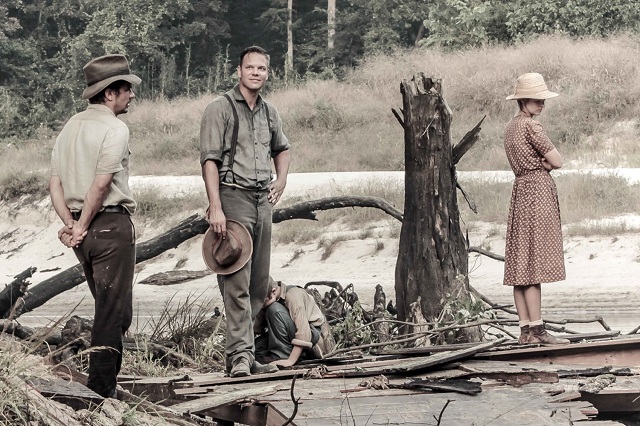
It’s especially affecting in the part where the family tries to ford the river with their mom’s coffin, with disastrous results. The music score brings strange delicacy to this tale of Murphy’s Law.
The split screen, for one, is meant to convey sometimes wishful thinking or things that each character wanted to happen, sometimes it shows inaction and loaded conversations at once, sometimes a delay in thought and then the execution of that thought in either screen at varying speeds.
There’s also the niggling suspicion that Franco is just messing with our head because he can, or that he took too much joy in this filmic device and went with it. It’s either remarkably self-indulgent or fraught with meaning – and it’s sometimes hard to sit through it until you realize it’s a set-up worth the wait.
There’s a scene where Anse and his neighbor Vernon just sit outside the house as Addie is dying and the left screen shows them not talking at all while the right shows their conversation. Not only does it indicate passage of time (hey, they just sat there for a long time), it also shows the part where some action does happen (hey, they were talking, too).
It’s a fine way to express multiple perspectives and it does keep the action interesting, especially during the many crises the family meets along the way to Jefferson. Faulkner, like other Modernists, felt that experimentation was almost a duty, and the subtlety of getting Addie’s monologue from when she was alive and from her coffin may go unappreciated by many but astute lit majors in the audience. We see what you did there, Mr. Franco.
Franco, Parrack, Brady Permenter and O'Reilly as four of the Bundren siblings.
As eldest son Cash puts all of his carpentry skills to work preparing her coffin, Darl and Jewel leave the farm to make a delivery to the Bundrens’ neighbor, Vernon Tull (McBride in this dramatic role surprises and delights). Shortly after Darl and Jewel leave, Addie passes away.
Be warned there are many shocking (sometimes downright grisly) moments here that are hard to watch. But it is the scenes prior to their departure for Jefferson that I really liked about Franco’s full-length directorial debut. From the pray over ceremonies, to the way Jewel brusquely handles his side of the coffin, even how Anse interacts with his neighbors during the wake. It’s about as much balm over grief as you can manage.
In the context of the later scenes, I came to realize that the Bundrens were in that moment as much a family united and insular in their heartache. As much as they could manage, I mean. Their grace in torment was beautiful.
You can probably tell that, for all its faults, I like this one. Whether this movie compels you to pick up the original Faulkner novel is of little consequence. It’s a hard read, I tell you. I couldn’t get past page 30 on my first few tries—and I’m on my third attempt now.
Nobody will think ill of you for preferring to watch Franco’s adaptation. Which is a fancier way of saying you must go see this to experience, abridged as it is, even a part of the tour de force of Faulkner’s vision of a family in the throes of suffering, doing their best to carry out a deathbed wish.
Albeit set in Faulkner’s fictional Mississippi county of Yoknapatawpha, the Bundrens' obdurate endeavor to bury their dead can be a remarkably relatable Pinoy experience. — BM, GMA News
All photos courtesy of Millennium Films.
“As I Lay Dying” is now screening in all Ayala Mall cinemas nationwide.
The views expressed in this article are the author's own.
Be warned there are many shocking (sometimes downright grisly) moments here that are hard to watch. But it is the scenes prior to their departure for Jefferson that I really liked about Franco’s full-length directorial debut. From the pray over ceremonies, to the way Jewel brusquely handles his side of the coffin, even how Anse interacts with his neighbors during the wake. It’s about as much balm over grief as you can manage.
In the context of the later scenes, I came to realize that the Bundrens were in that moment as much a family united and insular in their heartache. As much as they could manage, I mean. Their grace in torment was beautiful.
You can probably tell that, for all its faults, I like this one. Whether this movie compels you to pick up the original Faulkner novel is of little consequence. It’s a hard read, I tell you. I couldn’t get past page 30 on my first few tries—and I’m on my third attempt now.
Nobody will think ill of you for preferring to watch Franco’s adaptation. Which is a fancier way of saying you must go see this to experience, abridged as it is, even a part of the tour de force of Faulkner’s vision of a family in the throes of suffering, doing their best to carry out a deathbed wish.
Albeit set in Faulkner’s fictional Mississippi county of Yoknapatawpha, the Bundrens' obdurate endeavor to bury their dead can be a remarkably relatable Pinoy experience. — BM, GMA News
All photos courtesy of Millennium Films.
“As I Lay Dying” is now screening in all Ayala Mall cinemas nationwide.
The views expressed in this article are the author's own.

