

 GMA Brandtalk
 Tracking
 Archives

ADVERTISEMENT
Filtered By: Lifestyle
Lifestyle
Book review: Temperance in Neal Imperial’s ‘Silver Fish, Hook of Moon’
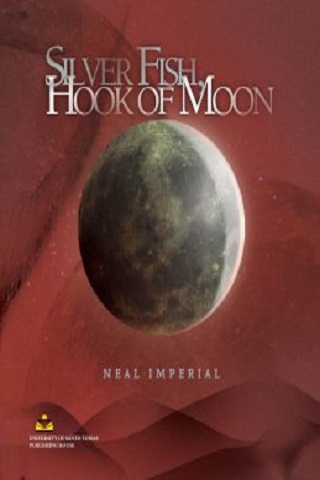
The book's official cover. UST Publishing House
In this first solo anthology of Imperial's poems, we are led to ruminate on the circumstances of Imperial's generation. This was a time when student activism during Martial Law blazed across the Jesuit-run campus, and writing bilingually became more acceptable, free from the “English Rule” policy that the Jesuits imposed in the postwar Ateneo de Manila in Padre Faura, as Emmanuel Torres explains in the book's introduction.
Written in modern free verse, the selection is in three parts, each titled with an English heading and a Filipino subtitle. The titles are not exactly translations of each other, lending further lyricism to the series. Take, for example, the first part which is titled “Eyes Into Mirrors,” with the Filipino subtitle, “Banging Walang Baging o Tubig sa Ilalim.” This section is given to political and social realist commentaries on the worlds that the poet has straddled.
Notable are two poems specifically about the megalomania immanent in mall culture, more popularly embodied in SM Megamall. In “The Megamall,” we get a glimpse of the poor labor conditions of its workers, whose afflictions hit the news after their attempts at several strikes in years past. Imperial, in circumspect solidarity, writes: somewhere/we weep in the sleeves/of blue uniforms.
In “Inside SM at Night,” he conjures the artificiality of being ensconced in its walls: a mannequin stares/at me/pleading to break free/from its deathless pose.
In “Paghahanda: Exposure Trip sa Smokey Mountain,” we read a sardonic list of rules for first time visitors to the infamous territory of scavengers and garbage in the metro, reminiscent of high school and college integration activities in poor communities. Huwag kayong mag-Ingles/ dahil nakakainsulto./ Kilalanin ninyo silang mabuti: huwag kayong kukuha ng litrato./Huwag kayong magbibigay ng pera/ dahil hindi sila pulubi./ At huwag na huwag kayong lalayo/ sa grupo—delikado.

Author Neal Imperial at the DFA-sponsored relaunching of his book in April. Department of Foreign Affairs Facebook page
Using a photo-caption from a major daily that speaks of a child force-fed in Somalia, he contemplates in “Last Supper” what a dying African boy would have thought before his demise: Take back what took/ so long to give./Better watch me starve/instead:/The sun has burnt my eyes/into mirrors.
Meantime, he speaks of his fond childhood exploits in a suburb that used to be “Tandang Sora,” which has transmogrified from a natural play space for the neighborhood's youth, to one that “now hides beneath/glass houses,[that] cannot mirror/the sky.”
In “Harlem, November '88” the author paints a snapshot of decadence in this Upper Manhattan borough known for its African-American communities, they who continue to face issues of gentrification: Unread,/even the 'Times'/flees with the leaves./Your trees have shed/all color,/desolate in their balding.
Equally, he exposes the same familiar wounds of impoverishment in his own country, exemplified in its public market in “Bayang Palengke”: Bangkay ng bayan/itong palengkeng nakahilatay/sa gilid ng uka-/ukang aspalto.
The severe power blackouts in the 1990s also captured the poet's attention in “Brownout”: Sa dilim/ hinahamon tayong dumilat/tulad ng buwang kinakalawang.
The second part of the book, “Hands of Wind: Mga Along Alibugha,” is composed of existential musings, from quotidian events to life's bigger truths—be it death, art, or the rain.
In “Ama," he speaks of standing by his father's deathbed, as he holds a wish for the old man's serene departure: Mag-iwan ka ng ngiting/singgaan/ng balahibong binitiwan/sa nagdaraang hangin.
We find, meantime, a brief philosophical meditation about the naturalness of decay and degeneration in “Entropi”: Sa pag-unat ng sibilisasyon,/hihikab ang bitak./Susubuan ng tubig/at alikabok./Uubanin ng ligaw/na damo.
Despite the last chapter being mainly comprised of poems on love and intimacy, we find here four poems that are commentaries on the issue of prostitution, as in “Floor Show”: Sa makintab na entablado/nagkakahugis/ang mga nilulunok na panaginip.
His love poems are marked by restraint, free from the usual effusiveness of works about personal affection, as seen in “Water Canticle”: Night is nomad./Its hourglass, full/of sand./But you are the certainty/that quenches its thirst.
In speaking of deprivation over a lover's absence, he astutely writes in “Leftover”: My love,/ to survive the dawn/ without you/ I must mend my heart/ with needles of tears.
Imperial's harvest of poems gifts us with the strength of restraint combined with tropes that are telling as well as sardonic. His intent appraisal of the world we live in comes alive for us, as if to make us muster the sensitivity needed to survive a world wherein, as the author intimates, we are called to bridge “distances, the chasm between earth and sky.” — VC/HS, GMA News
Rina Angela Corpus is an assistant professor at the Department of Art Studies, University of the Philippines. Her research interests include feminist aesthetics, dance history and spirituality in the arts. Her poetry has been featured in various publications.

