

 GMA Brandtalk
 Tracking
 Archives

ADVERTISEMENT
Filtered By: Lifestyle
Lifestyle
Brownbeat All-Stars’ Skarlet reaches out to fellow musicians with health NGO

Myra David-Ruaro, also known as Skarlet, has created an NGO to help Pinoy musicians get health coverage.
Where is Skarlet?
Pulp Summerslam, about a decade ago: My gawky self, wearing the strange phenomenon that was the elephant pants and other questionable items of clothing, approached her and asked for a picture.
I was 16 and still had enough courage to push my way into a hyperactive rock show crowd when I last watched Skarlet, a.k.a. Myra David-Ruaro: former Put3Ska vocalist, current frontwoman of the Brownbeat All-Stars, and member of the Asosasyon ng Musikong Pilipino (AMP) band. Awfully cool without even trying, I thought. People practically gape at her with astonishment when she’s on stage.
Fast forward to 2013. Her name came up after my father, who works for a pharmaceutical company, told me that they might soon start working with Skarlet’s NGO—something I didn’t even know existed.
Heart of Music
How a pharma company is connected with ska and jazz was so puzzling, I’d decided I needed to learn more. It turns out Skarlet has been modestly improving the lives of many Filipino musicians with Heart of Music (HOM), a non-profit, non-government organization that works toward providing healthcare to struggling musicians in the country.
The organization was officially launched in 2013, but the idea of a music-related NGO had been brewing in her mind since 2009. After selling her nitery Skarlet Jazz Kitchen and calling up fellow musicians who also want to help out, she started making HOM a reality.
Starting out has not been easy. Skarlet admitted that at first, people were hesitant to help, asking her what the catch was or why is she doing this, what’s in it for her.
“WALA. Walang wala,” she told me.
Filipino musicians rarely get access to healthcare or retirement benefits. Performing with a band in a small bar, for instance, would mean that members would have to take care of their own transportation and meals. A professional talent fee can go for as low as P200 net per musician. Sometimes, they don’t get paid at all.
How do they do it? “Mano mano,” said Skarlet. They put up a gig, and use the money raised to pay for the production cost (artists, sound system, venue), and use the money left for a PhilHealth enrollment for aging musicians.
“We have enrolled more than two-thirds of [our] 100 musicians per year target in PhilHealth,” she said, adding that she wants to make it clear that she does not work for the insurance GOCC or get any commission from it.
“I can only speak in behalf of HOM. We’re doing this because I have great pride of being a working musician. I want to empower myself, and I ask equally empowered musicians to be part of this advocacy.”
HOM's underlying aim, she adds, is an intangible one: unity. “It is a far-fetched idea but it is worth trying. To spread the feeling of putting aside all differences personal man yan, age, musical preference, principles.”
Skarlet explained that there are many initiatives that concentrate on music, like benefactors, donors, and philanthropists who support music education, intellectual rights, and cultural developments. These are all great approaches, but there are still people who are left out.
“HOM wants to go and lend a hand to musicians who cannot benefit from all of these great initiatives kasi may sakit na sila o wala na silang pang maintenance,” she said.
“Amplifier din lang ang HOM, and at the same time it’s also a shoulder to cry on ng mga kamag-anak at ng mismong may sakit. Only people who have experienced the coldness of being alone can relate to this and they are the ones who really help,” she added.
‘Music Heals’ campaign
Another effort of HOM is the “Music Heals” campaign, which was originally focused on sharing music in Manila hospitals, such as in cancer and geriatric wards. But due to the recent calamities, HOM is now also looking into extending the campaign to devastated areas in provinces. The idea, said Skarlet, is to have a mutual healing experience for both the sick and the musicians.
“HOM wants to encourage musicians that playing for the sick is not primarily an act of sharing what we have. It is a privilege...to see life in a different light,” she said.
Pulp Summerslam, about a decade ago: My gawky self, wearing the strange phenomenon that was the elephant pants and other questionable items of clothing, approached her and asked for a picture.
I was 16 and still had enough courage to push my way into a hyperactive rock show crowd when I last watched Skarlet, a.k.a. Myra David-Ruaro: former Put3Ska vocalist, current frontwoman of the Brownbeat All-Stars, and member of the Asosasyon ng Musikong Pilipino (AMP) band. Awfully cool without even trying, I thought. People practically gape at her with astonishment when she’s on stage.
Fast forward to 2013. Her name came up after my father, who works for a pharmaceutical company, told me that they might soon start working with Skarlet’s NGO—something I didn’t even know existed.
Heart of Music
How a pharma company is connected with ska and jazz was so puzzling, I’d decided I needed to learn more. It turns out Skarlet has been modestly improving the lives of many Filipino musicians with Heart of Music (HOM), a non-profit, non-government organization that works toward providing healthcare to struggling musicians in the country.
The organization was officially launched in 2013, but the idea of a music-related NGO had been brewing in her mind since 2009. After selling her nitery Skarlet Jazz Kitchen and calling up fellow musicians who also want to help out, she started making HOM a reality.
Starting out has not been easy. Skarlet admitted that at first, people were hesitant to help, asking her what the catch was or why is she doing this, what’s in it for her.
“WALA. Walang wala,” she told me.
Filipino musicians rarely get access to healthcare or retirement benefits. Performing with a band in a small bar, for instance, would mean that members would have to take care of their own transportation and meals. A professional talent fee can go for as low as P200 net per musician. Sometimes, they don’t get paid at all.
How do they do it? “Mano mano,” said Skarlet. They put up a gig, and use the money raised to pay for the production cost (artists, sound system, venue), and use the money left for a PhilHealth enrollment for aging musicians.
“We have enrolled more than two-thirds of [our] 100 musicians per year target in PhilHealth,” she said, adding that she wants to make it clear that she does not work for the insurance GOCC or get any commission from it.
“I can only speak in behalf of HOM. We’re doing this because I have great pride of being a working musician. I want to empower myself, and I ask equally empowered musicians to be part of this advocacy.”
HOM's underlying aim, she adds, is an intangible one: unity. “It is a far-fetched idea but it is worth trying. To spread the feeling of putting aside all differences personal man yan, age, musical preference, principles.”
Skarlet explained that there are many initiatives that concentrate on music, like benefactors, donors, and philanthropists who support music education, intellectual rights, and cultural developments. These are all great approaches, but there are still people who are left out.
“HOM wants to go and lend a hand to musicians who cannot benefit from all of these great initiatives kasi may sakit na sila o wala na silang pang maintenance,” she said.
“Amplifier din lang ang HOM, and at the same time it’s also a shoulder to cry on ng mga kamag-anak at ng mismong may sakit. Only people who have experienced the coldness of being alone can relate to this and they are the ones who really help,” she added.
‘Music Heals’ campaign
Another effort of HOM is the “Music Heals” campaign, which was originally focused on sharing music in Manila hospitals, such as in cancer and geriatric wards. But due to the recent calamities, HOM is now also looking into extending the campaign to devastated areas in provinces. The idea, said Skarlet, is to have a mutual healing experience for both the sick and the musicians.
“HOM wants to encourage musicians that playing for the sick is not primarily an act of sharing what we have. It is a privilege...to see life in a different light,” she said.
Reunited: The Brownbeat All-Stars
The return of the 'beat
Over and above the many great efforts of HOM, Skarlet also makes sure that the music keeps playing.
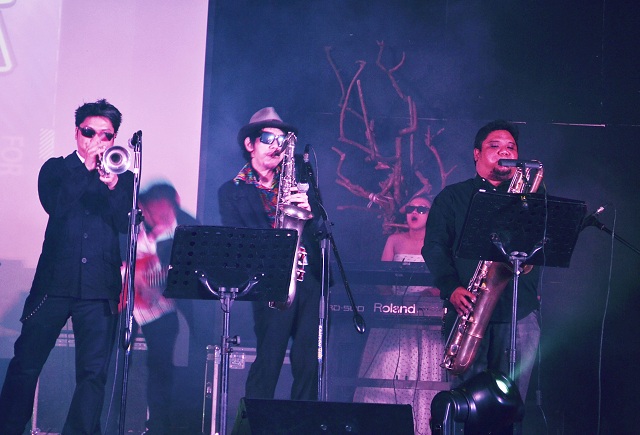
The Brownbeat All-Stars reunited for fundraising about three months ago, and it was there that they decided to continue making music. The band has had two lineups, and the current group is composed of members of the first album (plus three new players).
I asked Skarlet if anything has changed in the band performance-wise. She said that the energy is still very much there, but they have made some changes in how they played.
“We incorporated some jazzy elements to it and we slowed down the tempo a bit. You know, I’m 43 and not as agile as when I was 28. The mind is pushing it but the body is not following,” she laughs.
A lot of things have changed since my Summerslam years. The horrid pants I wore years ago, for instance, would never happen again, and I don’t think I’ll be brave enough to squeeze my way into a moshpit anymore.
Yet some things never change. Skarlet, still incredibly cool, is everywhere, doing so many great things at once. I watched her perform with the AMP band last month, and watched with the same amazement I had 10 years ago.
And yes—of course I asked for another picture. — BM, GMA News
Over and above the many great efforts of HOM, Skarlet also makes sure that the music keeps playing.
The Brownbeat All-Stars reunited for fundraising about three months ago, and it was there that they decided to continue making music. The band has had two lineups, and the current group is composed of members of the first album (plus three new players).
I asked Skarlet if anything has changed in the band performance-wise. She said that the energy is still very much there, but they have made some changes in how they played.
“We incorporated some jazzy elements to it and we slowed down the tempo a bit. You know, I’m 43 and not as agile as when I was 28. The mind is pushing it but the body is not following,” she laughs.
A lot of things have changed since my Summerslam years. The horrid pants I wore years ago, for instance, would never happen again, and I don’t think I’ll be brave enough to squeeze my way into a moshpit anymore.
Yet some things never change. Skarlet, still incredibly cool, is everywhere, doing so many great things at once. I watched her perform with the AMP band last month, and watched with the same amazement I had 10 years ago.
And yes—of course I asked for another picture. — BM, GMA News

