

 GMA Brandtalk
 Tracking
 Archives

ADVERTISEMENT
Filtered By: Lifestyle
Lifestyle
Movie review: ‘Her’ – a screen-age love story
There comes a point in every new relationship where someone will ask the other where they are going or, at the very least, where they stand. When that moment plays out in “Her”, it involves the protagonist (Joaquin Phoenix), his computer’s operating system (voiced superbly by Scarlett Johansson) and a surrogate sex partner the “couple” had previously agreed upon.
Welcome to the world of “Her”, Spike Jonze’s (“Being John Malkovich”, Adaptation”, “Where the Wild Things Are”) fourth film, an astonishing piece of work from a filmmaker whose movies have all, in one way or another, served as outlandish examinations of the psyche and what it means to be human. In this film, Jonze – who also wrote the screenplay – tackles loneliness and the search for (human) connection in an increasingly-isolating digital age. While the aforementioned scene may sound as farfetched as being able to step into John Malkovich’s head for a day, it’s probably the one most likely to occur in this lifetime. It’s a stretch, sure, but Jonze deftly directs the bizarre three-way (and the rest of the film) with such an intimate, understated style that you buy into the scenario completely.
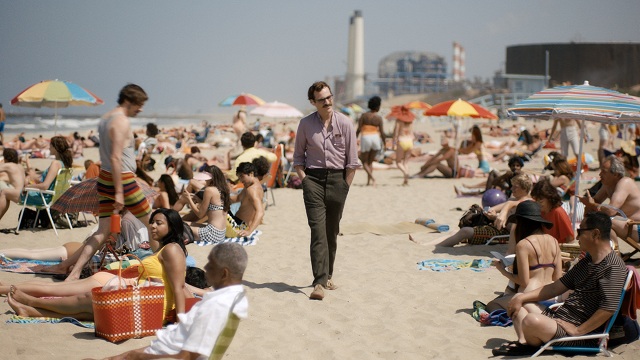
Currently going through a prolonged divorce, Theodore (Joaquin Phoenix) has become an introvert.
Phoenix stars as Theodore Twombly, a sad sack of a man who ghostwrites “heartfelt” letters for other people (for “BeautifulHandwrittenLetters.com”) by day and spends his nights holed up in his apartment playing video games. Currently in the process of a prolonged divorce from his wife (Rooney Mara) of many years, Theodore has withdrawn from social interaction, save for some awkward small talk with office receptionist Paul (Chris Pratt) and occasional conversations with his longtime friend Amy (Amy Adams).
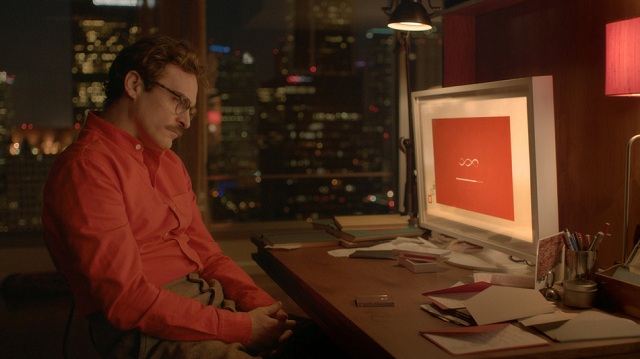
Things begin to change for Theodore when he purchases a new operating system for his digital devices. Touted as the world’s first artificially-aware program, the operating system is designed to continuously evolve based on its user’s needs. And evolve it does. It isn’t long before Theodore and the operating system, having dubbed itself Samantha (played to perfection by Johansson), enter into what can only be described as a relationship. Samantha becomes a constant presence in Theodore’s life, accompanying and conversing with him via an earpiece and “seeing” the world through his cellular phone’s camera (helpfully propped up in his breast pocket with the help of a handy safety pin).
Now, when your film has only two main characters and one of them is – for all intents and purposes – a disembodied voice, you’re going to have a lot of scenes where it looks like someone is talking to himself. Fortunately, Phoenix is in top form, creating a three-dimensional character from a character that could very easily have been reduced to being represented by his idiosyncrasies. As we learn more about Theodore’s and his growing emotional attachment, we soon forget that there really isn’t anyone else around to cut to.
As the voice in question, Johansson’s signature husky tones have never been put to better use, providing Theodore’s dreary existence with an almost palpable ray of light almost from the moment Samantha is installed. Whether the scene calls for her to be playful, professional, or just plain petulant, Johansson’s performance is one for the books, displaying a far greater capability here than the majority of her on-screen roles would suggest.
Things begin to change for Theodore when he purchases a new operating system for his digital devices. Touted as the world’s first artificially-aware program, the operating system is designed to continuously evolve based on its user’s needs. And evolve it does. It isn’t long before Theodore and the operating system, having dubbed itself Samantha (played to perfection by Johansson), enter into what can only be described as a relationship. Samantha becomes a constant presence in Theodore’s life, accompanying and conversing with him via an earpiece and “seeing” the world through his cellular phone’s camera (helpfully propped up in his breast pocket with the help of a handy safety pin).
Now, when your film has only two main characters and one of them is – for all intents and purposes – a disembodied voice, you’re going to have a lot of scenes where it looks like someone is talking to himself. Fortunately, Phoenix is in top form, creating a three-dimensional character from a character that could very easily have been reduced to being represented by his idiosyncrasies. As we learn more about Theodore’s and his growing emotional attachment, we soon forget that there really isn’t anyone else around to cut to.
As the voice in question, Johansson’s signature husky tones have never been put to better use, providing Theodore’s dreary existence with an almost palpable ray of light almost from the moment Samantha is installed. Whether the scene calls for her to be playful, professional, or just plain petulant, Johansson’s performance is one for the books, displaying a far greater capability here than the majority of her on-screen roles would suggest.
Everything changes for Theodore the day he buys a new operating system, which has dubbed itself 'Samantha' (Scarlett Johansson).
Set in an unspecified future, “Her” takes place in a Los Angeles whose aesthetic combines Shanghai-shot exteriors with logical extrapolations of existing technology to brilliantly infer a tomorrow far more effective than any number of computer-generated vistas. Adding to the illusion is the costume design, which gives us a sartorial prognostication of muted hues and high waists for an effect of near-homogeny that accomplishes the downright impressive feat of making Amy Adams look frumpy. Further highlighting the visuals’ subdued color palette is the deliberately minimalist score by Arcade Fire and Karen O. of the Yeah Yeah Yeahs.
Silhouettes, screens and soundtracks notwithstanding, “Her’s” best trick lies in its realization of the increasingly dysfunctional implications of a society raised on instant entertainment and social media. This is a film populated by broken people, be it in the form of a commitment-craving blind date (Olivia Wilde) or game designer Amy’s inability to save her marriage.
Ultimately, the conflict here isn’t whether or not Theodore and Samantha will live happily ever after, but whether Theodore will ever grow up and admit to anyone (including himself) his almost pathological tendency to push people away. It is no small irony that indeed, when his ex-wife calls him out on his immaturity, it makes for one of the film’s best dialogue exchanges. By this point, the audience is fully aware that whatever Theodore has (or thinks he has) with his virtual paramour can never last; despite Samantha’s algorithms having been written specifically to adapt to his (and every other user’s) specific wants and needs, her ability to expand beyond her programming means that, eventually, she will outgrow him.
When the film ends in the only possible way it can, we aren’t anywhere near as shocked as the characters involved, but we do somewhat understand their states of mind. After all, at one point or another, everyone needs a shoulder to cry on.
Even if it is just a voice in your earpiece. — BM, GMA News
"Her" will begin showing in Metro Manila theaters on March 12.
All photos from Warner Bros. Pictures.
Mikhail Lecaros is a professional magazine editor and freelance writer. The views expressed in this article are solely his own.
Silhouettes, screens and soundtracks notwithstanding, “Her’s” best trick lies in its realization of the increasingly dysfunctional implications of a society raised on instant entertainment and social media. This is a film populated by broken people, be it in the form of a commitment-craving blind date (Olivia Wilde) or game designer Amy’s inability to save her marriage.
Ultimately, the conflict here isn’t whether or not Theodore and Samantha will live happily ever after, but whether Theodore will ever grow up and admit to anyone (including himself) his almost pathological tendency to push people away. It is no small irony that indeed, when his ex-wife calls him out on his immaturity, it makes for one of the film’s best dialogue exchanges. By this point, the audience is fully aware that whatever Theodore has (or thinks he has) with his virtual paramour can never last; despite Samantha’s algorithms having been written specifically to adapt to his (and every other user’s) specific wants and needs, her ability to expand beyond her programming means that, eventually, she will outgrow him.
When the film ends in the only possible way it can, we aren’t anywhere near as shocked as the characters involved, but we do somewhat understand their states of mind. After all, at one point or another, everyone needs a shoulder to cry on.
Even if it is just a voice in your earpiece. — BM, GMA News
"Her" will begin showing in Metro Manila theaters on March 12.
All photos from Warner Bros. Pictures.
Mikhail Lecaros is a professional magazine editor and freelance writer. The views expressed in this article are solely his own.

