

 GMA Brandtalk
 Tracking
 Archives

ADVERTISEMENT
Filtered By: Lifestyle
Lifestyle
Theater review: Childhood confusion, teen turmoil in ‘Games People Play’
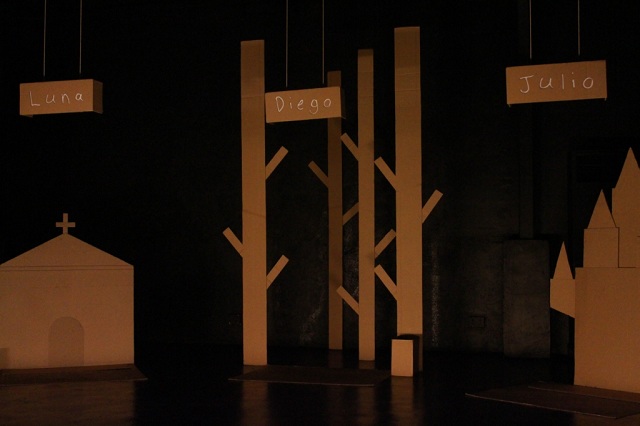
The sparse cardboard-box set of 'Games People Play'. Photos by Roxanne Cuacoy
The complex emotional and psychological portraits of three young children in a small village, and the mosaic of years of yearnings and times of turmoil that tagged along with them through adolescence and early adulthood, are the riveting and fascinating facets of “Games People Play.”
The play centers on three characters on an inward journey to understand themselves and “why they are the way they are” by revisiting their childhood, specifically the games that they played with each other.
Each character's favorite game symbolizes a rite of passage and represents a significant moment in their coming of age. Marbles, bahay-bahayan and pitik-bulag lead the trio to seizing their physical desires, freeing the “demons” inside them, and finally understanding and forgiving each other.
“Games People Play” is the last project that Prof. Glenn Sevilla Mas, theater arts coordinator of the Ateneo de Manila’s Fine Arts Department, wrote while completing his Masters in Fine Arts major in playwriting at the Catholic University of America in Washington D.C.
In 2007, it took 2nd place in the English Full-length Play Division at the Don Carlos Palanca Memorial Awards for Literature.
Mas said he was inspired to write “Games People Play” after reading a quote from child psychologist and writer Bruno Bettelheim: “The monster a child knows best and is most concerned with [is] the monster he feels or fears himself to be.”
Fairy tales and growing up
Ed Lacson, Jr. is both the director and production designer of this extra-lean, super-efficient, well-managed, and crisply staged production starring Abner Delina, Thea Yrastorza, and Kalil Almonte.
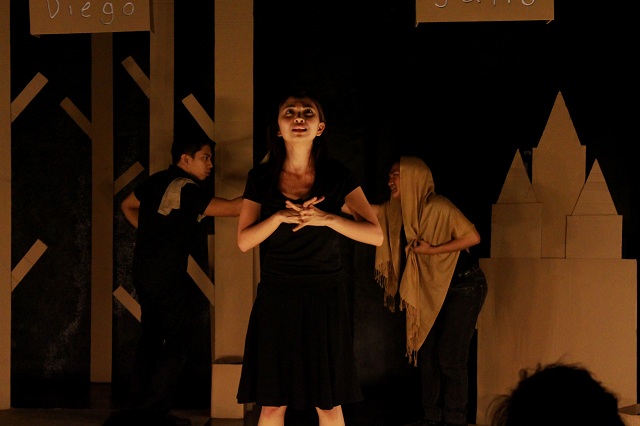
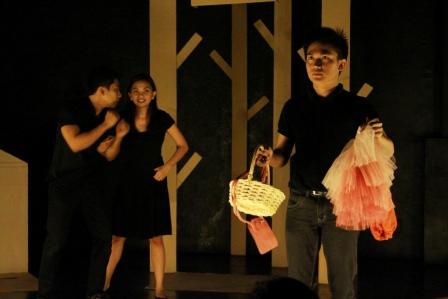
The trio, clad in all-black outfits, transform in a split-second into a mother, father, or a sister with the use of a doll, rosary, shawl, cigarette, or a fan.
The play centers on three characters on an inward journey to understand themselves and “why they are the way they are” by revisiting their childhood, specifically the games that they played with each other.
Each character's favorite game symbolizes a rite of passage and represents a significant moment in their coming of age. Marbles, bahay-bahayan and pitik-bulag lead the trio to seizing their physical desires, freeing the “demons” inside them, and finally understanding and forgiving each other.
“Games People Play” is the last project that Prof. Glenn Sevilla Mas, theater arts coordinator of the Ateneo de Manila’s Fine Arts Department, wrote while completing his Masters in Fine Arts major in playwriting at the Catholic University of America in Washington D.C.
In 2007, it took 2nd place in the English Full-length Play Division at the Don Carlos Palanca Memorial Awards for Literature.
Mas said he was inspired to write “Games People Play” after reading a quote from child psychologist and writer Bruno Bettelheim: “The monster a child knows best and is most concerned with [is] the monster he feels or fears himself to be.”
Fairy tales and growing up
Ed Lacson, Jr. is both the director and production designer of this extra-lean, super-efficient, well-managed, and crisply staged production starring Abner Delina, Thea Yrastorza, and Kalil Almonte.
The trio, clad in all-black outfits, transform in a split-second into a mother, father, or a sister with the use of a doll, rosary, shawl, cigarette, or a fan.
The young actors give intelligent performances as the leads and as other characters throughout the play.
Delina is Julio, an effeminate boy who grows up into an unhappy gay man. Yrastorza is Luna, a trusting girl who sought refuge in a convent by becoming a nun and yet is still continuously haunted by the most lustful dreams, and Almonte is Diego, a confused, fatherless boy who evolves into an even more confused young man, and becomes intimate with Julio.
The trio delivered richly layered and highly nuanced performances as their characterization progressed from being 7-year-olds to inquisitive teen-agers aware of the biological changes and hormonal spikes in their bodies, and maturing to 28-year-old adults.
In Delina, Yrastorza, and Almonte, the audience sees a trio of supremely intelligent performers giving astute and penetrating portrayals of people with child-like qualities, asking deep questions laced with strong cynicism, flawed as they are and yet heroically navigating the tortuous terrains inside their heads.
The play opens with the trio reciting lines from grim fairy tales, a foreboding of the dark tone of the drama. The recitation of the lines happens in the especially designated individual spaces prominently marked “Julio,” “Luna,” and “Diego.”
In the significant parts of the play, the three never leave their designated areas, seemingly imprisoned by these demarcated spaces, unless a scene calls for their transformation or interaction with one another in the dark and almost bare set. And then they return to their “prison cells.”
Another way to interpret these individually defined spaces is that these are the trio’s “safe havens” where they experience freedom and liberation from societal demands and impositions.
Cardboard boxes
The script uses Kinaray-a/Hiligaynon-laced English, first employed by Mas in his earlier plays: the “Rite of Passage” and “Children of the Sea.” The use of English with distinctly Antiqueño-Ilonggo moments was received well by the audience and gave the play a distinct village “feel.”
The production set entirely made of cardboard cut-outs is another outstanding aspect of “Games”.
 Lacson said he hid inside cardboard boxes as a kid.
Inside these boxes, Lacson found comfort and safety. His childhood experience of “finding individual space” inside them gave birth to the idea of a production set of three cardboard cut-outs: a castle, a forest, and a church.
The castle represents the fairytale monologues at the beginning and end of the play. Luna, who became a nun, is symbolized by the church, while Diego, as a confused and lost man, is embodied by the forest.
Lacson’s innovative directorial decisions when it came to lighting are worth citing. He used fluorescent lights and household dimmers, enclosing bulbs in cardboard boxes to limit the light spill to the individually assigned spaces.
All told, “Games” is an atmospheric little drama of three performers slipping in and out of different roles, against the backdrop of a three-piece cardboard cut-out production set, and yet manages to seethe with questions and commentaries about the lives of people in a small village exploring their desires and discovering their sexuality.
“Games” is a dizzying and ferocious aesthetic experience, with solid dramatic performances by Delina, Yrastorza, and Almonte.
Despite the play's bareness, barrenness and small cast, the scriptwriter, director, actors and production-artistic crew deployed their creative might with the precision of a suicide bomber and hit all members of the audience with awe and surprise. — BM, GMA News
During its February-March run, “Games People Play” was mounted at the Cultural Center of the Philippines’ Tanghalang Batute, and eventually moved to the Ateneo de Manila’s Fine Arts Blackbox Theater. The performances ended on March 6.
A journalist since 1983, Ibarra C. Mateo was an international wire correspondent based in Tokyo covering Asian politics. He returned to Manila after studying Japanese history and Japanese urban sociology at the Sophia University Graduate School. Mateo has no relevant affiliations with any company or organization that would benefit from this review. The views expressed in this article are his own.
The trio delivered richly layered and highly nuanced performances as their characterization progressed from being 7-year-olds to inquisitive teen-agers aware of the biological changes and hormonal spikes in their bodies, and maturing to 28-year-old adults.
In Delina, Yrastorza, and Almonte, the audience sees a trio of supremely intelligent performers giving astute and penetrating portrayals of people with child-like qualities, asking deep questions laced with strong cynicism, flawed as they are and yet heroically navigating the tortuous terrains inside their heads.
The play opens with the trio reciting lines from grim fairy tales, a foreboding of the dark tone of the drama. The recitation of the lines happens in the especially designated individual spaces prominently marked “Julio,” “Luna,” and “Diego.”
In the significant parts of the play, the three never leave their designated areas, seemingly imprisoned by these demarcated spaces, unless a scene calls for their transformation or interaction with one another in the dark and almost bare set. And then they return to their “prison cells.”
Another way to interpret these individually defined spaces is that these are the trio’s “safe havens” where they experience freedom and liberation from societal demands and impositions.
Cardboard boxes
The script uses Kinaray-a/Hiligaynon-laced English, first employed by Mas in his earlier plays: the “Rite of Passage” and “Children of the Sea.” The use of English with distinctly Antiqueño-Ilonggo moments was received well by the audience and gave the play a distinct village “feel.”
The production set entirely made of cardboard cut-outs is another outstanding aspect of “Games”.
Almonte, Yrastorza, and Delina
Inside these boxes, Lacson found comfort and safety. His childhood experience of “finding individual space” inside them gave birth to the idea of a production set of three cardboard cut-outs: a castle, a forest, and a church.
The castle represents the fairytale monologues at the beginning and end of the play. Luna, who became a nun, is symbolized by the church, while Diego, as a confused and lost man, is embodied by the forest.
Lacson’s innovative directorial decisions when it came to lighting are worth citing. He used fluorescent lights and household dimmers, enclosing bulbs in cardboard boxes to limit the light spill to the individually assigned spaces.
All told, “Games” is an atmospheric little drama of three performers slipping in and out of different roles, against the backdrop of a three-piece cardboard cut-out production set, and yet manages to seethe with questions and commentaries about the lives of people in a small village exploring their desires and discovering their sexuality.
“Games” is a dizzying and ferocious aesthetic experience, with solid dramatic performances by Delina, Yrastorza, and Almonte.
Despite the play's bareness, barrenness and small cast, the scriptwriter, director, actors and production-artistic crew deployed their creative might with the precision of a suicide bomber and hit all members of the audience with awe and surprise. — BM, GMA News
During its February-March run, “Games People Play” was mounted at the Cultural Center of the Philippines’ Tanghalang Batute, and eventually moved to the Ateneo de Manila’s Fine Arts Blackbox Theater. The performances ended on March 6.
A journalist since 1983, Ibarra C. Mateo was an international wire correspondent based in Tokyo covering Asian politics. He returned to Manila after studying Japanese history and Japanese urban sociology at the Sophia University Graduate School. Mateo has no relevant affiliations with any company or organization that would benefit from this review. The views expressed in this article are his own.

