

 GMA Brandtalk
 Tracking
 Archives

ADVERTISEMENT
Filtered By: Lifestyle
Lifestyle
Pinoy author David Ramirez makes int’l debut with ‘The Forever Watch’
First of two parts
Apart from a wealth of scientific knowledge, former molecular biologist and student bioinformaticist David Ramirez also has another card up his sleeve—he writes fiction.
And now, Ramirez, a Filipino who divides his time between the Philippines and the United States, has broken into the international Science Fiction and Fantasy scene with his debut novel, “The Forever Watch”.
Ramirez graciously agreed to an e-mail interview with GMA News Online.
 Q: What's the idea behind "The Forever Watch"? What gave you the inspiration to write it?
A: It started at the time Manning, Assange, and Wikileaks were dominating the news and I was dissatisfied with the simplified narratives on the news, in which there were only two sides to choose from. I wanted to write something in which the secrecy and control are not reducible to a binary question of right and wrong, and my subconscious supplied the setting and the plot to make it happen. “The Forever Watch,” with the setting, its rigid society and metrics-based living, as well as the major plot devices, all came to me in a dream.
And the other things that found their way in, like transhumanism and machine learning, are topics I have found interesting for a very long time.
Q: It states on your Facebook page that you used to be a molecular biologist and student bioinformaticist. When did you start writing fiction and what pushed you to finally pursue that?
A: I started writing for fun in third year at Philippine Science High School, when my section’s Filipino teacher taught Creative Writing instead of a language class. Auraeus Solito (who later became an independent film director) made writing fun enough that I started doing it on my own and not just for assignments and projects. Writing gave me a structured outlet for the constant daydreaming I was doing whenever I was bored.
I flirted with writing fiction on and off until I found myself skipping my classes in college because I was losing my passion for the work of science, just as the fire to focus on writing started growing. I still completed my Molecular Bio degree and worked in STEM for a little while, but that was just a job, while a writer is what I dreamed of being. Between false starts and distractions, it took a long time, but life is short, and I’m lucky enough to have a supportive wife and family.
Q: What was the best part about writing this book? The worst part?
A: The best part was writing those last few pages at the end. I really like the ending itself, and then there was the wonderful feeling of being just a few pages away from completion.
The worst part was near the beginning, when I wrote about a quarter of the book and realized that all the chapters written up to that point did not work and needed to be junked completely.
Q: What were the challenges of writing a female protagonist?
A: The genuineness of Dempsey’s experience was a major worry. It was probably the first question I asked Kristin when she started working with me on polishing it—whether or not the character was convincing as a woman. The physicality of her experiences and the gendered way in which society, even a futuristic one, would treat women took a lot of thinking and reconsidering.
Q: Who are your influences and what kind of influences went into this book?
A: I do not know if my style is good enough for their influences to be visible in my writing, but my major influences are probably William Gibson, Stephen King, and Haruki Murakami.
“The Forever Watch” as a work is influenced by Gibson’s Sprawl Trilogy, the Blade Runner movie (more than Philip K. Dick’s “Do Androids Dream of Electric Sheep”), and Katsuhiro Otomo’s “Akira.”
Q: Is there anything about the book that you'd want your readers to know, summary notwithstanding?
A: For those who are not my readers yet—I hope they give “The Forever Watch” a look. There is some detective story to it, some romance, some horror, and what I like to think are some pretty cool action sequences. A fair number of people who think they do not like science fiction still watch and enjoy movies like the “Avengers,” “Gravity” and the “Hunger Games,” when those all fall under Science Fiction. You may enjoy quite a lot of things you do not think you would—including, perhaps, my book.
For those who are already my readers, thanks for the support! They might find it interesting that in the very first version I was writing, the main character was Barrens, that it was written in third person, and Dempsey was a passive noir heroine in the sense that she had little agency and was only reacting to things while Barrens was doing all the work. It felt predictable and formulaic to me, which is why I dropped that approach completely.
Once Dempsey was the main character and I shrank the perspective to first person, the writing naturally tied together several of the crucial plot points of the story without making it a straightforward journey. — BM, GMA News
Part 2 of the interview will be posted tomorrow, May 28.
Apart from a wealth of scientific knowledge, former molecular biologist and student bioinformaticist David Ramirez also has another card up his sleeve—he writes fiction.
And now, Ramirez, a Filipino who divides his time between the Philippines and the United States, has broken into the international Science Fiction and Fantasy scene with his debut novel, “The Forever Watch”.
Ramirez graciously agreed to an e-mail interview with GMA News Online.
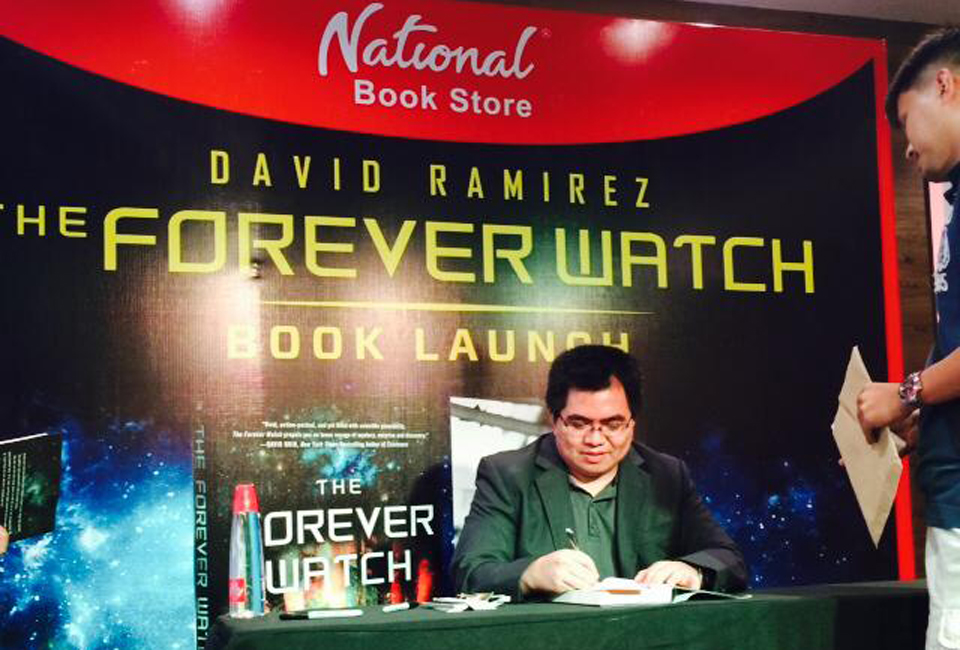
David Ramirez at the launch of "The Forever Watch" at National Book Store earlier this month. Photo by Rosemarie Lim
A: It started at the time Manning, Assange, and Wikileaks were dominating the news and I was dissatisfied with the simplified narratives on the news, in which there were only two sides to choose from. I wanted to write something in which the secrecy and control are not reducible to a binary question of right and wrong, and my subconscious supplied the setting and the plot to make it happen. “The Forever Watch,” with the setting, its rigid society and metrics-based living, as well as the major plot devices, all came to me in a dream.
And the other things that found their way in, like transhumanism and machine learning, are topics I have found interesting for a very long time.
Q: It states on your Facebook page that you used to be a molecular biologist and student bioinformaticist. When did you start writing fiction and what pushed you to finally pursue that?
A: I started writing for fun in third year at Philippine Science High School, when my section’s Filipino teacher taught Creative Writing instead of a language class. Auraeus Solito (who later became an independent film director) made writing fun enough that I started doing it on my own and not just for assignments and projects. Writing gave me a structured outlet for the constant daydreaming I was doing whenever I was bored.
I flirted with writing fiction on and off until I found myself skipping my classes in college because I was losing my passion for the work of science, just as the fire to focus on writing started growing. I still completed my Molecular Bio degree and worked in STEM for a little while, but that was just a job, while a writer is what I dreamed of being. Between false starts and distractions, it took a long time, but life is short, and I’m lucky enough to have a supportive wife and family.
Q: What was the best part about writing this book? The worst part?
A: The best part was writing those last few pages at the end. I really like the ending itself, and then there was the wonderful feeling of being just a few pages away from completion.
The worst part was near the beginning, when I wrote about a quarter of the book and realized that all the chapters written up to that point did not work and needed to be junked completely.
Q: What were the challenges of writing a female protagonist?
A: The genuineness of Dempsey’s experience was a major worry. It was probably the first question I asked Kristin when she started working with me on polishing it—whether or not the character was convincing as a woman. The physicality of her experiences and the gendered way in which society, even a futuristic one, would treat women took a lot of thinking and reconsidering.
Q: Who are your influences and what kind of influences went into this book?
A: I do not know if my style is good enough for their influences to be visible in my writing, but my major influences are probably William Gibson, Stephen King, and Haruki Murakami.
“The Forever Watch” as a work is influenced by Gibson’s Sprawl Trilogy, the Blade Runner movie (more than Philip K. Dick’s “Do Androids Dream of Electric Sheep”), and Katsuhiro Otomo’s “Akira.”
Q: Is there anything about the book that you'd want your readers to know, summary notwithstanding?
A: For those who are not my readers yet—I hope they give “The Forever Watch” a look. There is some detective story to it, some romance, some horror, and what I like to think are some pretty cool action sequences. A fair number of people who think they do not like science fiction still watch and enjoy movies like the “Avengers,” “Gravity” and the “Hunger Games,” when those all fall under Science Fiction. You may enjoy quite a lot of things you do not think you would—including, perhaps, my book.
For those who are already my readers, thanks for the support! They might find it interesting that in the very first version I was writing, the main character was Barrens, that it was written in third person, and Dempsey was a passive noir heroine in the sense that she had little agency and was only reacting to things while Barrens was doing all the work. It felt predictable and formulaic to me, which is why I dropped that approach completely.
Once Dempsey was the main character and I shrank the perspective to first person, the writing naturally tied together several of the crucial plot points of the story without making it a straightforward journey. — BM, GMA News
Part 2 of the interview will be posted tomorrow, May 28.

