

 GMA Brandtalk
 Tracking
 Archives

ADVERTISEMENT
Filtered By: Lifestyle
Lifestyle
Movie review: 'Dawn of the Planet Apes' — Blockbuster filmmaking at its finest
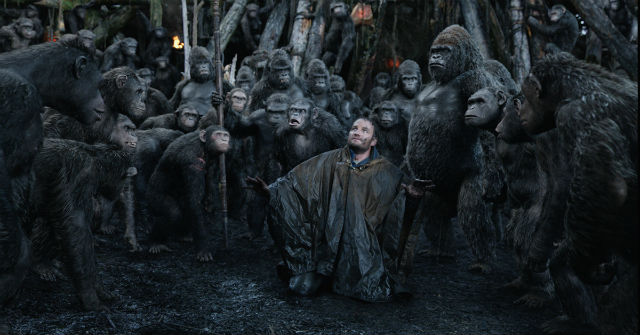
Malcolm (Jason Clarke) meets the apes in a tense confrontation.
When 2011’s “Rise of the Planet of the Apes” was announced, it was easy to look at the movie as little more than the latest attempt by a major studio to cash in on a recognizable franchise.
After all, 1967’s “Planet of the Apes” (itself based on the novel by “Bridge on the River Kwai” author Pierre Boulle) had spawned four sequels, a live-action TV show and an animated series back in the day. But Tim Burton’s attempt to reboot the series in 2001 was poorly received, and it seemed doubtful that any demand even existed for a prequel to what was then a 45-year-old movie.
At any rate, when “Rise” was finally released, there was more than enough humble pie to go around, as the film was a resounding critical and financial success. Almost improbably, with this year’s “Dawn of the Planet of the Apes” picking up where “Rise” left off, moviegoers the world over found themselves genuinely excited for an “Apes” sequel for the first time since the 60’s.
Set ten years after “Rise”, “Dawn of the Planet of the Apes” begins by showing us the spread of the lethal ALZ-113 virus and the subsequent breakdown of modern civilization as international authorities prove powerless to curb the catastrophic death toll. Viewers will recall that the virus, originally created by scientist Will Rodman (James Franco) in “Rise” as a cure for Alzheimer’s disease, had the side effect of increasing the cognitive abilities of any primates that came into contact with it.
Where “Rise” ended with Franco’s pet chimpanzee Caesar (Andy Serkis, “The Lord of the Rings”, “The Adventures of Tintin”) leading his now-intelligent ape brethren to sanctuary in California’s Muir Woods, “Dawn” reintroduces us to him as a capable leader and father fully committed to the survival and wellbeing of his tribe. It has been three years since the Muir Woods ape community’s last human sighting, and there are those beginning to believe that their former captors have finally driven themselves to extinction. Naturally, it isn’t long before a chance-encounter in the forest gone awry leads the apes to realize that they are not alone.
Right across the bay in San Francisco is a human settlement whose ALZ-113-immune inhabitants have eked out a modest existence in hopes of restoring what remains of their society. Led by Malcolm (Jason Clarke, “Zero Dark Thirty”, “The Great Gatsby”) and Dreyfus (Gary Oldman, “The Dark Knight” trilogy, “Harry Potter”), the humans’ primary goal is the activation of a long-dormant hydroelectric power plant located deep in ape territory. In order to achieve their objective, Malcolm will have to lead a team that includes his wife Ellie (Keri Russel, TV’s “The Americans” and “Felicity”), and son Alexander (“The Road’s” Kodi Smith McPhee, looking remarkably like a young Jay Baruchel).
As tensions mounting on both sides, Malcolm and Caesar will have to learn who they can trust in the inevitable confrontation, with the ultimate prize being nothing less than the right to be Earth’s dominant species.
At the forefront (literally and figuratively) of the conflict as Caesar is Serkis, the man most famous for his breakthrough motion capture and vocal performance as Gollum. Superbly reprising his “Rise” role, Serkis fully sells the battle-ready (yet battle-weary) leader that his character has been forced to evolve into over the past ten years. So effective is Serkis here that nary a moment goes by that you don’t find yourself empathizing with the stoic simian.
As is almost always the case, Peter Jackson’s (“The Lord of the Rings”) New Zealand-based Weta Digital defends its position at the bleeding edge of visual effects technology, allowing the audience to fully buy into the illusion that what they are seeing is (to an extent) absolutely real. Such is Weta’s (and the director’s) confidence in their abilities that the film opens and closes with an extreme close-up of Caesar’s face, with every hair, wrinkle and texture on full display. In between, we are treated to a number of action and dialogue(!) sequences boasting virtual camera moves and variable environment lighting that put most other visual effects houses to shame. Of course, as films like “Transformers 4” show, the finest effects in the world are meaningless without compelling (or at least, competent) performances to make us care about what we’re seeing. Fortunately, “Dawn” has these in spades, elevating the apes from computer-generated lights of fancy into full-blown characters.
In the director’s chair is Matt Reeves (“Cloverfield”), taking over for “Rise’s” Rupert Wyatt. Reeves carries on the previous film’s near-silent treatment of the apes’ sequences, with the bulk of the “dialogue” in their community being carried out in sign language, with only the occasional spoken word from the more evolved primates. In fact, it can be argued that while admirable time and care are taken to establish the apes’ new society, the same can’t be said of the humans, reducing the majority of them to the status of stereotypes.
Indeed, as Malcolm, Jason Clarke is as steadfast and moralistic as the story needs him to be, but he doesn’t really make enough of an impression to be memorable. Faring slightly better is Gary Oldman, who spends the majority of his limited screen time avoiding the screaming fits that have (rightly or wrongly) come to characterize the majority of his villainous roles. Fortunately, we are given enough of an insight into Dreyfus’ character so as to be a bit more forgiving when he finally lets loose the screaming fit seen in every trailer for this film (“THEY’RE ANIMALS!!!”).
Reeves does better on the action front, with the final third of the film presenting one of the finest “city-under-siege” scenarios of recent memory. Harrowing and imaginative, with bravura cinematography adding unexpected flair and impact to the proceedings, the preview audience was in rapt attention at the carnage unfolding onscreen.
Inevitable downer of an ending notwithstanding — see the title of the film for a clue — this is a prime example of blockbuster filmmaking at its finest. When all is said and done, “Dawn of the Planet of the Apes” is that rare summer film that is able to transcend its outlandish concept to provide an exhilarating experience that almost singlehandedly redeems what has been, for the most part, a season of disappointments.
Hail, Caesar! — JST, GMA News

