

 GMA Brandtalk
 Tracking
 Archives

Xyza Bacani on shooting in low light and capturing candid moments
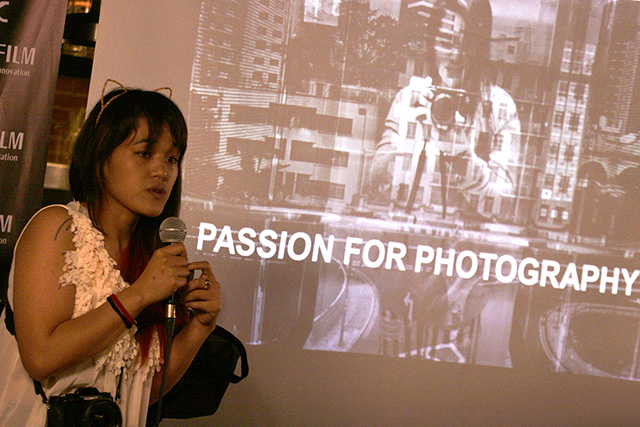
A decent banker in a suit during the day turns into a raging drunkard at night.
This is one of the reasons why photographer Xyza Cruz Bacani, who is also a domestic helper in Hong Kong, loves to shoot at night.
"People change in darkness, you can see the difference of their personality," she said, speaking in front of at least 60 photo enthusiasts during a photography forum at Bonifacio Global City earlier this month.
She said the bluntness of people in the dark are just some of her favorite things to shoot.
"When it turns dark, the change of personalities is really interesting. It's why I wait until 6 p.m., o wala nang araw, para mag-shoot," Bacani added. "Imagine a banker wearing a suit during daytime, pagdating ng gabi, lasinggerong tatakbo sa Central."
Overseas Filipino worker Bacani has been slowly carving a niche in Hong Kong through her striking photographs of ordinary life there.
She said in order to capture the candid moments, especially in low light, she sometimes had to resort to using the automatic mode of her camera, which she purchased with money she borrowed from her employer.
"Shoot using the thing that makes it easier. You might miss something, you might miss capturing that fleeting moment, habang nagpapalit ka ng setting," she said.
With that, she said she also uses a high ISO setting, going as far as ISO 3200, which may capture photos in low light but may result in a high amount of grain or noise in a photo.
"Mataas lagi ang ISO, huwag matakot sa grain, grain is wonderful. Heavy-ish. ISO ko hindi bumababa ng 1600," she said, noting that the grain and noise only adds more depth to the photo.
"Actually, even sa araw naka-[ISO] 3200 ako. It's beautiful," she added.
She also said when she sees a moment she wants to capture, she does not restrict herself and takes a lot of shots.
"Hindi naman ako naka-manual, naka-digicam ako so why should I restrict myself; if I see something, I shoot," she said.
"The more you work hard, the luckier you get. Luck is something that comes to you when you work hard. The more you shoot, the more na makakakuha ng magandang shot," she added.
Not typical
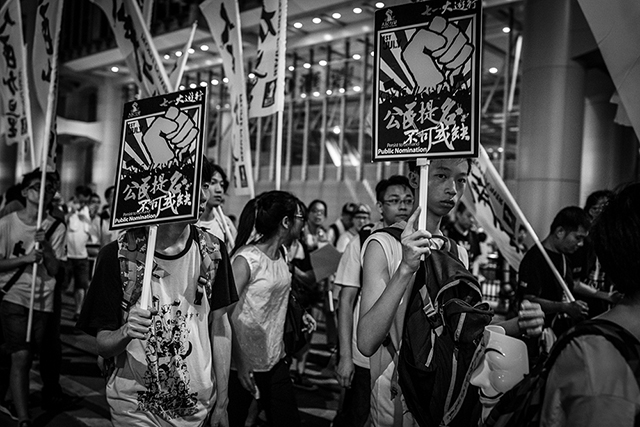
Bacani admitted that while her techniques are not typically accepted by other photographers, she insisted that it is how her photos turn out great.
She also recalled how she was once bullied by other street photographers, who said her shots were not good enough.
"You should be nice to new photographers, kasi nakakababa talaga [ng spirit]," she said. "They laughed at my images."
Bacani is not a trained photographer employed by a big company, but rather a second-generation domestic helper serving the same woman who has employed her mother for 20 years.
She said though she loves photography, she will never leave her day job as "it pays very well."
Discrimination vs. domestic helpers
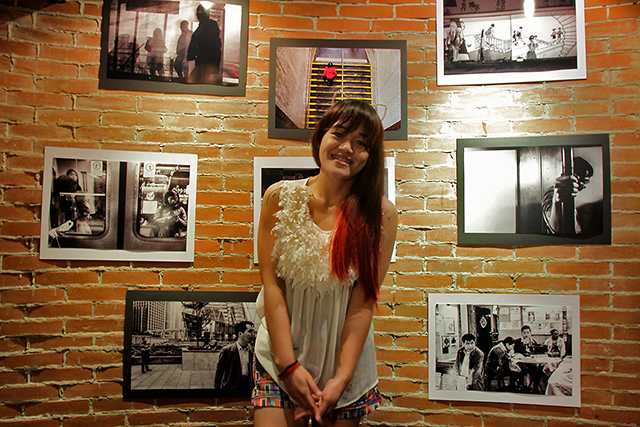
Aside from street photography, Bacani has also been helping Bethune House, a shelter in Hong Kong for abused Filipino workers, by taking photos of the people at the shelter.
"We just hope that it can affect a lot of people. Malay lang natin, may isang makakita ng kuha ko mula sa Bethune, mag-donate, that's a big help. Images speak," she said.
She also noted that she, herself, has been discriminated against because of her occupation.
"I was almost disqualified from a photo contest because I'm a domestic helper. It's the worst, I've been doing this contest for years and then suddenly you will ask if I'm a resident here. Kinuwestiyon ang validity ng mga entries ko," she said.
"By occupation, OFWs there are considered, ka-level niya ang mga refugees. If you will read their law, ka-level ng OFWs ay refugees. We're not even considered an ordinary resident kahit na may Hong Kong ID kami," she added.
In spite of all this, Bacani has begun to make a name for herself in the photography world, her work discovered by noted Pinoy lensman Rick Rocamora and featured in The New York Times and Italian Vogue. — BM, GMA News

