

 GMA Brandtalk
 Tracking
 Archives

Theater review: A hero’s ennobling revolution from within in ‘Ang Huling Lagda ni Apolinario Mabini’

A richly profound foray into the unsung life of the Brains of the Revolution, “Ang Huling Lagda ni Apolinario Mabini” comes as a welcome and rejuvenating addition to the meager body of creative and expository ventures into the life of the man also known as the Sublime Paralytic, whose sesquicentennial we celebrate this year.
This recent Dulaang UP musical production offers an intelligently fleshed-out narrative about Mabini’s life as a patriot and the principles he penned that propelled the ideals of the nascent revolutionary government.
Thanks to the stellar and dedicated artistic leadership of director Dexter Santos, lyricist and playwright Floy Quintos, and composer Krina Cayabyab, we are given a thoughtful and relevant reckoning of Mabini’s life and his contribution in defining the ethos of Philippine nationhood and history.
The narrative begins with a nostalgic scene on the shores of Asan, Guam: Mabini and younger brother Prudencio are engaged in conversation just outside their barracks. Prudencio is portrayed as Mabini’s opposite: playful, young-at-heart, hopeful, as Mabini is introverted, serious, withdrawn to a deep inner life where he yearns to return to his homeland and continue his mission of seeing it free.
Theater actor and former pop singer Roeder Camañag portrays Mabini with conviction, showing him as a gentle persona with the contemplative nature of an intellectual.
Prudencio, meantime, is generously given character by young theater student Ralph Oliva, who enacted with gusto his loyal obedience and innocence.
Together with the two brothers are the other Filipino revolutionaries, exiled after their staunch refusal to sign the oath of allegiance to America during that crucial time between the Spanish and American colonial periods. It is at this point that they learn the news of Emilio Aguinaldo’s signing of allegiance to America, which put an early end to Asia’s first Republic. Feelings of betrayal and hopes doused come over the exiled patriots and become the dramatic highlight at the start of the play.
While Mabini’s fellow patriots are seen in a drinking frenzy, he remains thoughtful, stationed in a wheelchair as he deeply ponders the future of the revolution that he helped create.
Archival photos of old Manila, and key figures and scenes that led to the Philippine Revolution of 1896, were projected on screen to provide a sense of historicity to the narrative.
Add to this the artfully minimalist stage design by Ohm David, which allowed for the actors’ freedom of movement while a few necessary props appeared seamlessly in and out of the scene.
Cayabyab’s score was tight, upbeat and fast-paced, exquisitely rendered by the Manila String Machine with piano accompaniment by Farley Asuncion.
Finding a crossover between the Western musical styles of 19th to early 20th centuries, together with a fusion of Philippine northern indigenous bamboo music and Maguindanaoan kulintangan, Cayabyab has done proper research to set an engaging tone for Mabini’s opening soliloquy, “Hindi Ito ang Bayan Ko.” Cayabyab’s musical work has a captivating energy that is fully sustained throughout the production, climaxing into the final ensemble songs “Ang Tunay na Dekalogo” and “Bayaning Pinunla”. It also helped that the individual actors as well as the male chorus were vocally compelling.
Powerful characterizations
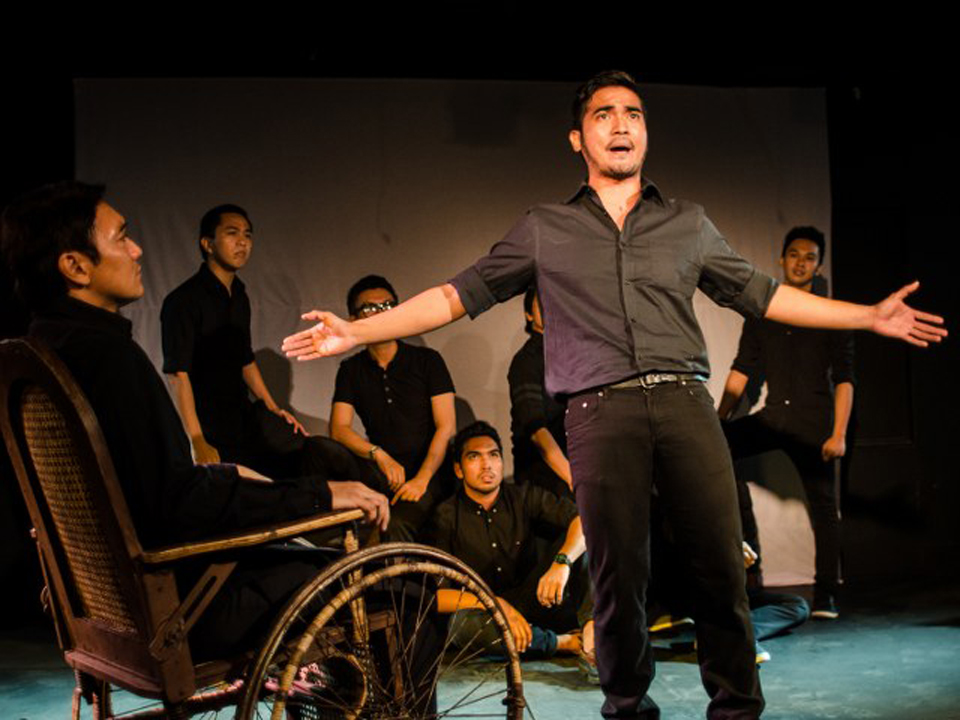
Equally given full life was the character of Artemio Ricarte, a little-known Katipunan general and Mabini's more prominent compatriot. Seasoned theater artist Al Gatmaitan embodies Ricarte with superb sensibility and a grounded grasp of one of the revolution's last insurgents.
One of the dramatic points of the play was the imagined interrogation between Governor General Taft (deftly played by Leo Rialp) and Mabini, in which Taft offers Mabini the option to return to Philippine shores in return for his signing the pledge of allegiance. The struggle inside Mabini's head is clearly put to fore. Sickly and dying to go back to his country, Mabini finally gives in, while Ricarte, the brave general, remains unfazed. Mabini gives Ricarte a final salute, a gesture of comradeship and admiration for the lone man who stood his ground to the end.
This moment is highlighted as a powerful denoument: the hero is finally allowed to go back home, but with head held high, maintaining his aura of nobility with his refusing America's token offer of a seat in the new colonial government.
Another interesting, albeit fictional, character is Salud, a Filipino nurse assigned by the American government to take care of Mabini. Banaue Miclat is gentle but sure in her portrayal.
Salud’s character is representative of how Filipinos of the time would have viewed Mabini as a persona to reckon with and admire, as Salud reveals herself as a secret "fan" of the hero. It is also Salud who shows him that signing the oath need not diminish his ideals or spell the end of his patriotism. Salud symbolizes the voice of a mother’s practicality and nurturing, showing the need for the hero to retire and take care of his well-being, too.
“Kailangan mo nang magpahinga, marami ka nang nagawa,” she assures the hero.
The musical was written some five years back by Quintos, who said that in the process of researching and writing the play, he gained deeper insight into Mabini’s life and work. He was particularly intent on highlighting and introducing to the younger generation the ennobling ideals behind one of Mabini’s greatest works, "The True Decalogue."
For enshrined in the Decalogue is the spirit behind Mabini’s life work that remains resoundingly true: the need for a “revolution from within,” where any real and lasting change can only be based on personal change, one that is rooted in a change of one’s inner values, no less than aligned to the higher moral principles of life. — BM, GMA News
“Ang Huling Lagda ni Apolinario Mabini” runs until Oct. 24 at the Wilfrido Ma. Guerrero Theater, UP Diliman. For more information, call the Dulaang UP Office at 9261349 or visit its official Facebook page.

