

 GMA Brandtalk
 Tracking
 Archives

Movie review: Blow by blow with ‘Kid Kulafu’
The roar of the crowd mixed with the sweet taste of hard-earned victory can make for a euphoric mixture best described as nothing less than intoxicating. Hot on the heels of last year’s Liam Neeson-narrated documentary “Manny” and released mere weeks before Pacquiao’s long-awaited bout with Floyd Mayweather, director Paul Soriano has chosen to bring that euphoria to movie-going audiences with “Kid Kulafu.” Chronicling the events that led a boy named Emmanuel to become one of the greatest boxers the world has ever seen, “Kid Kulafu” has been released to local cinemas with all the force of a proverbial right cross to the jaw.
The film opens in the mountains of Bukidnon, as Dionisia Pacquiao (Alessandra De Rossi) is giving birth to our protagonist. The sequence is framed by what appears to be a modern-day mixed martial arts fight shot through torrential rains. As far as birthing scenes go, it’s pretty dramatic, though one has to question the contextual veracity of the perfectly-executed arm bar that ends the bout – but I digress.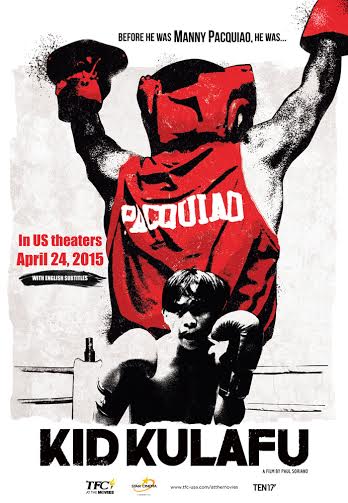 Following the birth, we skip forward a few years to Pacquiao’s childhood via some heavy-handed scenes depicting everyday civilian life in what is essentially a warzone, with rebels and army forces alike arriving unannounced and asking for supplies. At the same time, we are treated to the future pugilist’s proclivity for mischief and love of Bruce Lee (“Who is this Bruce Lee?!” demands Dionisia at one point). The childhood portion ends with a brutal encounter in front of the Pacquiaos’ home, prompting them to relocate to the relatively less volatile locale of General Santos City.
As his parents struggle to make ends meet, Manny is introduced to the wide world of boxing by his uncle Sardo (played by Cesar Montano), who watches taped broadcasts of classic matches with infectious enthusiasm. Before long, Sardo takes it upon himself to train the boy, christening him with the nickname (from the Vino Kulafu bottles Manny collects and cleans as a part-time job) that the film takes its title from. From here on in, we are presented with numerous slick montages and fight sequences as Manny rises through the ranks to find himself in Manila for a shot at the big time.
While the standard underdog story would have been the obvious way to go in highlighting the rise of one of the world’s most beloved athletes, Soriano set out to differentiate his film by setting it almost completely before Manny Pacquiao became a household name. Of course, whether or not he has actually succeeded is another question entirely.
Far from the definitive version of Pacquiao’s life story, there is little here that hasn’t already been covered in any number of interviews, documentaries, and articles over the years. Further muddying the narrative waters, the film spends so much time trying to make viewers love Pacquiao that it neglects to show (or tell) them why they should.
The opening itself is symptomatic of the film as a whole: the fight scene is well-shot and executed, but it doesn’t add anything to the overall narrative (unless the intention was to show that mountain villagers were into mixed martial arts long before the rest of the world). Indeed, by about the fourth or fifth fight, the repetitive nature of the screenplay is all too clear. Now, punctuating dialogue scenes with boxing matches doesn’t sound like a bad idea in theory, but it would have been nice to have a story to care about in between all the punching. Indeed, with plot points introduced and forgotten in quick succession, the only constant we are left with is the boxing scenes.
As Pacquiao, Robert "Buboy" Villar carries the bulk of the film on his shoulders, and he is more than up to the task, delivering a believable turn as the young Manny from childhood through to his teenage years. Also impressive is the actual boxing skill displayed (by Villar and others) throughout the film to great effect. As Mommy Dionisia, De Rossi puts in a solid performance, playing the long-suffering, pious mother her real-world counterpart has long been made out to be. Truth be told, the entire cast is commendable, coming out miles ahead of the glorified soap opera that was 2006’s “Pacquiao: The Movie” (starring Jericho Rosales in the title role!).
Sadly, while “Kid Kulafu” does an infinitely better job at presenting the biographical aspects of the story than the 2006 attempt, there’s simply no hiding the disproportionate scale to which it deifies its hero, as even instances that could have given us insight into the man’s character take a backseat to the fights (and, in one bizarre instance, a psychedelic dream sequence). Take, for example, the single montage devoted to Manny’s experiences with alcohol, womanizing, and (of course) karaoke as a single man in the city. Whatever lessons he may have picked up or strength of character he utilized to overcome temptation during this period are left to the imagination, cast aside in favor of, yep – you guessed it – another fight scene.
Whether or not Pacquiao himself had a hand in the overall story is, of course, irrelevant. From a technical standpoint, this is a great-looking, well designed, superbly-shot film. From a storytelling standpoint, however, one can’t help but wish the filmmakers had had the will to go the narrative distance.
As it is, what we’re left with amounts to little more than a visually-impressive blow by blow. — BM, GMA News
"Kid Kulafu" is now showing.

