

 GMA Brandtalk
 Tracking
 Archives

ADVERTISEMENT
Filtered By: Lifestyle
Lifestyle
To wed or not: How to avoid an annulment
As in years past, this month of June photographers and caterers prepare to do brisk bridal business once more as trend-addicted Filipinos surge to say “I do,” oblivious that the popularity of June weddings in the idolized West is due to the mild weather there this time of year.
Here in the Philippines, typhoons be damned, blushing maidens will insist on being June brides.
Here in the Philippines, typhoons be damned, blushing maidens will insist on being June brides.
Forget for one moment the potentially waterlogged garden reception… let’s say you’re climatologically aware and you prudently pick the dry but comfortably chilly month of January to get married in, the question remains: should you even get married at all?
To arrive at a prudent answer to that question, it might help to consider the practical effects of marriage in the Philippines:
1. If you and your spouse did not execute a pre-nuptial agreement, your properties will be joined in absolute community.
2. Your spouse becomes your heir.
Notice that the only guarantees in marriage are economic in nature. Contrary to what your lovesick mind may have imagined, marriage does not guarantee fidelity. And forever is not part of the bridal package either. To attain forever, you and your spouse will have to work exceptionally hard, especially after passion fades and your biological objectives have been achieved.
If the bridal package is rushed and the foundation for the marriage is shallow, there is usually another package that awaits the spouses---the annulment package. This package---which can range from PHP 250,000 to PHP 500,000 and above---is compelling reason to delay marriage until one is mentally and emotionally ready.
Dissolution of marriage in the Philippines is not only costly, it is also emotionally taxing and time-consuming. Furthermore, litigant-spouses often become hostile, sometimes traumatizing their children and infecting everyone else with their antagonism.
A judge once told me, “Itong mga mag-asawang nagpapa-annul, kung mag-away at magsiraan sa korte akala mo ay hindi nagmahalan dati (These couples seeking annulment, when they fight and accuse each other in court you would think they never loved each other before).”
Those viciously warring couples the judge observed must have been passionately in love at some time in the past, but passion fades, often leading to emotional estrangement and sometimes even loathing.
When the thrill is gone, whatever commendable values the spouses share must be strong enough to turn waning ardor into companionable partnership.
When the thrill is gone, whatever commendable values the spouses share must be strong enough to turn waning ardor into companionable partnership.
Indeed, marriage is not for everyone. To succeed at wedded life, you must have great patience, for you will have to endure the peculiarities of someone who is not your kin. More importantly, you must first live an exploratory life and acquire the mental and emotional competence to handle problems in a relationship, for marital trials can come unexpectedly, and often they are too bewildering and damaging to someone inexperienced in human relations.
In my work, I have observed that those who marry too young usually flounder for lack of self-awareness, while those who marry solely for love soon find that it is not enough, that there should be shared goals and interests as well, similar social backgrounds, parallel levels of education, identical values, mutual respect and support for each other’s vocation, and genuine admiration of each other’s character.
I’m often asked what the most popular ground is in petitions for judicial declaration of absolute nullity of marriage or for annulment, and, as a follow-up question, which gender usually initiates such petitions.
Both sexes seek nullification of marriage with almost equal frequency. The no. 1 ground for such petitions is harder to pigeonhole, but there are three grounds that appear more frequently than others: (1) psychological incapacity (which covers a wide range of conditions from narcissism to sexual dysfunction); (2) an existing prior marriage which makes the current one bigamous; and (3) lack of an essential or formal requirement of marriage, such as a valid marriage license.
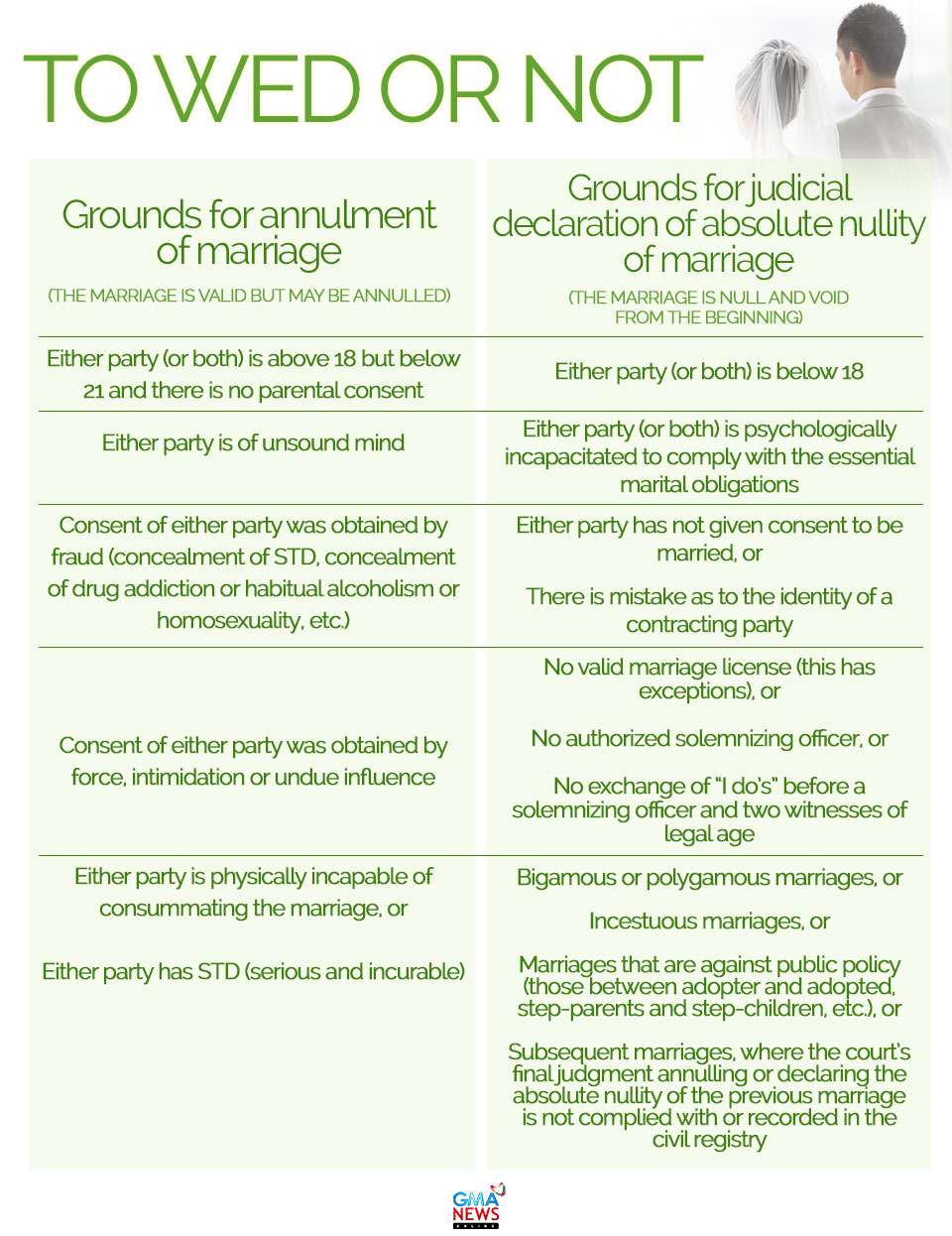
When a marriage unravels, many couples cite infidelity as the culprit, but note that it is not a ground for either annulment or judicial declaration of absolute nullity of marriage.
Moreover, infidelity is seldom the root of a couple’s estrangement. Infidelity is usually only a symptom of a deeper marital malaise. The usual precursors of infidelity are a matrimonial bed that has grown cold and diminished communication between the spouses, but even these may still be traced to a graver root cause.
Whatever the cause of estrangement, the lesson for everyone is the same: Love gives no guarantees. If you must marry, wait until you have lived and defined yourself as a person, and then choose your partner in consonance with that, because dissolution of marriage is costly and regret is even costlier.
Reeza Singzon is a trial attorney specializing in family law and civil law. Before she became a lawyer, she worked in mass media for more than ten years writing and producing television news, editing for a major broadsheet, and writing feature articles on business and entrepreneurship.
For questions and comments, she may be reached at reeza.singzon@gmail.com

