

 GMA Brandtalk
 Tracking
 Archives

‘Sayang ka!’ and other hurtful comments LGBT people hear
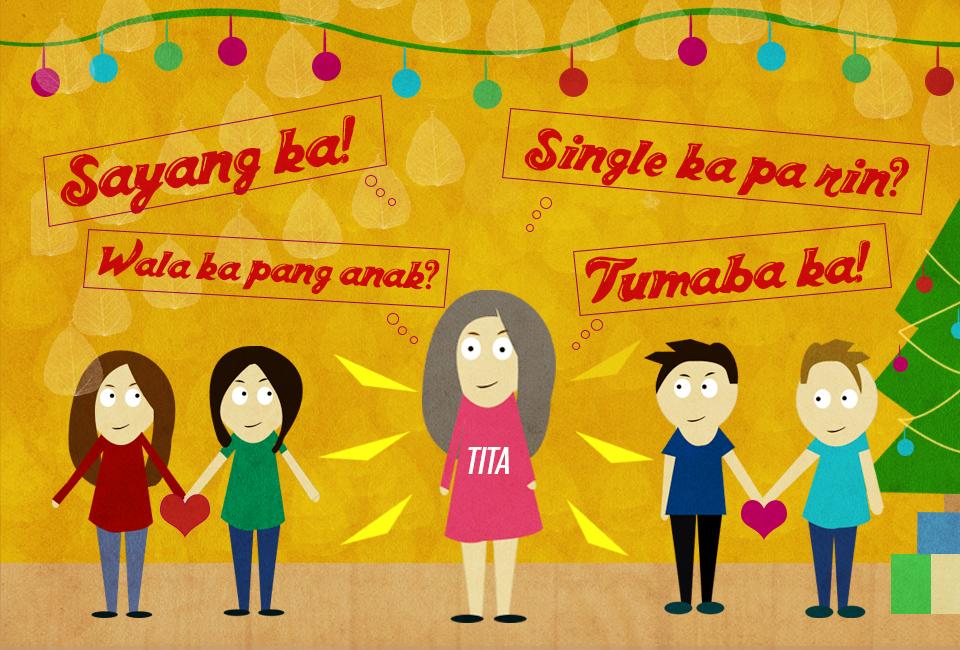
Holiday family gatherings tend to be less fun that you think they'd be, and quite a lot more stressful—especially when there are awkward encounters with well-meaning but unenlightened relatives.
These usually involve comments like, "Ang taba mo na!" "Bakit wala ka pang boyfriend?" "Wala pa ba kayong planong magkaanak?"
For LGBT individuals, there’s an additional set of hurtful remarks they have to deal with: "Sayang ka." "Hindi mo pa kasi nami-meet ang tamang babae."
As intrusive and even offensive these comments are, some people are able to handle it, or at least have become used to it. They're able to come back with responses that vary from good-humored retorts ("Sayang lang kasi hindi kayo ang market!") to more serious statements ("Wala kayong pakialam sa gusto kong gawin sa matris ko").
Unfortunately, all too often the person then hits back with, "Joke lang," and "Ang pikon mo naman!"
So what can you do, when you have to deal with people who say insensitive things that may hurt you and they don't even realize it?
'Phase lang 'yan'
Holiday gatherings are often the annual venue for family members to measure each other up on an "end-of-the-year meritology checklist," as Sipat Lawin Ensemble artistic director Jk Anicoche puts it.
"Paminsan may mga kamag-anak din na sobrang idle rest of the year at naghahanap ng mas mataas na ground to [do some] sexuality-shaming, often concealed as jokes or concern. Or perhaps unaware lang din talaga," says Jk.
There is still a lot of misunderstanding out there about the complexities of human sexuality. There will be the Tito or Tita who will say something like, "Successful nga, bakla naman." "Bakla pero di mukhang babae." "Tomboy pero di short hair." "Confused lang yan."
For many people, it is hard to understand that what they think they know about gay people are just stereotypes that they need to get past. So while it may be easier to ignore these comments, these are also opportunities to educate your loved ones.
"As much as we feel they should leave us alone...hindi pa rin ito [ignorance] naa-address dahil wala din kasing nagpapaliwanag o sumasagot sa mga tanong, or hindi natin alam kung anong sasabihin kay Tito o Tita o kay Papa o Mama," says Jk.
Personal experiences
When people tell Mac that he's "sayang," he either stays quiet, or replies, "Sayang sa girls pero hindi sayang sa guys." Other times, he says, "I educate them. In Mindanao kasi, the thinking is when you're gay you like straight guys, eh I'm not like that."
For Patricia, the response depends on her mood. Sometimes, she can be glib, especially with people she hardly knows. But when it's someone she knows, she can be more patient, telling them it's insulting to her to be told she's "sayang." They don't immediately understand, so she then proceeds with a lot of patience. "I explain I'm not any less than other women, and to imply that is ignorant," she says.
"Also saying na 'sayang' ako implies if I were straight I'd go out with them, which is entitled, and sexist on top of homophobic," she adds.
While it doesn't always work, Patricia believes it's still a step forward. "At the very least it always opens up the topic for discussion, which I count as a win over ignorance any day," she says, adding that she'd think twice about engaging when the person she's speaking with grew up in a close-minded environment, or advertises strong religious beliefs.
"Always put your safety first. And sometimes with all the negative things being said about LGBT people, it's easy to forget why we bother. But I try to keep in mind that when I get tired (when everyone else gets tired) that's when progress stops. So it's hard to keep explaining. But I'm also one of those people who would say, Yes, please ask me about these issues. And that I'd love to share my life with you, and show you that were not damaged or sick or whatever you may have heard," she says.
'Not in my family'
There are cases that still end with avoidance, such as when the person is extremely close-minded. Ru's family is very religious. "When I'm in the mood, I engage them in discussion—why LGBTQI [lesbian, gay, bisexual, transgender, queer or questioning, intersex] are not really different human beings. The problem is, they always go back to the teachings of the church which says that being gay is a 'weakness' or an 'ailment'. I think they could tolerate, but acceptance is another issue altogether. They could tolerate it when they see it on other people but not within their blood relatives," she says.
At some point, she decides not to try to persuade them, as "it would be painful for them as it would be painful for me." She says that in Filipino culture, the best option would be to know where the person is coming from before responding. "I tend to take the diplomatic approach, unless i-provoke ako. So I would think that being diplomatic, ignoring the comments, or politely introducing the concept of LGBTQI are the best ways to go about it," she says.
Renee agrees, saying it's important to know who you're engaging with. "And when in doubt, don't engage," she says. "It's really difficult to deal with prejudice. To shatter it requires a lot of not just knowledge and patience, but skill. Even if you know everything and you have facts to back you up, if you cannot get yourself across then it can even be a bigger mess than it was in the beginning."
Renee says there's also a need to choose who to engage with, as some people simply aren't willing to understand. "And in the end, I feel like it doesn't matter if they understand the situation or not. If they respect you naman, you can just agree to disagree," she says.
When it comes to her family, her sexuality is the most taboo topic, despite the fact that her partner lives with her. "I get away with a lot of things and they don't discuss LGBT stuff and LGBT me in front of me. But I achieve it by making sure I'm living a life they deem desirable. To them I seem to have done more 'glamorous' or cool things professionally and academically. I never ask them for help. And in turn, I try to be significant in their lives by helping them when they need me," Renee says.
Fighting ignorance with education
For Anton, the best way to educate people is simply by living your life. "Live a proper life. Try to set a good example," he says. "You can only explain so much. The concept is very theoretical. So just live your life the way you want it. They'll see how happy you are. And they'll see that LGBTQI is a wide spectrum. May maririnig ka na: 'Ah, okay lang pala sa inyo yun.' 'Ah, so kailangan bading din BF mo.' 'Ah, hindi pala galit yung bakla sa tomboy'," he says.
Jk hopes that people can be engaged in discussion that does not paint LGBT people as part of a "victimized minority" but as "empowered members of society."
"[Tell them] love knows no boundaries—then boom, ayan na, start na 'yan ng Bible conversation," he says. "'But the God that I know, Tita, is inclusive, doesn't judge. God nga kaya, kaya din natin yan!' Then in a very Pinoy way you may crack a joke. Or talk about how gay men had been helping communities and how difficult it was for some to come out...'pero Tita, mas mapagmahal at bukas na po mga tao ngayon. Human rights level na 'to!'"
Ru also adds that it is very important in these situations to keep calm. "Huwag mainit ang ulo," she says.
With a side of leche flan
Jk says that it really takes a lot of patience to "unravel the bigotry." "I think LGBT should take the higher ground at first. Paliwanag nang mabuti ano ang idea ng paggalang, or why what they are doing is discrimination and can hurt people... Magalit ka pag naipaliwanag at naituro mo na pero sarado pa rin. But remember to be the good person. I prefer not to get mad," he says.
Similarly, Bern suggests focusing on the good, and not antagonizing your relatives. "Be calm. And smile. Tell them the successes you've had in life in a non-aggressive manner. Kasi if you know you haven't thrown your life away into stupid things like maybe substance abuse, you're not 'sayang'. You're doing well. Tell them that. In a nice way, maybe while having leche flan," he says.
And you could let them read this article. Merry Christmas! — BM, GMA News

