

 GMA Brandtalk
 Tracking
 Archives

Cats, coffee, and culture in Patti Smith’s ‘M Train’
Her story starts and ends in a café.
Acclaimed singer-songwriter Patti Smith follows up her National Book Award-winning memoir "Just Kids" with "M Train", a non-linear regression into her life before and after the death of her husband, guitarist Fred “Sonic” Smith.
While "Just Kids" was rather more sequential in structure, a recounting of her early artistic life and relationship with artist Robert Mapplethorpe, "M Train" is a journey of starts and stops, of flashbacks and meanders, where dreams are as real as waking life. It is a journey is made at her own pace, at her own time, rather than an organized documentation.
She turns out to be of a literary bent, consumed by fantasies spun from her extensive reading. She name-drops authors she’s read with faint whispers of intimacy, so closely she’s read them: Murakami, Genet, Bulgakov, Bolaño.
Guided by dreams as real to her as waking life, she sets out on quests that are literary- or art-related: to the prison where Jean Genet was disappointed not to be sent to (Saint-Laurent in French Guiana), Frida Kahlo’s home in Mexico (Casa Azul).
Not only does she seek real places, but also fictional ones. After reading Haruki Murakami’s "Wind-Up Bird Chronicle", she obsesses about finding “a certain property” described there, “an abandoned house on an overgrown lot, with a paltry bird sculpture and an obsolescent well.” She does not find the house, and later loses the book, but not the memory of a feeling of longing for something she has never seen.
To a profound extent, she enjoys wallowing in this intense emotional state of yearning; the Germans have a word for it, sehnsucht, that’s been described as a pining for happiness while realizing that some wishes cannot come true; or a longing for a country, unidentified, unearthly, the stuff of dreams.
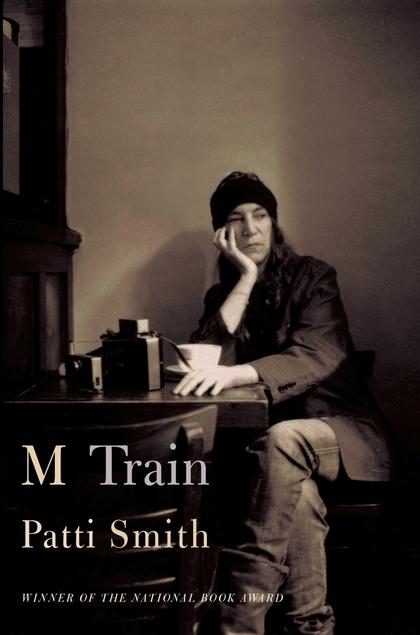
Her daily routine follows a simple pattern: she wakes, feeds her cats, puts on a watch cap and a coat, and walks over to her second home, Café Ino, where she has toast and olive oil and cup after cup of coffee. She writes, or doesn’t, as her whim dictates, at a corner table she considers her own: “What are you writing? [a barista asks.] I look up at her, somewhat surprised. I had absolutely no idea.”
A café established in Rockaway by a former Café Ino barista becomes another haunt, until it is swept away by Hurricane Sandy. Later, Café Ino closes too – a metaphor, perhaps, for death and dying.
Smith’s memories are anchored in places and things: rocks she keeps in a matchbox, a 200-year old “Flemish crèche… carved from bone,” “a snapshot of a sleepy-faced Fred, a Burmese offering bowl, Margot Fonteyn’s ballet slippers…”
She is a pack rat, a hoarder, not only of possessions but also of ideas, memories, and experiences, that she goes out of her way to court. There was that time when, without regret, she paid six euros for what might have been a fake lottery ticket from “some guy” in Madrid:
“Lucky or not, I went along with the part I was targeted to play: the pigeon who gets off a bus at a pit stop on the road to Cartagena, hit on to invest in a suspiciously limp lottery ticket. The way I look at it is that fate touches me and some rumpled straggler has a repast of meatballs and warm beer. He is happy, I feel one with the world – a good trade.”
Smith records her experiences with Polaroid photographs as surreal as her mind’s landscape – images taken at odd angles, defocused, blurred, not so much records of artifacts or places but spurs to her own memory. The temptation is strong to pick up the book and turn it this way and that to interpret the images – Virginia Woolf’s walking stick, Frida Kahlo’s bed, Roberto Bolaño’s chair.
Caveat to the reader: this is not a straightforward biography, nor a recounting of life events as Just Kids was; rather, it is a revelation of the workings of a highly creative and complex mind fueled by caffeine and curiosity. “Falling down the rabbit hole” does not even begin to describe this book.
Read this while drinking pots of coffee and a tab open to Google to look up the more obscure cultural references. — BM, GMA News

