

 GMA Brandtalk
 Tracking
 Archives

A Too-Tall Tale: a Review of ‘Mercury is Mine’
What Jason Paul Laxamana’s "Mercury Is Mine" has primarily going for itself is its firm sense of “worldedness” in the vicinities surrounding Mt. Arayat in Pampanga.
It’s plain to see (and hear) in the locations, the music, the food, the language, the people, and the overall evidence of material culture that surround and suffuse the main characters, who are both misfits, and in this sense “compatible”: the failed mother and struggling carinderia operator Carmen, whose house stands on one of the foothills of this famous dormant volcano; and the 16-year-old American tourist Mercury Sellers, a stowaway and fugitive who seeks refuge in the company of the lonely and middle-aged cook.
Unbeknownst to her the handsome young man had killed his awful and abusive father in the middle of a thunderstorm somewhere nearby. Soon enough this secret comes tumbling out of him, but she doesn’t mind. She still decides to keep him as a stay-in waiter in her house-cum-eatery, because he’s good for business (his curious and incongruous presence attracts customers and even reporters to her carinderia), and because he undeniably fulfills certain rudimentary needs.
On one hand her own estranged children are—in her own words—physically and emotionally damaged and disadvantaged: too dark-skinned, too stupid, too morally loose, too ugly... On the other he’s white, young, and beautiful, and therefore embodies the perfection to which she and her family, in their skin-bleaching plainness and halting English themselves desperately aspire.
While the promise of a cross-generational liaison is insinuated by the film here and there, mercifully the audience is spared what would have doubtless been a prodigious awkwardness, although the last favor Carmen asks of Mercury redounds to something similarly cringe-worthy, come to think of it: she asks him to impregnate her youngest daughter, and give her the good-looking grandchild she’s always dreamed of. Out of a kind of befuddled gratitude Mercury obliges, and they have sex in the house while Carmen and the rest of her unprepossessing children excitedly wait in the adjoining eatery.
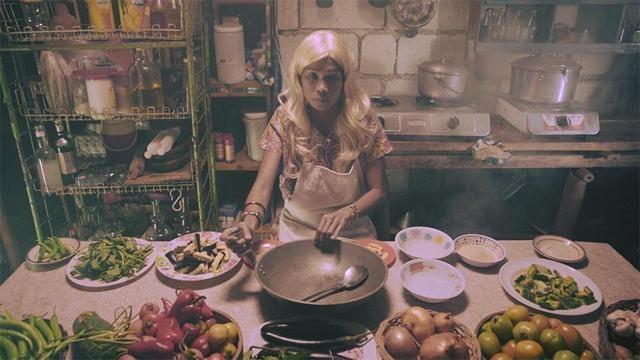
These are all hyperboles, to be sure, but they simply serve to solidify the film’s critique of the enduring colonial mentality that afflicts many rural (especially Kapampangan?) Filipinos, bombarded as they daily are with urban images of mestiza and mestizo showbiz actors and personalities, a number of whom have indeed come from their own ranks—except that, some fortunate way or other, in the manner of the old colonial doctrine to “improve the race” (in Spanish, mejorar la raza), they had been sired by white parents. This critique is dished out heavy-handedly at times, with Carmen serving as its most chromatically aggrieved, benighted, and pathetic occasion.
The twist in the end is supposed to undo this pathos—for it shows the wide-eyed native “slave” to be more clever and scheming than what the white “master” had granted her to be—but because it splays off from an unlikely and off-tangent side story (of, all things, a treasure chest that’s been buried in the wilds of the fabled mountain), this humorous reversal proves too extravagant and “tacked-on” to accept, and therefore falls flat.
Finally, while competently acted for the most part (by the generally droll Pokwang and an intently performing and seriously peroxided Bret Jackson), "Mercury is Mine" is a cinematographically polished feature whose reckless and ebullient ambition to be a funny-sad “tall tale,” while cute, proves to be its own dramatic undoing. — AT, GMA News
"Mercury is Mine" is part of the Cinemalaya Film Festival, which runs until August 14 at the Cultural Center of the Philippines and Ayala Malls.

