

 GMA Brandtalk
 Tracking
 Archives

Remembering a princess
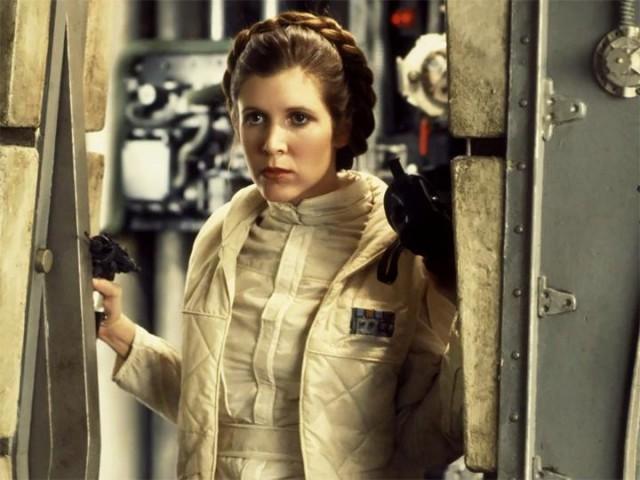
As far as “Star Wars” memories go, my introduction to George Lucas’ galaxy far, far away was somewhat inauspicious: It was around 1992, and I was with my family at a laser disc rental store (remember those?) on Katipunan.
We were browsing for movies to rent, and my younger brother had decided that he wanted to check out the “Star Wars” series—the first three in what would be a larger franchise.
With the infinite arrogance (or ignorance, I can never tell) of an elder sibling, I tried to dissuade him, wanting to use our rental allocation for something else. My arguments ranged from the inane (“Do you realize how many of these we’d have to rent to get the whole story?!”) to the just plain selfish (“We can get your movies next time”).
Thankfully, good sense (i.e. our mother) prevailed, and we went home with the classic Star Wars Trilogy: “A New Hope” (1977), “The Empire Strikes Back” (1980), and “Return of the Jedi” (1983), and, truth be told, I’ve never really looked back.
Flash forward to December 27, when I woke up to find the pop culture world in mourning over the passing of Carrie Fisher, the indomitable Princess Leia having succumbed to the heart attack she suffered last week on a flight home to Los Angeles.
In a year that’s seen more beloved celebrity deaths (Prince, Bowie, Rickman) than perhaps seems fair, the loss of Fisher four days before 2017 hit like a cruel joke.
While I claim no personal relationship or affiliation with the actress, it is impossible to deny the impact her character had on the formative phase of my fandom—in the weeks, months, and, yes, years that followed that fateful day at the video shop, the six hours and twelve minutes (pre-1997 Special Editions) that Lucas and his cohorts had created were etched in my brain, and Princess Leia was a justifiably large part of them.
Sure, there are critics who would point out that Luke (Mark Hamill) and Han (Harrison Ford) got the big heroes’ journeys and the bulk of the character development while Leia was little more than the token female, but those hacks couldn’t be further from the truth: the mere fact that she knew from the start who and what she was were precisely what made her appealing.
In a genre where females were traditionally relegated to eye candy at best (Jane Fonda as Barbarella), and glorified props at worst (Star Trek: The Original Series’ Uhura), Princess Leia more than held her own in what could very easily have been an outer space extension of an Old Boys’ Club.
Think about it: who else in the entire Saga had the audacity to look Darth Vader in the lenses and lie right to his facemask (seconds before her home world was vaporized)? Who else could pick up a blaster to show the (male) heroes how to carry out her own bloody rescue while displaying just why she’s known as one of the only characters in the series to nearly never miss a shot? And who else had the temerity to strangle an intergalactic crime lord to death with the very chain he’d used to subjugate her (subtlety was never Lucas’ strong suit—but I digress).
Now, I may not have seen the original Trilogy films when they were first released in cinemas, but like many who grew up in the home video generation, the story of "Star Wars" became near and dear to me. It provided a shot of sci-fi flavored fantasy even in the lean years when the franchise had seemingly faded from the zeitgeist.
In the years following 1983’s Episode VI, Fisher hadn’t just been sitting on her thumbs, having worked her way towards becoming a noted novelist, stage performer, and script doctor (performing uncredited rewrites on some of Hollywood’s biggest blockbusters).
But despite her professional success, Fisher’s personal affairs were another story: Having been born to famous parents (singer Eddie Fisher and actor Debbie Reynolds), she had lived her entire existence in the public eye, which meant her dirty laundry was up for the whole world to see; everything from her battles with substance abuse to her failed marriage to Paul Simon was tabloid fodder.
Ironically, Fisher would ultimately use a combination of her writing talents and constant public exposure to conquer her demons: Through self-autobiographical novels, advocacies, and—later on—a hilarious Twitter account (@carrieffisher), she held nothing back, regardless of how she was perceived.
So you have to
— Carrie Fisher (@carrieffisher) October 15, 2016
be attractive to be groped uninvited by Trump. Finally! A reason to want to be ugly!
The only exercise I get lately is running off at the mouth & jumping to conclusions.....
— Carrie Fisher (@carrieffisher) September 11, 2016
Using her razor-sharp, self-deprecating wit, Fisher took on the self-proclaimed role of everybody’s crazy aunt, confronting her addictions and afflictions on her own terms, dealing with them by virtue of being open about them.
The result: not only did Fisher become an inspiration to others with similar problems, she became one of the foremost celebrity advocates for mental health, as well as a social media sensation, garnering arguably more love from fans than when she was actively starring in films.
In 2012, Disney bought Lucasfilm and all of a sudden, there came word of a new Episode. In December 2015, The Force Awakens presented moviegoers with Princess Leia in her first new big screen adventure in 32 years. While her character didn’t figure as heavily in the overall plot or action this time around, she was nevertheless a welcome presence.
Elevated to the rank of general, the formerly scrawny Princess was now an esteemed elder in her own right, leading the Rebel forces with an innate calm that her character had naturally aged into (her performer, however, was as off-kilter behind-the-scenes as ever). The Force Awakens was a runaway hit, and with Fisher, Hamill, and Ford back in their familiar roles, all was right with the galaxy as we were reunited with old friends.
But of course, all good things must come to an end, which brings us back to a morning of mourning.
Just as the Star Wars characters grew older, so must we accept the inevitability that they will pass on. It is precisely for this reason that the ending of Rogue One proved so affecting; as that film’s creators are doubtlessly aware, few properties in modern pop culture are as capable of delivering a shot of pure nostalgia as the original Trilogy.
While the Star Wars franchise will most likely go on for as long as it continues to be profitable, it is a fact we must accept that, regardless of which direction they go with future installments, it will have to be done without the physical presence of our favorite princess.
Rest in Peace, Carrie Fisher; on-screen and off-, you showed us that heroes don’t need to be perfect (or Jedi) to be inspiring—they could be rebels. — AT, GMA News
Mikhail Lecaros works in advertising and has been a pop culture sponge for as long as he can remember. Check out his takes on the original Star Wars Trilogy, the Prequel Trilogy, and his review of The Force Awakens from GMA News Online.

