

 GMA Brandtalk
 Tracking
 Archives

ADVERTISEMENT
Filtered By: Lifestyle
Lifestyle
Dining on Davao's somewhat healthier street food
When I was still living in Metro Manila, I had this complicated love/hate relationship with street food. There’s something comforting about the crisp of deep-fried chicken skin, the sweet-sour tanginess of fishball sauce, the creaminess of kwek-kwek egg yolks, and the shamelessly artificial flavors of samalamig. At the same time, I hate the fact that I’m willingly poisoning my body with too much cholesterol, salt, fat, preservatives, and sugar. Most of the time I’m able to resist, but when I’m having a really bad day, sometimes I can’t help but give in.
When I had a baby I promised myself that I’d control my urges so my daughter wouldn’t be exposed to that kind of temptation. It was so far so good until we moved to Davao City early this year. My husband, without even blinking, bought something from a street vendor and gave it to my daughter. And I didn’t have an aneurysm; I didn’t even mind.
What did he get her? Fresh mango shake made right before our eyes. Its ingredients: water, ice, fresh mangoes, and milk. How much did it cost us? 5 bucks.
Davao street food was like manna from the heavens for me because I was finally able to eat street food without the guilt (and without burning though our food budget). I’m not saying all the street food in Davao are healthy. But when you look around, you can see that the streets of Davao do offer a lot of healthy options. To show you exactly what I’m talking about, here’s a quick tour of Davao City’s guilt-free street food.
.JPG)
Fried food comes with as much salad as you can eat. Photo by Jae Manuel Sta Romana
Fresh fruit shake. You can find freshly made fruit shakes practically anywhere in Davao for a lot less. They usually have flavors like mango, avocado, durian, melon, and whatever fruit is in season. Fruit shakes from vendors in People’s Park are among the cheapest, 5 pesos for a small cup. Fruit shakes from stands around the city cost more but they’re still cheaper than those sold in the malls (P35 for a large cup).
Fried food with salad. Down San Pedro Street and in front of most schools, kwek-kwek and crispy chicken skin vendors usually serve these fried treats with a side of fresh salad. The side salad is usually made of fresh seaweed, cucumber, onion, ginger, and vinegar. You can eat as much salad as you want when you “dine in” or have a small pack for free when you “take out” per order of kwek-kwek (P15-P20) or crispy chicken skin (P20).
Fruit slices. In Manila, pica-pica usually means fried nuts, green peas, and garbanzo beans. In Davao City, pica-pica means slices of papaya, guavas, mango and singkamas. You can usually find these fruit vendors in front of schools or along J.P. Laurel Avenue. These fruits slices usually come in P5-P10 packs and your choice of condiments (salt, sugar, vinegar, soy sauce, and spicy vinegar).
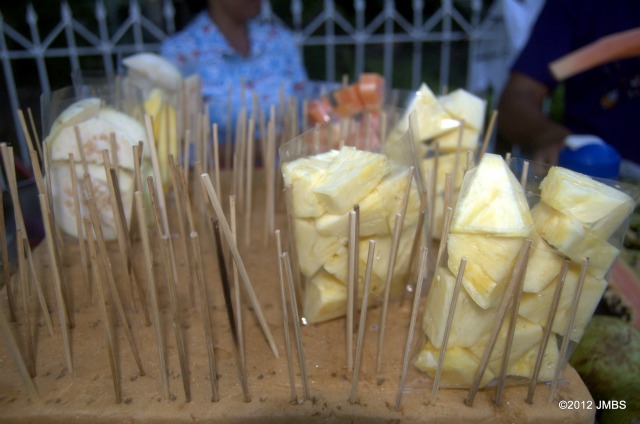
In Davao City, pica-pica means slices of fresh fruit dipped in condiments. Photo by Jae Manuel Sta Romana
Ginanggang na saging at mais. Ginanggang na saging is Davao’s healthier version of the banana cue. It’s grilled, not fried, lightly brushed with margarine and sprinkled with white or brown sugar. Ginanggang na mais is grilled yellow corn that’s usually eaten as is or sometimes brushed with a little bit of margarine and sprinkled with salt. A word of warning though, the starch in ginanggang na mais and saging are not as completely cooked as those in the fried and boiled versions and it can cause stomach upset. So if you’re not used to eating ginanggang, don’t overindulge.
Milky samalamig. One of the things my husband found particularly odd about Davao is the milky samalamig. Whatever the flavor, it has milk in it. Halo-halo, sago’t gulaman, melon, buko, you name it, there’s usually evaporated milk in it. And for only 5 pesos, I like to think my daughter at least gets some calcium with all the sugar in those drinks.
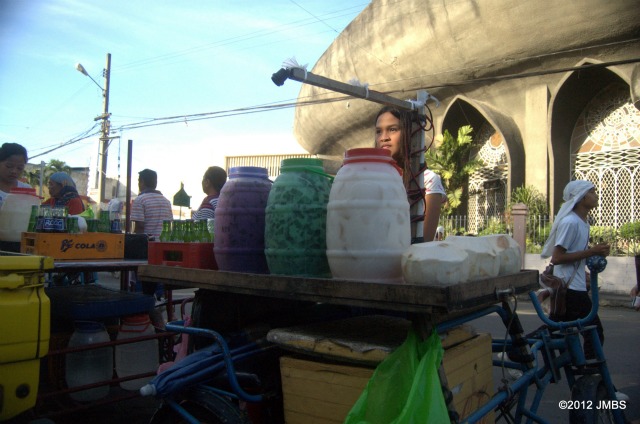
For only five pesos, you get a cup of this sugary cold drink. Photo by Jae Manuel Sta Romana
Takoyaki. Uyanguren is Davao City’s version of Divisoria or Tutuban and it has a large population of Moslem, Chinese, and Hindu vendors. It kind of makes sense that one of the most popular street food in that area would be the takoyaki. It is a type of Japanese street food composed of vegetables like cabbage and carrots molded inside a soft dough ball. It contains no beef or pork (so it won’t offend anyone), is easy to prepare and is cheap to make. The average price for 4 golf ball-sized takoyaki in Uyanguren? Fifteen pesos.
The healthier taho. Taho, in itself, is already healthy. It’s rich in protein without the fat. It’s warm and filling, especially on cold mornings. So how do you make the already healthy taho even healthier? Adding a little bit of milk to taho gives it a calcium boost while adding jackfruit or langka to arnibal gives it a shot of vitamin C and a bit of fiber. And you get all that for just P5 to P10 a glass. –KG, GMA News

