Before the invention of cup noodles, there were just noodles. And by noodles, I mean long strands created through much kneading and stretching done by an actual person, not a machine.
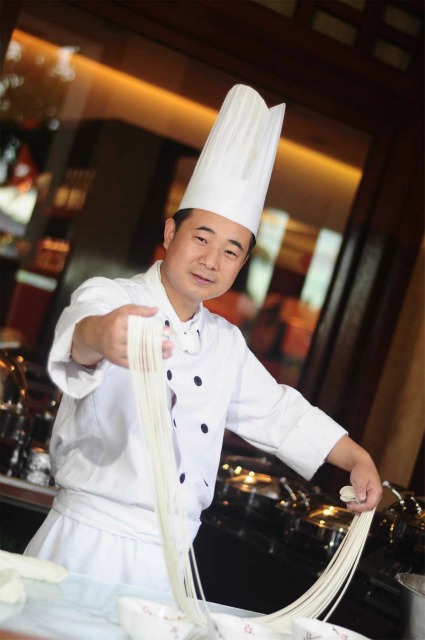
Chef Sun Yi Li of Xian, China makes making la mien or hand-pulled noodles look so easy. Photo courtesy of Makati Shangri-La, Manila
This was how the ancient Chinese had their noodles. Everything was made by hand, including what National
Geographic reported was a bowl of “beautifully preserved, long, thin yellow noodles” dating back 4,000 years ago that were found in Lajia in northwestern China. An expert interviewed by National Geographic, archaeochemist Patrick McGovern of the University of Pennsylvania’s Museum of Archaeology and Anthropology, said that even today, “deft skills” are needed to produce long thin noodles such as those discovered in Lajia. Last month, I had the opportunity to see those deft skills at work when 31-year-old Chef Sun Yi Li of Xi’an, China took his position at a hand-pulled noodle station at Makati Shangri-La Manila’s Circles Event Café. Under the spotlight and in front of diners, Chef Li took some dough and kneaded it. He would press it, roll it, fold it, and knead it all over again. Every so often, he would pull and stretch the dough sideways like a conductor directing an orchestra, and voila!—strands of long, thin noodles would be produced, which he would then drop into a pot of boiling water. He made the whole process look so effortless, it was fascinating to look at. And to think that he did this several times over lunch and dinner during his 10-day visit to Manila on Feb. 20 to 29, when the hotel held the Art of La Mien festival. “La mien,” said Chef Li, “is a type of hand-made or hand-pulled Chinese noodle. It is also the name of the dishes that use these noodles.” The most important thing to remember when preparing la mien is “to roll a workable thickness and cut it into workable portions,” said Chef Li, who holds the position of “pull noodle chef” at Shangri-La’s Golden Flower Hotel in Xian. Next to the hand-pulled goodness, the other secret to a good bowl of noodles is the sauce. “Also very important is to make a good sauce for noodles,” shared Chef Li, who studied cooking at the Shaan Xi Cooking Academy in China. At the noodle station at the Art of La Mien food fest, rows of condiments for the sauces were placed in front of the pots of soup stock. Guests could choose the sauces that they like and the meats (beef, pork, seafood) that would go with the noodles.

A row of meats, from seafood to pork and beef, and condiments at the noodle station. Karen Galarpe
We tried Chef Li’s Beef Noodles with Garlic, Leeks and Special Sauce, and were immediately impressed just by the aroma of the steam wafting from the bowl in front of us. It was not your usual beef mami noodles—it’s not at all soupy—nor was it your familiar pancit canton. But the flavors, oh the flavors! It wasn’t salty, nor was it sweet, but something in between. And no MSG was added, hurray. Diners could also taste and see that the noodles were freshly made—some strands were thicker than others, the overall taste was light, the texture al dente. Chef Li said his top five specialty dishes are the Hand-pulled Beef Noodle, Noodle in Special Sauce, Noodle with Meat Sauce, Noodle with Sliced Meat and Mushroom, and Noodles with Tomato and Egg. The thing to remember with hand-pulled noodles is that it can be a meal in itself. That said, I’m looking forward to Chef Li’s next visit so I can try his four other specialty dishes. –
YA, GMA News 

 GMA Brandtalk
 Tracking
 Archives


