

 GMA Brandtalk
 Tracking
 Archives

ADVERTISEMENT
Filtered By: Lifestyle
Lifestyle
Eats more fun in Malabon
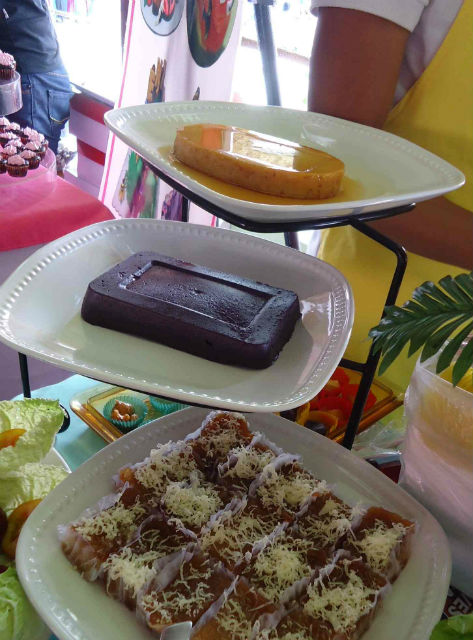
A Taste of Heaven is just one of many kakanin businesses that have thrived in the city.
Driving through Malabon, one cannot help but notice the many stores bearing the name “Nanay’s,” “Mommy’s,” “Inang’s,” and other terms of endearment for “mother.” And then of course, there is the famous “Dolor’s” whose kakanin (rice cake) stores seem to outnumber the popular burger joints in this city north of Manila.
Seeing all these signs on the way to the Malabon Kulinarya Festival at Dampa sa Paseo, held in celebration of the city’s 413th foundation day on Tuesday, I wondered how many mothers have opened a store here, and if the famous Dolor and these other “mommies” were, in fact, just one and the same person.
These “mom” stores speak volumes as to how the womenfolk of Malabon have held on dearly to the culinary traditions of this once sleepy coastal town. They kept close to their hearts the recipes that were passed on to them from generations past. It’s as if they need to cook this food, the food that nourished them and they grew up with, so as not to forget where they come from.
Pancit Malabon at iba pa
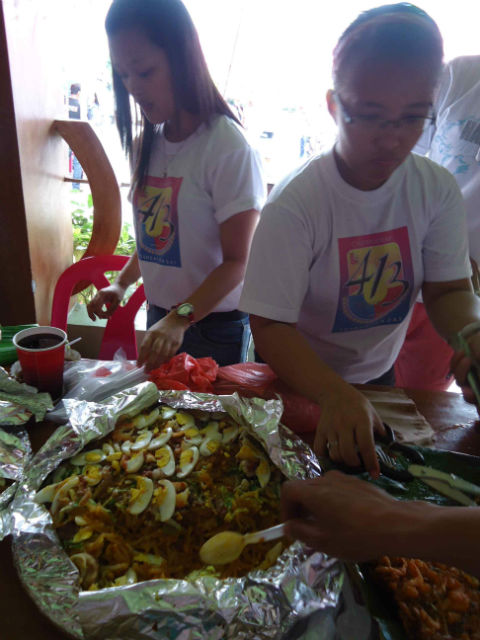
Malabon's famous Pancit Malabon is a noodle dish that remains unrivaled in color and flavor.
This is a city where heirloom recipes of almost a hundred dishes and delicacies still flourish.
And on top of that list are the two things Malabon is famous for: bilaos with colorful swirls of kakanin, maja blanca, ube and cassava cakes, and the quintessential Pancit Malabon – thick rice noodles swathed in a bright and sunshiny yellow-orange sauce, a mixture of patis (fish sauce), achuete, shrimp juice or aligue (crab fat), and topped with an assortment of seafood that’s abundant in this area—shrimps, squid, mussels, oysters and tinapa (smoked fish) flakes. Of course, no bilao of Pancit Malabon is worthy of desire without the slivers of hard-boiled eggs that go on top, making this the most festive noodle dish in town.
Annie Guerrero, founder of the Center of Culinary Arts (CCA) and a native of Malabon, said it best when she told those who came to the Malabon food fest, “Anong sinabi ng japchae sa Pancit Malabon?” Looking at this dish and how it has become the life of the Filipino party over the years, indeed, the japchae or any other noodle dish does not come close to the liveliness of color and the richness of flavor of the Pancit Malabon.
There is, however, more to Malabon than its famous pancit as the Kulinarya Festival had shown. A project of acting mayor Len-Len Oreta, this festival, held for the first time in the city on May 15 this year, showcased the sapin-sapin, pichi-pichi, menudo, okoy, lumpiang hubad, kusilbang saging, and more dishes that define the flavors of Malabon.
Preserving its culinary heritage
Interestingly, one of the less visited stalls in the festival was that which featured the one ingredient to which the city owes its name. This was the stall that had Ginataang Labong (bamboo shoots cooked in coconut milk). As legend has it, the name Malabon comes from having had an abundance of bamboo shoots, “maraming labong” or “ma-labong.”
Still, we owe it to the people of Malabon for keeping their culinary heritage alive. Oreta said, “We are proud that our City has maintained its distinct food culture despite the continuous increase in the number of fast-food chains in the city.”
The acting mayor is especially proud of the “gifted chefs” of Malabon who have developed delicious recipes without formal training. One of the beneficiaries of the city’s livelihood projects is Empananay’s Lourdes de Jesus. She has been cooking her famous ham and cheese and pork asado empanadas for five years and now sells them through the outlets of Dolor’s Kakanin in the metropolis.
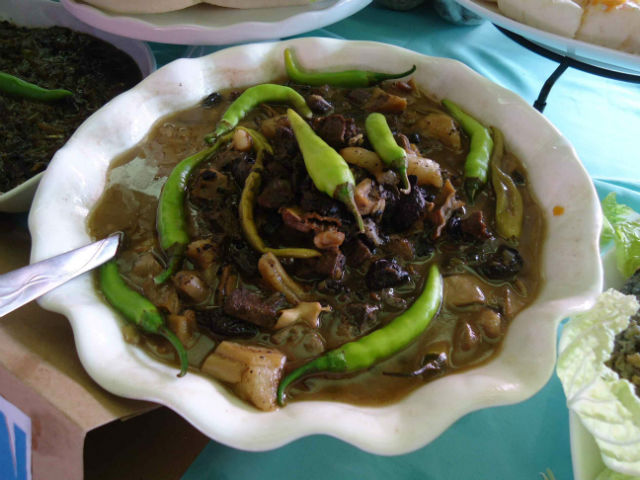
Dinuguan - a perfect complement to the puto of Malabon.
The same holds true for Eddie Torres of A Taste of Heaven which started making kakanins like ube halaya, cassava cake, and puto four years ago. They have since moved their famous kakanin business to the rest of Manila by joining food bazaars and opening stalls inside huge supermarkets in the metro.
ADOBONG PUSIT MALABON-STYLE by Annie P. Guerrero, CC
Ingredients: oil for sautéing 2 kilos small squid 2 heads garlic, minced 1/4 kilo leeks, slivers approx. 1 cup vinegar salt and pepper Procedure: 1. Wash the squid and separate the ink. Reserve the ink. 2. In a sauté pan, heat vegetable oil. Saute the garlic for a few minutes. 3. Add the squid and sauté with the garlic. Once the squid becomes opaque, slowly pour the vinegar. Lower your fire to simmer and reduce the vinegar. 4. Once the vinegar has reduced, add the leeks, pepper, salt and the squid ink. Continue to simmer until the sauce thickens. Recipe from the Malabon Kulinarya Festival 2012
The festival also held a cooking demonstration. Guerrero, whose mother used to run a cooking school in their Malabon ancestral home way back in the 70s, led her CCA students in demonstrating two popular Malabon recipes: Sumpia with Garlic Vinegar Dip and the Adobong Pusit Malabon-Style.
The sumpia is actually a “lumpia” or fried spring roll filled with suahe (shrimps) and assorted sliced vegetables like carrots, cabbage, green beans, kamote and to which ground roasted peanuts and sugar are added.
Indeed, Malabon has so much to offer in terms of Filipino cuisine. And the men and women of this coastal city deserve to be proud of their culinary roots. As they have kept their love of Malabon food intact, so have they preserved their pride as a people and their identity as a city that no hell or high water can extinguish.
For Malabon, famous not only for its rice cakes and pancit, is also notorious for flooding during typhoon season. And it is this last bit that distinctly shows just how tenacious the people here can be. They are survivors. And it is perhaps, this bond, forged in adversity, that has made them cling to life, to tradition, and to the food that has been at the core of their lives for years. –KG, GMA News

