GMA Brandtalk
 Tracking
 Archives

Falling in love with Chai in India
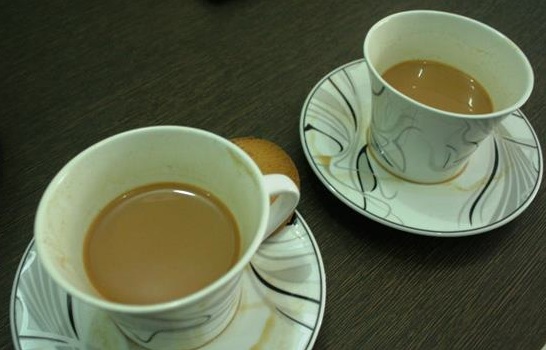
If there was one constant during my six-week Indian sojourn, it was Chai. The heat – though relentless in the day – stole away on cloudy nights, dissolved in rain showers, and didn’t enter the fully-airconditioned Kolkata shopping malls and hotels. The bugs were there only when we forgot to close the windows and switch off the lights. The cows liked to hang out on provincial roads, but were nowhere to be seen in the city. The Chai, however, was everywhere. It’s really no wonder why they plan to declare Chai their national drink. I fell in love with Chai the first time I tried it, only a few hours after touching down at Kolkata airport in the middle of April to start my volunteer work at a school. After settling my luggage down, my travel partner Krista and I and our new local friends decided to take a walk. Kolkata was definitely much hotter than Manila at the time, and the heat stuck to my skin uncomfortably. I felt like I had been put in an oven, and was slowly roasting to a crisp.  When we stopped at a stall to get some Chai, I couldn’t quite believe we were doing the right thing. I could barely see the man behind the counter for all the steam coming from the teapot that whistled mockingly on the stove. What I needed at that point was an ice-cold soda, not a steaming cup of tea. Part of me wanted to decline the offer because a.) it was hot, b.) the sheltered city brat in me didn’t want to disobey my father’s instructions to not try anything from the streets “no matter how good it looks,” and c.) I didn’t even like tea anyway. But a bigger part of me shrugged off those concerns, because why else was I traveling if not to try new things? After a few seconds of staring at the Chai rippling inside the little clay cup, I took a sip. It was a pleasure and a surprise to find that even under the bright sun, the hot Chai was inexplicably comforting. It was certainly not the milk tea that people drink in gallons here in Manila. Yes, it had the taste of all the familiar flavors—milk, black tea, and sugar. But it also carried the taste of spices, and colored powder, and Bollywood, and saris, and raga rock, and yoga, and that same indefinite something that drew me to India in the first place. I finished my Chai in two sips and a gulp, then smashed the clay cup on the ground, just like the locals do. From that moment on, I was hooked. And thanks to the gods of India, Chai wasn’t hard to find. There was Chai in sidewalk stalls, in bus stops and overnight trains, in bookstore cafés, in malls, in hotels, in airports. There was Chai at lunchtime in the faculty room of the school where Krista and I were stationed. If we asked nicely, there was Chai for breakfast and tiffin too. And there was an unending amount of Chai in every home of every family we visited. The Chai came in different variants and price points. Roadside stalls served it sweet and milky for only five rupees. Cafés served it foamy and strong in big mugs for quadruple the price. In trains, they used tea bags instead of brewed loose tea. Home brew Some places served better Chai than others, though I was always happy to get any Chai at all. My favorite Chai, however, was the homemade kind, mostly because they always came with something more, and I don’t mean crackers or a Good Day butter cookie. One evening, Krista and I dropped in on the nursery teacher unannounced. We called her didi, the Bengali term for “older sister,” because just like a big sister, she was always caring, sweet, and generous enough with the details of her very exciting love life. She and her husband Mr. Ritesh, (consequently, our dada) are of Nepali origin and came from Darjeeling, a city in West Bengal famous for its tea leaves. Every time we visited her, she would tell us magical stories about her hometown, how beautiful it is, how much she missed it. That particular evening, when we knocked on her door, she was already in her nightdress, and in the middle of preparing dinner. Still, she let us in with her usual warm smile. “Go, sit on the bed and watch TV, I’m just making dinner!” she chimed. “Oh, sorry, didi! Don’t worry about us, we’ll just stay here out of your way,” Krista answered. “It’s no problem,” she said, smiling. So we sat down and watched TV, shuffling from the Hindi news to HBO and enjoying the feeling of home as we disarranged their pillows. A few minutes later, Ms. Manisha opened the door, carrying a silver tray and two cups. The distinct Chai smell followed her in. “Didi! You didn’t have to!” I said, rather alarmed that we put her through such trouble. “No, please. It was no trouble!” she reassured us, whisking off to the kitchen to resume cooking. Krista and I followed her, sipping our Chai slowly and watching with fascination as she rolled out roti with her deft hands. “Didi, your Chai tastes really good,” I told her. “Oh, it’s because I mix Darjeeling tea with it. It makes it better,” she explained. She shook a bottle on her kitchen counter. “I only have a little bit left, so I have to go back home to get more.” I stared at the puddle of Chai at the bottom of my cup and saw a little piece of our didi’s beloved hometown looking back at me.