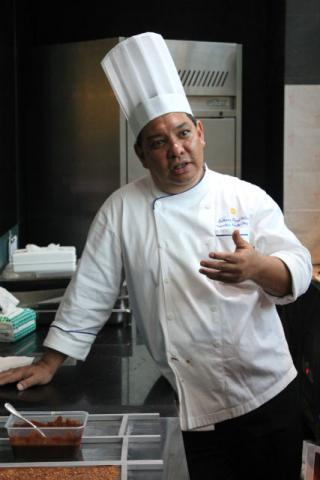
Makati Shangri-La’s Executive Pastry Chef Anthony Collar explains the basics of making chocolate creations.
You may call yourself a chocoholic, but chances are, you're eating your favorite treat the wrong way. Most Pinoys
love chocolate — whether it's a peso-sized Curly Top, a giant Hershey's bar, or a mug of steaming tsokolate — but there is so much more to to the rich, sweet fruit of the cacao tree than simply munching on a piece. A lot have a tendency to just chew chocolate, but you don't have to do that, says Chef Anthony Collar. As he hands us pieces of dark chocolate, he explains that chocolate will melt in the mouth, and the flavors will burst on the tongue. He demonstrates how to warm the chocolate in the palm of your hand, then places a piece on the center of his tongue. We follow his lead, and soon, everyone in the room understands what the chef is talking about. The chocolate spreads slowly, and we can detect a hint of saltiness, the smooth creaminess made sweeter by bitter undertones. We catch ourselves closing our eyes as we savor the rich flavors, and it takes a lot of self-control to keep from licking our sticky fingers. "Chocolate is very sexy. If you eat it nicely, it's very, very sexy," he says. Moments before this, the chef showed us a diagram of the tongue, pointing to the different groups of taste buds. Before that, he taught us about growing cacao, and how chocolate tastes different depending on where it was grown. He also gave us a smell test — small containers with different ingredients, which we had to identify using our noses. This was no ordinary afternoon of indulging in chocolate; we were at a preview of Sinfully by Makati Shangri-La's chocolate-making classes, which will be taught by Collar, the hotel's Executive Pastry Chef. "To eat you need to understand, and it takes time to understand," he told us. "The more you do the blind smelling, tasting, the more you learn to appreciate where the chocolate comes from," he said, explaining that some smells are easier to identify than others, depending on where you grew up. "For Asians, it's very simple. Ah lemongrass, ah chili, ah vinegar. Because these are flavors we grew up with. You learn to smell it everyday and because you're so used to it, you walk in, 'Ah, Mama's going to cook adobo today,'" he said. As for other things, like apricot and vanilla, these are things you need to teach yourself to smell, says Collar, who will teach aspiring chocolatiers using hands-on pastry techniques.
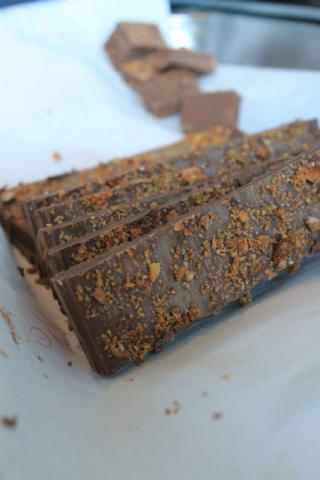
Almond Gianduja with caramelized almonds
"All the chocolates have a different taste. Every region has its own profile," says Collar, so that chocolates from the Philippines have a hint of mango in them, while others will taste of spices, or citrus fruit. "Depending on where the chocolate is grown, it takes on the flavor. That's why we have chocolate that we call origin chocolates. These are only grown in a specific area and they have a very particular taste to them. That's why sometimes you pay so much money for chocolates," he says. As for pairing chocolates with other food, Collar says you need to understand the different flavors. "If I'm having cognac, I'd choose a stronger, more robust, dark chocolate. If I'm having tea, I'd go toward the milk line, because milk is very fine... tea is fragrant, fragile. The milk goes with it, it flows together," he says. Collar also explains why chocolate can be so expensive. He lets us sample tiny bits of cocoa butter — which looks and tastes like soap, or candle wax. But cocoa butter is what makes the chocolate more expensive, the chef says. "The chocolate becomes so fine because the butter content is so high. This is what we pay for virtually. This is what is magic, it melts in your mouth," he says, as he shows us how to make Cafe Whisky, a liquer-infused ganache coffee. Before this, he showed us how to make Almond Gianduja, almond praline paste topped with caramelized almonds. When it comes to health properties, Collar says dark chocolate is better, because it has better antioxidants. White chocolate, he explains, is not real chocolate — it's just cocoa butter with milk powder and sugar. We spend a whole afternoon discussing chocolate and learning tips and tricks from the chef. "A good teacher will teach you how to do things, and an excellent teacher will show you how to read between the lines," he says, adding that recipes rarely teach you the proper way of doing things. Collar's goal, he says, is for his students to go home and be able to say, "I can do this."
— BM, GMA News The chocolate-making classes will be held from 11:00 a.m. to 5:00 p.m. on September 29 and the weekends of October at Sinfully by Makati Shangri-la. The workshop fee is P2,500 including lunch buffet at Circles Event Café
. For more information, call the Restaurant Reservations and Information Center at 813 8888 ext. 7588/7599 or email rric.slm@shangri-la.com or sinfully.slm@shangri-la.com. Photos courtesy of Sinfully by Makati Shangri-la 

 GMA Brandtalk
 Tracking
 Archives


