

 GMA Brandtalk
 Tracking
 Archives

ADVERTISEMENT
Filtered By: Lifestyle
Lifestyle
From good seeds to good food: East-West Seed's farmer-heroes
For some Pinoy diners, the launch of Meatless Monday on October 1 is not something to look forward to. But "green chef" Sau Del Rosario proves that vegetable dishes can be delicious and exciting as well, with dishes like citrus shitaki mushroom confit and squash blossom stuffed with queso and tomato ragout. Before serving guests a special vegetarian lunch at a press conference held by seed-breeding company East-West Seed Philippines on September 20, the chef also made the case that no matter how good his technical skills, a chef is nothing without good ingredients.
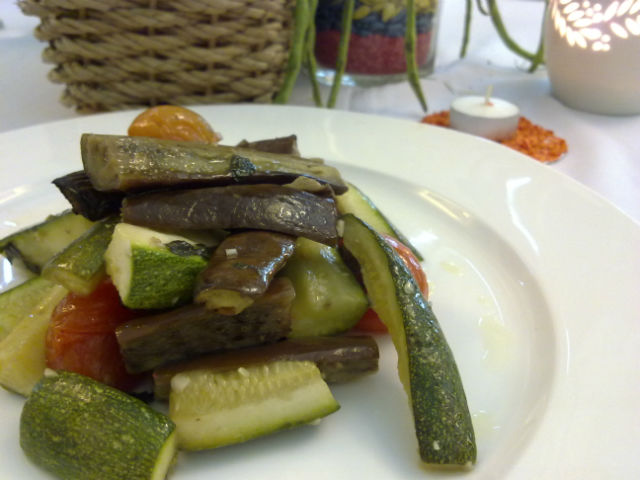
Grilled marinated tomatoes, zucchini, eggplant and kesong puti at the East-West Seed lunch
"[I]f you give [me] bulok na vegetable, I don't think I could give justice to that," he said, and gave credit to the farmers who "make our lives easier, make us healthier, and make us grow."
"We go around the country and we encourage them to grow more and more, whether it's organic or not. It's very important for us to get fresh ingredients," he said. Celebrating farmers
With the international East-West Seed Group celebrating 30 years in 2012, its Philippines office has launched a nationwide search for 30 farmer-heroes.
"We want to celebrate not just our own success, but the success of farmers," East-West Seed general manager Mary Ann Sayoc said.
"We have 101 stories of successful farmers who were able to send their children to school and build better houses through vegetable farming," she said.
The search for 30 farmer-heroes spanned 15 regions nationwide, with 30 nominees per region. Judges from East-West Seed will choose based on the following criteria:
- the candidates' unique success story as vegetable farmers;
- their positive influence in their farming community;
- their promoting the growth of vegetable farming;
- their creating jobs and uplifting the livelihood of others; and
- their exemplary adaptation of improved technologies for vegetable production.
The farmer-heroes will be given cash awards, seeds and trophies. "We will have a grand celebration on December 12. We'll invite all of them to come, we'll have a big field demo and in the evening, we'll have a party. We'll fly them in and give them VIP treatment," Sayoc said.
Established by Dutch agriculturist Simon Groot in 1982, East-West Seed sowed its first seed in the country in Leyte. Groot's goal was to breed suitable varieties that allow farmers to be more productive.
Combining European seed technology expertise with Asian tropical farming know-how, Groot set out with the belief that "a good seed can change the lives of more farmers than millions of aid money."
The business did not immediately flourish. "Success, as they say, did not happen overnight... money was just going out. Everything was spent on research," said Sayoc.
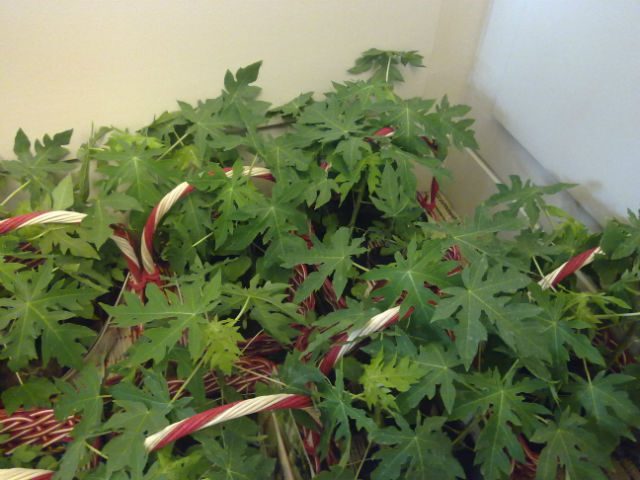
Papaya, tomato and eggplant seedlings
The company first tasted success with its ampalaya, Jadestar—the first locally developed commercial vegetable hybrid in the Philippines and all of Southeast Asia.
According to Sayoc, a localized breeding program is necessary to be able to develop varieties that are suited to local farming conditions.
"This variety was remarkable because it had a higher yield and also, better disease tolerance," Sayoc said, adding that the company now comes up with at least five new products every year.
"Just providing good quality seeds is not enough to develop the vegetable industry. We also need appropriate vegetable farming technology," she added.
Sayoc said the company seeks to continuously develop high quality vegetable varieties, in order to keep the farmers' trust.
"We are really proud to say that East-West Seed has revolutionized Southeast Asia's vegetable seed market by pioneering hybrid varieties which give farmers better income," she said, noting that while a hectare of rice farming can give a farmer an income of P10,000, vegetable farming on just a thousand square meters—or a tenth of a hectare—can give a farmer around P20,000 in one cycle.
Apart from creating value for farmers, Sayoc said the company also creates value for consumers, beginning with the seeds.
"We set off an entire chain of value creation, which would help farmers get larger yields and higher quality produce, which would in turn result in more attractive vegetable products that could sell better in the markets. This will end up on the table of consumers, and they will have more tasty and more attractive vegetables to eat," she said.
Promoting nutrition through greater vegetable consumption is also a goal of the company, which gives training and provides hybrid seeds to public elementary schools and typhoon-affected areas for the establishment of school gardens.
"We advocate healthy eating in schools because this means better learning and greater productivity in the community. Every Filipino can support this advocacy, too," Sayoc said in a press release, urging consumers to choose locally-grown vegetables. "That's the best way we can show appreciation and tip our hat to Filipino farmers." — BM, GMA News

