

 GMA Brandtalk
 Tracking
 Archives

Revisiting the Filipino kitchen
There is perhaps no room more central to the Filipino home than the kitchen. It’s where you can find the patis, toyo, bagoong, and suka; where the sound and smell of longganisa and sinangag that wakes you up in the morning comes from; where adobo is whatever the cook wants it to be; where a pot of sinigang or bulalo waits to warm up the cold and hungry on a rainy day; and where the steam rising from a pot of rice holds the promise of the best meal you’ll ever have every time you see it. More than that, it is within the busy Filipino kitchen that families gather, wisdom is taught and learned, and inimitable culinary traditions on the verge of disappearing get passed on.  “To me preservation is not just documenting them and putting them in a file somewhere,” Amy Besa, co-author of the book ‘Memories of Philippine Kitchens,’ said at the launch of its updated version Tuesday night. “You have to cook and eat them again,” she said. Besa believes our long colonial history, when our ancestors were repeatedly told that the local cuisine was inferior and even nutritionally deficient, has resulted in Filipinos getting ashamed of our own cuisine such that instead of promoting it, we often hide it. “Whenever people want to celebrate or to show something off, they have foie gras, caviar, they have the kurobuta pork. To me, whenever I see that in a menu, I am so bored. Truffle foam…bo-ring! Give me pukot any time, or hagikhik,” she quipped. “Show me something that came from the rural areas of the Philippines, I will pay attention,” she said. Besides, she noted that when travelers or balikbayan Pinoys visit the country, it’s not the foie gras they want to experience. “If they came here and looked at all the restaurants and saw all the foie gras and all that, they will say, ‘why are we here?’” she said. “I want home cooking. That’s where the best food is. Give me your lola’s cooking,” she added.
  Besa, who opened the Purple Yam restaurant in Brooklyn in 2009 with her husband Chef Romy Dorotan, wrote the book with him in 2006 when they were still running their restaurant Cendrillon. They updated the book earlier this year to include recipes and stories from their new restaurant. According to Besa, the work—which is part cookbook, part memoir, and part photo book—aims to promote Philippine cuisine to Filipinos and foreigners alike. “Everybody asks me, how do we promote Filipino food abroad? The best way is to show what we had before,” she shared. “One of my goals here is to share the excitement of these beautiful ingredients, dishes, cooking methods, cooking equipment and heirloom recipes that you can still find in the rural areas,” she added.
 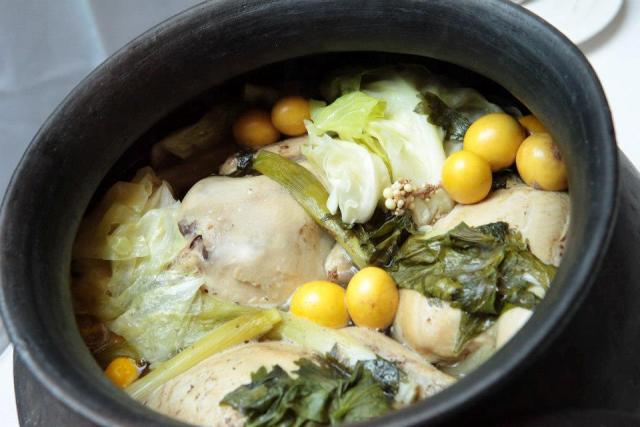 For instance, there is Chicken Kinulob, made from the recipe of Lola Anday Tolentino from Bulacan. It’s a stew laden with cabbage, leeks, celery, unlaid eggs, chicken blood, and native chicken stuffed with ginger, onions, and pork stomach, all slow cooked over an open fire in a palayok covered with banana leaves. More well-known dishes are also in the book, like the pig’s blood stew Dinuguan according to Nana Meng of tsokolate fame, or the eternal Chicken Adobo the way they serve it at Purple Yam. The recipes, though familiar, are given a new twist or have a special back story. The back stories, in fact, seem as important as the recipes themselves, because according to Besa, they make food more interesting. “For me, food per se is boring. Food to me becomes interesting if first, it’s shared and eaten with friends, and then you know the background, there’s a back story, there’s a context. So to me, that’s the beauty of food,” she said. Perhaps it’s the stories that are getting Filipinos interested in local cuisine again—because even with a long history of cuisine colonization, Besa said that more and more Pinoys are becoming “enlightened” and willing to explore Filipino cuisine. Traveling the length and breadth of the Philippines, and doing research, are the best ways to discover more local food, Besa shared. “All you have to do is be aware. Your mind has to be open,” she said. “You read. You research. There’s a lot of stuff on the internet, you just have to intelligently look at it. “You really have to know what you’re looking for because it’s not there for you to see, it’s not very obvious. You just have to look for it. Once you uncover it, there’s so much underneath that surface and it’s so fabulous,” she concluded. – YA, GMA News Photos courtesy of Enderun College

