FLORENCE, ITALY--It’s the perfect “touristy” thing to do on a rainy morning in Florence, Italy. Whether you are a foodie or not, a day inside Mercato Centrale, one of the world’s oldest covered food halls centrally located at the Via dell’Ariento right beside the Basilica di San Lorenzo, should rank highly on the must-do list of anyone visiting this glorious city. Opened in 1874, this is the original food market after which the Mercato Centrale at Fort Bonifacio, Alabang, Makati and now in Mandaluyong was named after. But the original Mercato Centrale is not just a weekend market. In fact, it is open from 7:00 a.m. to 2:00 p.m., everyday EXCEPT Sunday. The cast iron and glass-vaulted food hall itself is a sight to behold. After all, Giuseppe Mengoni, the same Italian architect who did the oldest shopping mall in Italy, the Galleria Vittorio Emanuele II in Milan, designed it. While the market has earned a top spot as a sight-seeing destination, Mercato Centrale is still where most Florentines go to every week for their supplies. These include the best cheeses, meats, olive oils and balsamic vinegars, fruits and vegetables, simply everything that one needs for a good Tuscan meal. With stalls like the Nerbone (established 1872), well-known for specialties like the panini della lamprodetto (boiled veal stomach) and bollito (lamb shoulder), the market is packed at lunch time with both locals and tourists elbowing each other for seats at the few tables that are available.
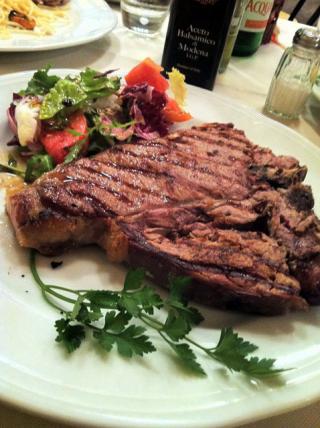
Bistecca alla fiorentina
In Florence, there’s a saying that goes,
“Mangiate i’lesso. Fa bene al sesso.” Loosely translated in English, it means, “Eat your meat and have a great sex life.” So as Florentines are known for being great meat-lovers or just plain great lovers, the Mercato offers a wide variety of meats, the most popular of which is the cut for their popular Bistecca alla Fiorentina. For this, one must get a two-inch thick T-bone steak, grill it just a little over two minutes on each side – never well done. The outside of the meat should appear well done but the inside should still be very tender, and hence, delectably juicy. When in Florence or anywhere in Italy, you’ll surely end up in a place that serves cheese. Pass up on all other cheeses except the Pecorino, made from sheep’s milk. In Mercato, you can have all sorts of Pecorino cheese: aged a month which is the softest, or the Pecorino Stagionato which is aged for a year. Then there’s the Pecorino al Tartufo which is dotted with bits of truffle. It quite approximates the vision of cheese heaven. And then there’s the hard Parmigiano-Reggiano made from cow’s milk, still preferred for finishing pastas. When getting some Parmigiano-Reggiano at a deli anywhere in the world, check the bottom of the cheese for the “engraving” or mark that says “parmigiano reggiano” so you know you’re getting the real stuff, produced in Parma and other nearby areas in Emilia-Romagna which are the only places allowed under Italian law to label their cheese as such. But of course, they only sell this kind at the Mercato Centrale, so no worries about that.
Salami toscano, prosciutto and hams of all kinds are also widely available at the Mercato Centrale where Florentines stock up on these, their staples, every single week. As if the selection of meats and hams are not overwhelming enough, brace yourself for the wide variety of balsamic vinegars and olive oils to choose from. There are balsamic vinegars of all ages, from as short as one year to as long as 25 years and beyond. Like wine, the older the
Aceto Balsamico is, the better and more expensive it becomes. And just like wine, A
ceto Balsamico is also made from pressed grapes, which are boiled then fermented, in a slow-aging process inside different types of wooden barrels where they become oxygenated. The reduction is transferred from one type of wooden barrel to another which enhances the flavors of the fermented grapes as they become more concentrated, more complex, and thicker as a result. Hence, the older the vinegar is, the glossier and more syrup-like it is.
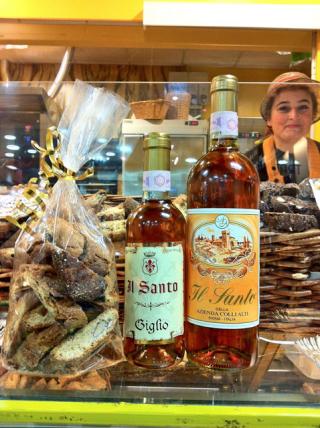
Cantuccini and Vin Santo
Chefs and gourmets go to the Mercato for the
Aceto Balsamico Tradizionale di Modena, aged 12 years and more, which is authentic balsamico and great when drizzled on cheeses, steaks and grilled fish, and on strawberries and pears. The non-traditional or commercial grade balsamico, which does not bear the word “tradizionale” on the label, is used for marinating meats and dressing salads. As olives grow widely in this part of the world, there is no better place to get a good bottle of olive oil than here. At the Mercato Centrale, you can snag a good bottle of extra virgin oiive oil, cold-pressed or from the first press of olives. While you’re getting bottles of balsamic vinegar and olive oil, stock up on some fig jam, honey with truffle, or red pepper jelly to go with your cheeses. Of course, there are rows and rows of fresh fruits and vegetables, all colorful and looking amazing as they grew on soil bathed under the Tuscan sun. The tomatoes here look red and ripe and oh, so sweet. Another touristy thing to do here is to grab some dried porcini mushrooms which they can vacuum pack so they’d fit nicely in your overstuffed luggage as you go back home with your haul of gourmet foods. Lastly, while here it pays to stop by a pastry store or one selling some
cantuccini or almond biscotti. These hard, crunchy cookies are a perfect way to end a Tuscan meal but not in themselves. They are dunked in a glass of sweet dessert wine or
Vin Santo, called “holy wine” as they were previously used in Mass and to help heal the sick. Dunking or dipping some
cantuccini in some
Vin Santo softens the cookies and gives it a sweet, cool and heady taste.
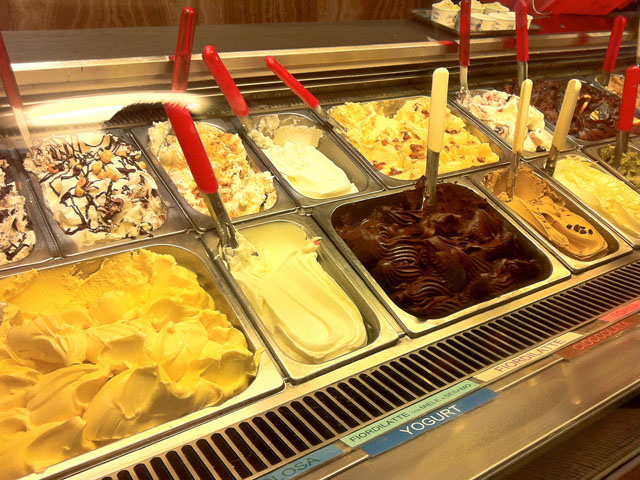
Gelato at Perche No!
Stepping out of the Mercato Centrale, near the stalls selling Italian leather goods, one can round up a great foodie experience by stopping by a wine store for a bottle of good prosecco. Then cap your day with a
gelato at
Perche No! (Italian for “why not?”), a historic ice cream store that has been making artisanal gelato from organic ingredients since 1939. And while there, do as the Italians do and stop at a coffee shop for a cup macchiato, cappuccino or maruchino (mocha). Indeed, the Mercato Centrale in Florence is a foodie’s Disneyland. It’s a happy place for food lovers, whether to eat or simply to gawk at the finest food products and ingredients that have placed Tuscan cuisine at the top of the world’s best. Now that we have a glimpse of the real Mercato Centrale, and while we have our own versions of food markets in every poblacion and in the cities, there, too, is hope that maybe one day we will achieve the same standards that the Florentines have in food production and quality. In turn, this will push Filipino cuisine forward in a similar fashion by showcasing the very best that we have to offer to the rest of the world.
--KDM, GMA News 

 GMA Brandtalk
 Tracking
 Archives


