The heady aroma of herbs and spices filled the air, and the bright paper parasols on the wall were a prelude to the colorful spread at the "Tastes of Thailand" food festival at Mandarin Oriental Manila's Paseo Uno. At the end of the buffet table was a large bowl of Phad Thai Goong, surrounded by small cups of ground peanuts, chili powder, and lime wedges. Resisting the temptation to begin with the stir-fried noodles, my husband and I decided to try a bowl of Tom Yaam Goong.
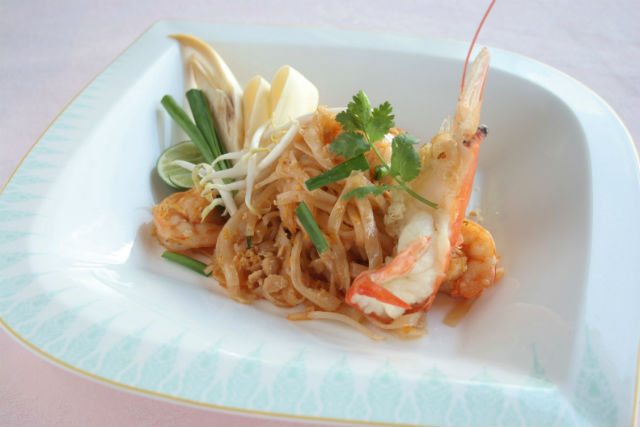
Phad Thai Goong - Stir-fried Thai style noodle with prawns and condiments Photo from Mandarin Oriental, Manila
Asked if we wanted it spicy, he said, "just a little bit," while I said, "yes." My grandparents were from Bicol, and while I didn't learn the language, I did learn to like spicy food. Back at the table, we had very different experiences of the soup. He smiled after each spoonful, saying the soup was pleasantly sour, with hints of sweetness. Meanwhile, I tried to put my finger on where the spiciness was. I could taste lemongrass, and I could tell the prawns were tender, but my lips burned. "Ang challenge dito, kung paano mo pipigilan 'yung pagtulo ng sipon," my husband said, and gave me a glass of sugarcane juice. After the soup, we were ready to try some of the main courses. The Pla Thod Khamin Naam Pla Waan (fried dish with sweet salty tamarind sauce) reminded us of bagoong, and the curry leaves were slightly sweet, like crunchy candy. At the table, the stir-fried soft shell crab with chili salt was a hit. "It's like fried essence of crab. It's crab, times five," my husband told me.
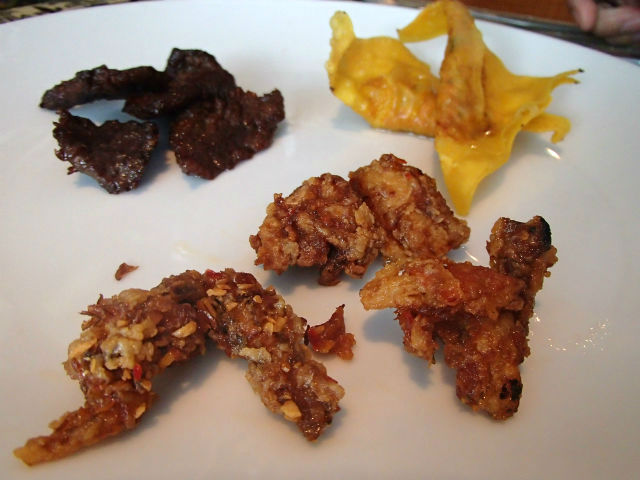
Appetizers of stir-fried soft shell crab with chili salt, fried sun-dried marinated beef served with chili sauce, and stuffed wonton Carmela Lapeña
Spa food The only vegetarian-friendly dishes were the Som Tam Polamai (spicy assorted fruit salad) and the Khow Phad Phag (fried rice with mixed vegetables). But even the dishes with meat and seafood were prepared with health in mind. The Phad Makjuea Yow Goong Sub (long eggplant with minced shrimp, garlic, chili garlic and Thai basil) wasn't too oily, as it was stir-fried in a wok. Later, Chef Sumet Sumpachanyanont explained that this was due to Chinese influence in Thai cooking. "But we don't use that much oil. This is a concern for healthy cuisine," said Chef Sumet, who is Mandarin Oriental, Bangkok's Thay Executive Sous Chef and Consultant. Meanwhile, my husband tried the Gai Ob Khamin (oven baked chicken marinated in yellow turmeric), which he said was not dry, even if only white meat was used. The chef explained that this was "spa food," which is made for health-conscious diners. "It's light for your body. We calculate the fat and also how much energy you have to get per meal," he said. The recipe calls for a simple marinade of yogurt, yellow turmeric, a bit of salt, coriander root, and garlic. Coriander was also used in the Nuea Dad Deow appetizer of fried sun-dried marinated beef served with chili sauce. This time, only the seed was used.
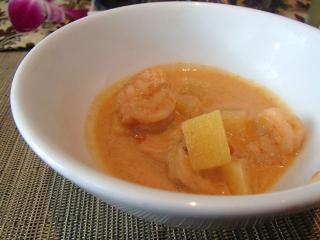
The Gaeng Kya Sapparos Goong (pineapple curry with prawns) had a hint of spice, but the strong flavors were subdued by the creamy coconut milk. Carmela Lapeña
"We roast them and ground them," Chef Sumet explained, adding that before the beef is fried, it has to be smashed in order to make it tender. The beef goes with a chili dip, which was sour, salty, and spicy at the same time. The chef explained that combination is important in Thai cuisine. "If something is spicy, we have to try to tone it down," he said. For instance, the Gaeng Kya Sapparos Goong (pineapple curry with prawns) had a hint of spice, but the strong flavors were subdued by the creamy coconut milk. The Yaam Mamuang Nuea Poo (spicy mango salad with crab meat) was a refreshing dish to eat in between main courses, according to my husband. "Parang atsara na luluwag ulit 'yung tiyan mo," he said. After the salad, he went back for more of the beef, which was his favorite. "Parang lahat ng parts ng dila mo gumagana. Ang daming lasa, parang sumasabog," he said.
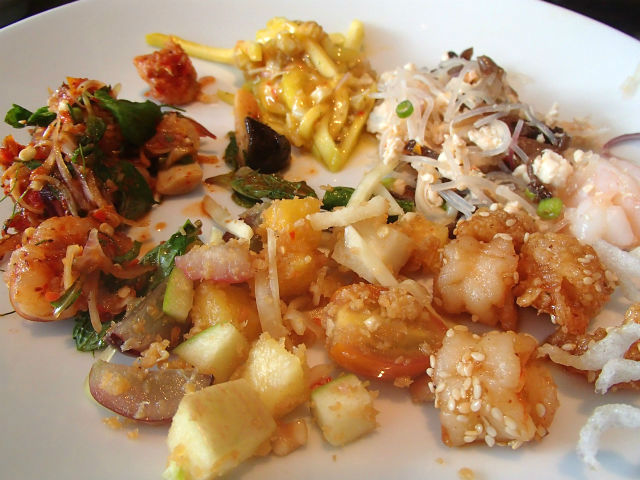
An assortment of salad dishes, including Som Tam Polamai (spicy assorted fruit salad) and Yaam Mamuang Nuea Poo (spicy mango salad with crab meat) Carmela Lapeña
Sugar and spice While tasting the different dishes, I thought that there must be an entire alphabet of spices in Thai cuisine. There was a spiciness that went straight to the nose, and there was one that settled in the throat. There was spice that made your lips burn, and spice that brought tears to your eyes. Chef Sumet said a lot of herbs are used in Thai cuisine. "The chili makes spiciness, and we use fresh and dry. It depends on the type of the dish," he said. The green curry, for example, is made using bird's eye chili. "We use the tiny one. The smallest is more spicy than the bigger ones," he said.
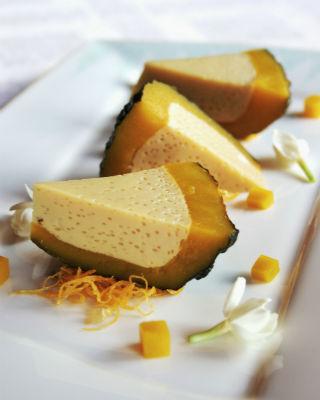
Sang Khaya Fugthong - Steamed pumpkin egg custard Photo from Mandarin Oriental, Manila
I ended my meal with a cup of Phad Thai, sprinkled with a pinch of chili, while my husband sampled the desserts. There was Khow Niew Mamunag (coconut sticky rice with mango) and Sa Rim (chilled mung bean threads in scented coconut syrup). "Parang reward pagkatapos ng lahat ng anghang," he said as he ate Sa Rim, his favorite, because it reminded him ice scramble and halo-halo, Filipino sweets that are especially popular during the summer. The chef explained how Sa Rim gets its unusual flavor. "The coconut milk is very special because after we mix the coconut milk with the sugar, we smoke with a scented candle," he said. For dessert, there was also Khanom Khow Phod (sweet steamed corn puddings), Khanom Pang Nueng Sangkhaya (steamed bread with pandanus egg custard), and Khanom Krok (coconut rice puddings). In the past, only three major ingredients were used in Thai dessert: coconut milk, sugar, and flour. But when the Portuguese arrived in Ayutthaya, their influence spread to Thai cuisine, the chef said. "You can see some Thai desserts like egg yolk cooked in heavy syrup, that's exactly because of the influence of Portuguese," he said. The chef said that he likes to mix things up for some dishes, but keeps the others authentic and traditional. "This is good for people so they can enjoy different types. I would like to make new things, but some I keep because these are the favorites," he said.
—KG, GMA News "Tastes of Thailand" is at Paseo Uno in Mandarin Oriental, Manila from March 4 to 10. The buffet is P1,990+ while the Luxury buffet, available for dinner on Fridays and Saturdays, is P2,450+. For reservations and more information, call Paseo Uno at (02) 7508888 ext 2411 or email momnl-paseouno@mohg.com. 

 GMA Brandtalk
 Tracking
 Archives


