

 GMA Brandtalk
 Tracking
 Archives

ADVERTISEMENT
Filtered By: Lifestyle
Lifestyle
'Real' food taken up notches at Solaire
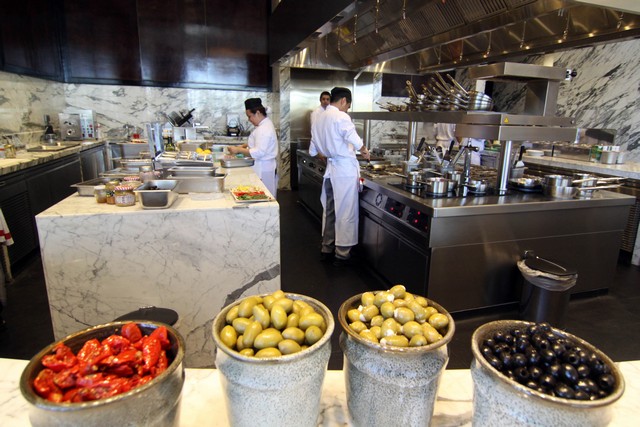
Filipino staff preparing food at a live-cooking station in Fresh. Solaire employs 4,600 full-time staff, of which over 400 are former overseas Filipino workers from first-class casinos the world over. Photos by Danny Pata
Authentic world cuisine is not the norm in the Manila restaurant scene, with many establishments going for fusion cuisine—their own take on a culture's culinary treat.
The integrated casino of businessman Enrique Razon, however, aims to plant seeds of what it calls true world cuisine taken up notches, in its signature restaurants and buffet.
“We aim to provide dining experience that is second to none,” Wolfgang Fischer, culinary director of the recently unveiled Solaire Resort & Casino, told the local press days before the resort-casino’s opening.
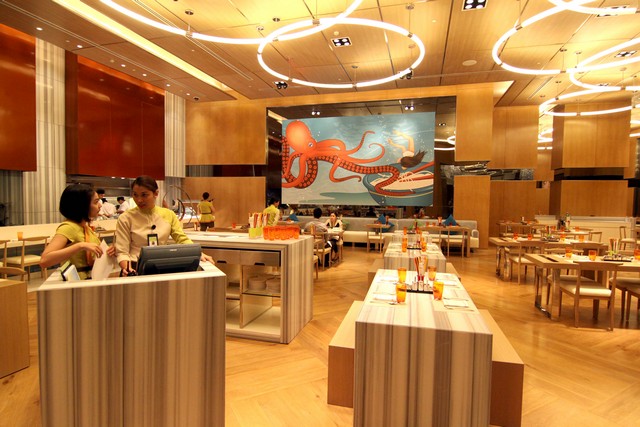
Asian cuisine restaurant Lucky Noodles boasts a modern design as it promises to serve authentic Asian dishes. The interiors of Solaire are designed by world-renowned casino and entertainment architect Paul Steelman.
Promising nothing but an upscale authentic dining experience for casino high-rollers, Fischer said, “We have a quality first approach, staying true to our tagline ‘The Game Changer.’”
In its international buffet, Fresh, for instance, online journalists and bloggers feasted on an array of cuisine served right off seven live cooking stations.
While my colleagues trooped to the Korean and Chinese food stations to get some dumplings and kimchi, I lurked around and got to chat with Fresh’s Chef de Cuisine Sascha Gausselmann at the buffet’s carvery—a favorite station of meat lovers like me.
“What we are presenting here is well thought of and a product of long discussions—the type of food and ingredients here,” Gausselmann said.
Asked whose idea it was to have cooking stations of different world cuisines, he said, “That’s the layout Mr. Razon wanted to have—carvery, Italian, cold cuts, Korean, Japanese, Chinese, et cetera. Simple.”
“Just like the layout, food here is simple. We stick to the classic, the basic,” Gausselmann said as he guided a staff in putting a newly sliced strip of meat from an eight-rib slab onto my plate.
Back at my table, I indulged in the medium-cooked beef, as flavors of herbs and oil played tug of war in my mouth. “This is exactly how I want meat to taste,” I remembered telling my colleagues.
That line went on repeat, as my colleagues and I ate our lunch. A co-reporter gladly shared how “really awesome” her plate of cold cuts and cheeses were, while another gorged on Fresh’s take on chicken inasal.
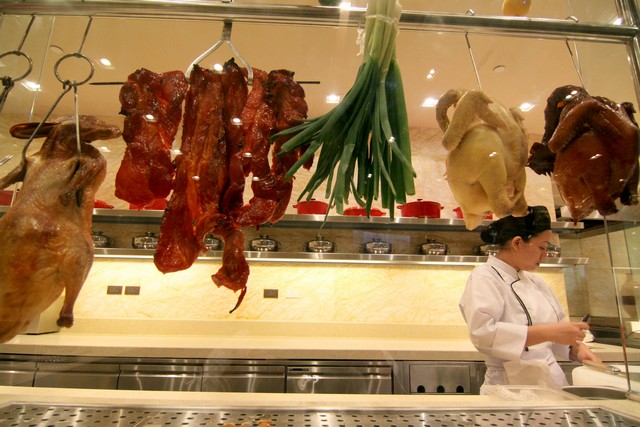
Ingredients are on display in a food station in Solaire's buffet dubbed Fresh. The resort-casino prides itself in having fresh ingredients, some of which are flown in from Tokyo markets and slaughterhouses in the US and Canada thrice a week
Although all of us had our own preference on cuisine—one egging everyone to get some Japanese, others Korean, and I staying true to my love for carvery, we all agreed that Fresh’s thin-crust-and-cheese-melt-on-top pizzas were a must-have.
For dessert, we all went for Fresh’s own gelato. The pistachio and banana caramel gelato, which the staff gave me when I asked for a scoop each of her two favorites, had the right mix of lightness and sweetness with the dairy not overpowering the gelato flavor.
“Except for the ice cream, nothing here is frozen, just chilled,” Fischer quipped in a press round table after lunch. “If it’s something that needs to be kept frozen, we don’t have it here, sorry.”
“Aside from being fresh, you're also going to find ingredients that you wouldn't find anywhere here in Manila,” Fischer noted, referring to selections in Solaire’s other food outlets.
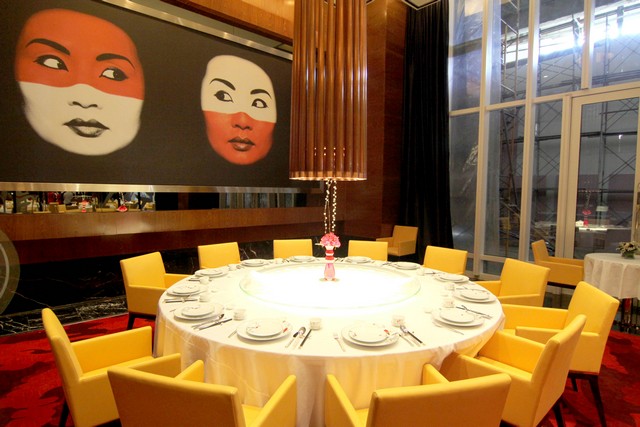
Works by Filipino artists—like this red, white and black painting in Chinese cuisine restaurant Red Lantern—are hung on walls in Solaire.
For example, 95 percent of the ingredients for Solaire’s signature Japanese restaurant, Yakumi, are flown in from nowhere else but Tokyo’s Tsukiji market.
“The chef goes there, the market in Japan, to buy fish, ingredients three times a week,” Fischer said.
A diner can also pick from a large selection of sake managed by a sommelier to complement raw fish and skewers from Yakumi’s sushi and robatayaki counters.
Sommeliers were also brought in to steward a fine selection of wines and aid in wine and food pairing for customers of the resort-casino’s other signature restaurants.
Solaire’s Italian cuisine restaurant, Finestra, will showcase classic Italian pasta and pizza made of ingredients imported from Italy.
Meanwhile, the classic steakhouse Strip serves prime cut meats directly commissioned from slaughterhouses in the US, Australia, and Europe.
Cantonese cuisine and Asian selections—like dumplings, rice dishes, noodles and soups— are also featured at the Red Lantern and Lucky Noodles restaurants.
And if good food were not enough, Solaire’s buffet and signature restaurants are nestled in the architectural work of renowned US-based Paul Steelman, with curved glass chandeliers sprung from high ceilings, luxury furniture adorning every nook, and a kaleidoscope of artwork by Filipinos hung on every wall.
“The vision was to create the ultimate gaming experience. We needed to tap a good, high-end market, so the food and beverage, and even the ambiance, just follow suit,” said Karsten Roettger, director for food and beverage at Solaire.
With the scenic Manila Bay serving as its backdrop, Solaire is out to draw gamers and diners alike and let “real” world cuisine grow into full bloom here in the metro. —KG, GMA News
Solaire Resort and Casino is at the Entertainment City, Aseana Avenue, Parañaque City. For details, visit solaireresort.com or call +632-888-8888.

