

 GMA Brandtalk
 Tracking
 Archives

ADVERTISEMENT
Filtered By: Lifestyle
Lifestyle
Portuguese on a plate at O'sonho
I’m happy that my adventurous palate takes me around the world. I recently revisited Portugal via O’sonho (oh-son-nyo), a fusion restobar at the heart of the metro.
Many Filipinos are not familiar with Portuguese cuisine, but know the more common—and similar—Spanish cuisine. What differentiates Portuguese from Spanish cuisine is basically the spices used in cooking. You'd know it once you get a taste of it.
Upon entering the restaurant, I felt at ease with the spacious interiors and comfortable seats. The décor had splashes of gray, yellow, and orange. One wall even had a mural artwork of the map of Portugal and a ship, to boot.
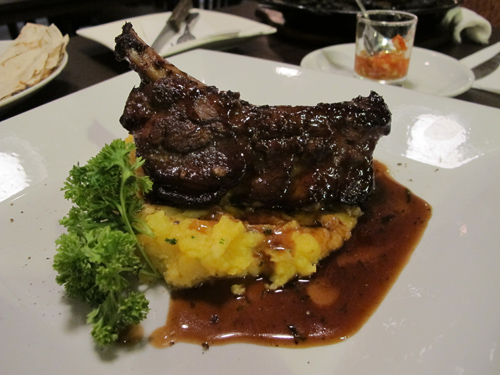
The coffee-marinated roast pork is served on a bed of herb-whipped potatoes.
The restaurant’s hanging lights provided dramatic atmosphere and added to the warm ambience. It got me in the mood to eat.
Portugal via peri peri
Along with my husband, who likes trying new things as well, I indulged in a feast of Portuguese flavors. To whet our tastes, we ordered an appetizer called Portuguese Chourico (P260 solo, P440 for sharing), a staple food and a popular sausage in Portugal.
The sausage had a particular blend of spices that gave it a piquant taste. O’sonho makes their sausages from scratch, and it is cooked in olive oil and served with toasted pita bread. We devoured it down to the last morsel—even the bits of sausage left in the crimson colored oil was tasty. We were definitely off to a good start.
Of course we had to order Bacalhau de O'sonho (P380), a famous Portuguese dish. A fish dish made with dried salt cod, it's stewed with carrots and olives and served with pita bread. Despite the main ingredient, it was not at all too salty. The seasoning was just right and it went well with the pita, as it counteracted the strong flavor.
We also sampled the Peri Peri Chicken Pasta (P310 solo; P880 family), their flagship dish. Peri peri (or piri piri) is a common condiment in Portugal. The sauce is basically made with bird’s eye chili, olive oil, and other seasonings.
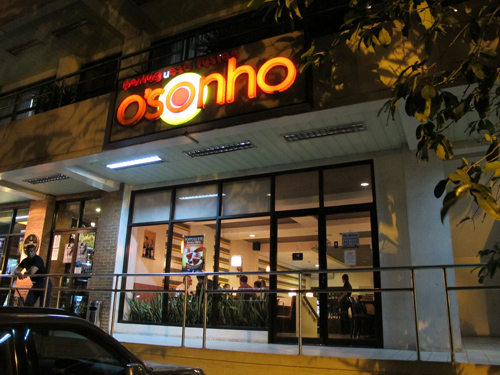
O'sonho is a Portuguese fusion restobar. It means "the dream."
The sauce can be added to any dish, depending on the diner’s preference. We were given a separate serving of peri peri sauce, but I though this pasta dish didn’t need more because it was hot enough. The linguine noodles were cooked in pesto with had pieces of sun-dried tomatoes in them, and slices of spicy chicken sat on top.
It was the first time I had spicy pesto, and I enjoyed it.
Sangria is a must
In the course of the meal, we sipped our Sangria (P190 glass; P580 carafe), which is made with Portuguese port wine and fresh fruits. It is a bit sweet but it packs a punch. I could feel the alcohol kick in by the middle part of dinner. The sangria is served in a big glass of wine, which lasted me throughout the meal.
While there, we had a chance to meet and chat with O’sonho’s Director for Marketing, Cris Barancik, whose husband is the owner of the restaurant. We were curious as to why they decided to bring Portuguese cuisine to Manila.
“More than anything, it was really because of the love of food and the love of the rich flavors and spices of Portuguese cuisine that O’sonho was born,” she shared. “O’sonho means 'the dream' in Portuguese, after all.”
Both husband and wife are foodies. With O’sonho on its fifth year, Barancik revealed that the secret to their success is, “Definitely passion. Each and every dish undergoes rigorous testing before it’s ready to be included in the menu. There’s a lot of research, testing, love and time that goes into every dish.”
Coffee on meat
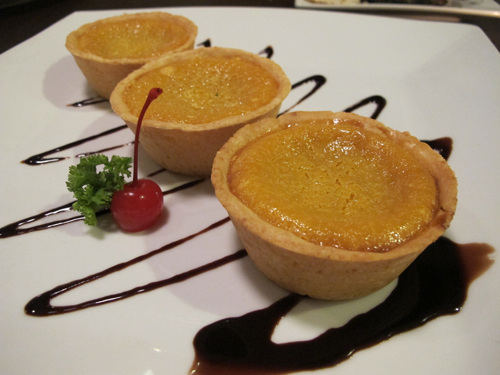
Custard Tarts or "Pasteis de Nata" (P130) are Portuguese egg custard pies; a creamy filling encased in flaky and buttery dough.
My husband and I weren’t done with dinner so we sampled some new dishes such as the Coffee Marinated Roast Pork (P490). The meat is marinated in coffee and served on a bed of herb-whipped potatoes.
The meat had a slightly bitter taste from the coffee but it gave the dish another dimension of flavor. The slow roasted meat was so tender that I could even cut it with an ordinary table knife. It’s a very filling dish so it's best to order ahead. According to the menu, slow roasting it would take 20 to 25 minutes.
Another must-try is the Black Paella (P480, good for two), which is actually my favorite kind of paella. The rice is cooked in squid ink—thus the dark color—and topped with different seafood, bell peppers, and boiled egg. A squeeze of lemon gives it some zing. It is not a dish to order during a first date though. You’ll know why when you smile after taking a bite.
We were already full but we couldn’t leave the restaurant without trying the Custard Tarts or Pasteis de Nata (P130). These egg custard pies are a Portuguese bestseller. The rich and creamy filling is encased in a flaky and buttery dough, which is not overly sweet at all.
I liked the smooth texture of the tart, and apparently, my husband did, too. He’s not really a dessert person but he practically devoured a whole serving.
As we attempted to finish all the tarts and our sangria, we saw a big group of diners who looked like office workers on the other table.
We found out that a lot of yuppies from nearby offices are the usual clientele of the restaurant. Sometimes, a company would close down the place, as O’sonho also accommodates private functions and catering. The only challenge for big groups would be parking but it would be worth it because of the quality of the food. – KDM, GMA News
O’sonho Portuguese Fusion Restobar is at 20 Jupiter St., Bel-Air, Makati City.

