

 GMA Brandtalk
 Tracking
 Archives

ADVERTISEMENT
Filtered By: Lifestyle
Lifestyle
Molecular mixology: Where food and science collide
Ever seen a liquid chef in action before?
He plays around with the physical traits of the food and beverage while not disrupting its flavor in a show that closely resembles a scientist experimenting in a laboratory.
Syringes, transparent tubes, pots, pans, all sorts of measuring devices, and of course, ingredients of vibrant colors and tastes were at the kitchen-slash-laboratory.
Neil Ocampo, Chief Liquid Chef of Stellar Bar at 1-Altitude in Singapore, showed how the magic was done to chefs, bartenders, and enthusiasts alike at the N20 Gastropub in a workshop titled Mixology Goes Molecular.
All these tricks are possible with the help of a little chemistry.
Molecular gastronomy
For his first trick, Neil brings out a big bowl filled with water and adds four grams of Algin—a natural product extracted from brown algea that grows in cold-water regions of Ireland, Scotland, and North and South America among others.
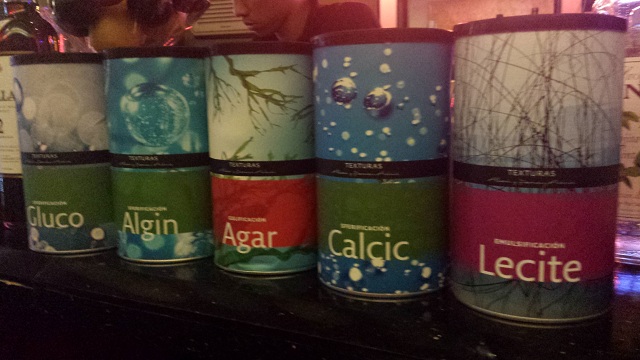
Some of the chemicals used in molecular mixology. Kim Luces
Then he brings out a smaller bowl with strawberry puree, which he then mixes with a few grams of Gluco or calcium gluconolacteta, a mixture of two calcium salts. He takes a syringe and deftly puts in a few drops of Gluco-infused puree into the bath of Algin water.
A few minutes later, he scoops up the puree from the Algin bath, where bubbles of liquid are now trapped in a gelatinous membrane.
This is a result of what is called reverse spherification. The Algin reacts with the Gluco and forms the gelatinous membrane that traps the liquid inside a bubble.
The liquid chef brings out shots of rum with bubbles of strawberry puree. As you take a shot, you first taste the alcoholic tang until the bubbles pop in your mouth, releasing the sweet, strawberry flavor. The same effect is produced by spherification but, instead, a liquid infused with Algin is put in a bath of Calcic.
Next, he turns rum and Coke into jelly spaghetti strings using a syringe and a transparent tube.
He gradually boils the rum and Coke mix with agar in a pan. This is a gelling agent and then, using a syringe, he injects the liquid into a long, transparent tube and drops it into a bowl of ice-cold water. A few minutes later, he injects air into the tube using the syringe once again, to bring out the now jellified rum and Coke string.
By adding some modified chemicals to the food, and making them react together, the physical traits of the food changes and allows such things to happen.
Algin, for instance, reacts with Gluco or Calcic to produce a gelatinous membrane that keeps the liquid inside trapped in a bubble.
Agar, on the other hand, speeds up the gelatinization of liquid in order to form jello.
Flashy and delicious
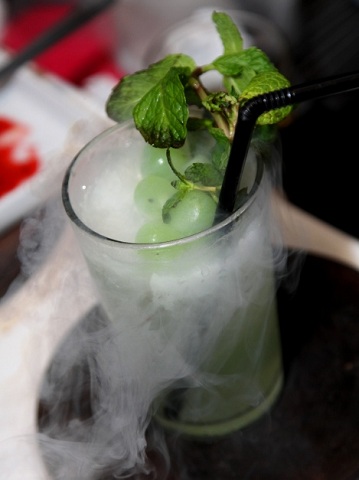
A mojito with kiwi spheres. The spheres are made by dropping kiwi puree into liquid nitrogen. Photo courtesy of Neil Ocampo
It’s not as easy as it looks. Ocampo had to study the concepts of molecular gastronomy in order to use them to invent new beverages and new presentations for dishes. He trained directly under Molecular Gastronomy proponent Chef Ferran Adria from Spain of the elBulli restaurant, during one of his workshops in Singapore.
“I grabbed a book, studied every single day, and practiced,” Ocampo said. “You can’t just snap your fingers and you’ll be able to do every single [trick] because you’re dealing with chemicals.”
During the Molecular Mixology workshop, Ocampo had to repeat the tricks once or twice before he achieved the right effect.
“The [water’s] alkaline level is too high,” he said, when the first batch of strawberry puree bubbles did not work. He had to adjust the measurement of Algin and Gluco before the bubbles were able to form.
“It’s too precise, doing this kind of thing,” he said. “Everything has to be measured, unlike when you work in a hot kitchen where you can just throw the salt [into the dish] and that’s it.”
The main philosophy of molecular gastronomy, Ocampo said, is having customers experience food differently.
“Usually, when you go to a restaurant, you just want to have a great meal. That’s it,” he said. “You can do that anywhere else. For us, it’s all about experience. That [when] you come to our restaurant, we give you something you haven’t had before—something that you haven’t seen, tried, or experienced before.” —KDM, GMA News

