

 GMA Brandtalk
 Tracking
 Archives

From baguette to gaufres: Food trippin’ in Paris
There are six things you must eat in France, said my nephew in an email: baguette, croissant, croque-monsieur, crepe, bouillabaisse, and gaufres. “You have to try it all!” he said, adding that he got it from an article on the Web.
I've tried all five here in Manila, but gaufres? What are gaufres?
It turns out the gaufre is the French version of the Belgian waffle, and while I've had the latter one several times (the latest at a Starbucks in Makati where I had the barista take out the overflowing whipped cream on top), I'm in on any plan to partake of the French version. In fact, I was more than ready to eat real French food in Paris, the City of Light, on my dream vacation!
And so, like Vogue food critic Jeffrey Steingarten, “Iron Chef” judge and author of “The Man Who Ate Everything” and “It Must've Been Something I Ate,” I hit the ground running. Upon landing in Paris, he picked up 15 croissants or 20 kilos of pain de campagne (country bread), armed with a map and a friendly airport taxi driver.
The French baguette
Within two hours of landing in Paris, I was at Franck Perotti Artisan Boulangerie, a few steps away from Hotel Elysées Flaubert, our hotel for the night, for some true French baguette.
In his book, Steingarten enumerated the following qualities of a true French baguette: thin, 24-28 inches long, slightly flattened, weighing 9-10 ounces, with 5-7 oblique sashes on top, toasty crust, and creamy white insides with holes that may be as large as olives.
We began attacking the freshly baked baguette as we walked toward the Arc de Triomphe. Even without butter or cheese to go with it, it tasted soooo good: the crust was indeed toasty, the inside (with bubbles) had just a hint of sweetness. For 0.90 euros, this was a really good deal!
For the rest of our weeklong stay, we were able to sample other baguettes, but nothing came close to this artisanal one from our first day. Steingarten said he hasn't tasted an American baguette that comes close to the French paragon—maybe due to the difference between French and American flours—and it's not difficult to believe him.
Paris hands out an annual award to the best baguette in the city. If what I had was so good, then those on the list of winners must be even better.
Croissant and croque-madame
The French have been eating and making croissants since the Middle Ages; though every continental breakfast elsewhere in the world includes it, one must not miss ordering it in Paris, where they hold an annual contest for the best croissant.
We had some of these pastries at the hotel breakfast buffet, but the more interesting ones were found at Le Petit Pont near Notre Dame Cathedral and even food bar Monop'Daily at the Orly Airport. Go for the full experience of sitting down while sipping un café and breaking the soft, warm, flaky, buttery croissant while watching the world go by. No stale croissants sitting on shelves here. A croissant and coffee set (don't call it value meal, though) costs around 4 euros.
At Le Petit Pont—a charming café awash in yellow, with heaters in its outdoor area to combat the winter cold—we also had croque-madame, which is croque-monsieur with a fried, sunny-side egg on top. A ham and grilled cheese sandwich drizzled with bechamel sauce (cheese may be Emmental or Gruyere). It's certainly filling especially if you're going to the museums and other points of interest in the area.
Crepes and gaufres
Paris was among the world's top 10 street-food cities last year for its crepes and other food items.
Crêperie kiosks indeed abound, especially around iconic Parisian landmarks. Three such kiosks can be found just across the Eiffel Tower, by the Seine River, and two at Champ de Mars—that stretch of garden offering the best view of the tower. We found here Pavillon Breton, which serves big, freshly made crepes for upwards of 2.50 euros.
I shared a Nutella and banana crepe with my sister-in-law—delicious, especially after watching how it was made. In five minutes, the lady poured a sandok of batter on the crepe pan; just a few seconds later, the batter resembled a very thin pancake. She sliced two bananas, laid them on the crepe, added sugar and Nutella, and flipped the crepe this way and that to create a cone shape, then wrapped it in wax paper.
Meanwhile, my sister had a crepe with marron or chestnut sauce. Though it was unfamiliar, it was delicious.
A few days later, we were at Jardin des Tuileries—once the garden of French royalty—near the Louvre Museum and Musée de l'Orangerie. There was a crêperie right by the gate, flanked by a stall for hot wine and another stall for gaufres and coffee.
We lined up for gaufres and said “marron”; soon, we were served freshly made waffle with chestnut sauce, a perfect accompaniment to our espressos. This is how I want my waffle—not smothered in sweet whipped cream, but with just the right amount of sauce to give it flavor. A gaufre and espresso cost about 5 euros.
No bouillabaise

Since the dish called for shellfish, I resigned myself to not having it lest my allergy act up. To make up for this, I turned to other typically French foods and did not regret it.
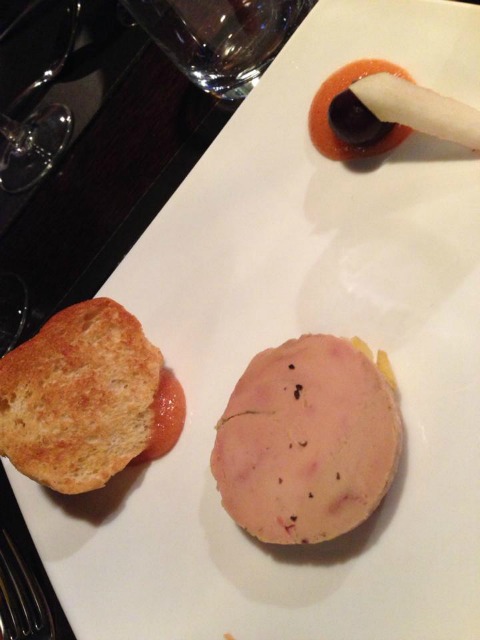
At 58 Tour Eiffel at Eiffel Tower, there was melt-in-your-mouth foie gras on the menu, the kind that makes you forget your name. I also had a bowl of cream of chestnut soup with mushroom duxelles and herb croutons—though it looked so sad and brown, it was surprisingly good. The pan-fried salmon with polenta was cooked just right, pronounced the night's winner by my family.
A dinner set menu for the first sitting at this restaurant cost about 79 euros with champagne, but with an added treat: a view of Paris at night from the second floor of the Eiffel Tower.
The escargot—snails cooked in garlic butter, parsley, and wine—were absolutely divine at Select Hausmann near Galeries Lafayette. We also had oh-so-tender beef bourguignon, which lived up to Julia Child's compliment: "certainly one of the most delicious beef dishes concocted by man." And with entrecôte (the classic French steak) and a platter of French cheese, this dinner was memorable. We ordered sorbet and dessert as well; after splitting the bill, each person's lunch cost about 24 euros.
By the banks of the Seine River, we had sausages (saucisses) cooked in a giant frying pan, which went so well with tartiflettes (sauteed Reblochon cheese, potatoes, and onions)—what I call “sosyal na torta.” Cost: 5 to 6 euros in total.
And what's a French food trip without macarons, the ideal French pastry? It was the sweetest thing in our trip, and I made sure to have some from French icon Ladurée (about 1.50 euro each) to McDonald's McCafé (0.90 euro each!). My fave is raspberry, although the pistachio is good, too.
The wonderful thing about French cuisine is that everything tastes great and inviting—except if you're not a fan of raw food. If that's the case, don't order steak tartare—raw steak topped with egg—like my nephew did. Take it from Mr. Bean, that's one dish that's difficult to swallow. — VC/JDS, GMA News

