

 GMA Brandtalk
 Tracking
 Archives

ADVERTISEMENT
Filtered By: Lifestyle
Lifestyle
Meet the hard-working female organic farmers of Sarilaya

Organic vegetables from the women farmers of Sarilaya.
Part of a series on women this month. March is Women’s Role in History Month in the Philippines.
When it comes to farming, people have the notion that everything is done by the males. In fact, a big part of the farming process is carried out by females.
For 20 years, Kasarian-Kalayaan, Inc. (Sarilaya) has been teaching women from rural communities methods in organic farming. The NGO aims to promote women empowerment and healthy living through nutrition, and has provided women with skills that help augment their family income and broaden their abilities.
Recently, Sarilaya organized Earth2Plate, a fundraiser to help the female organic farmers sustain their typhoon- and drought-stricken farms and communities. Diners were treated to a full-course dinner made of fresh, organically-grown produce. Raw veggies and fruits grown by the female organic farmers were also available in the mini-marketplace at the venue.
Former commercial farmer-turned-Sustainable Agriculture Coordinator of Sarilaya, Margie Lacanilao says that it is important for farmers to switch to organic farming because farmers must not go after quantity alone, but also the quality of their produce.
“We used to focus on profits alone, and it was enough that the produce we consume was safe,” she shares. “Farmers need to understand the effects of these chemicals on the environment and the people—this was why we went organic.”
To eat or not to eat
Most people would be surprised to know that many commercial farmers don’t consume the produce that they sell in the market.
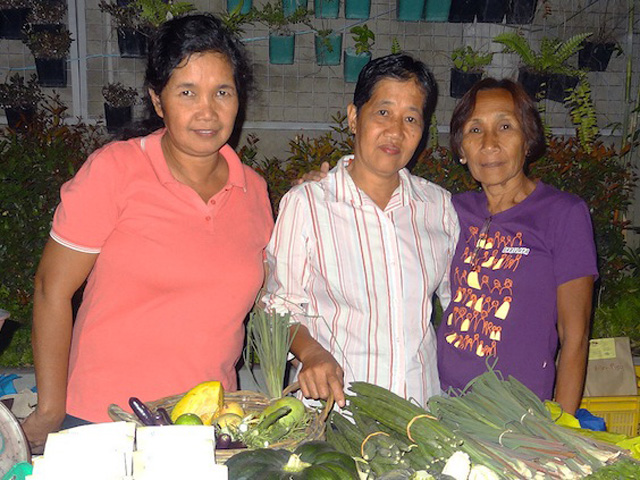
The women farmers of Sarilaya during the Earth2Plate fundraising event held at Earth Kitchen.
Lacanilao, a former commercial farmer from Nueva Ecija, shared a dark secret: “We don’t eat chemically-sprayed produce; vegetables for our family’s consumption have always been separated from the produce we bring to market. Usually the supermarkets demand smooth and perfect looking veggies and fruits, so that is what we deliver to them.”
To be able to harvest blemish-free, super-sized, brightly-colored vegetables and fruits, farmers usually need to resort to chemical-based fertilizers and pesticides. Because consumers demand such quality, the farmers are encouraged to continue using these harmful products.
Now an organic farmer, Lacanilao admits that switching to organic farming from commercial farming is very challenging to many farmers. “Plenty of farmers backslide after the first or second year, because it could take at least three years before a piece of chemical-rich land is ‘cured,’ and during that period your harvest and income will definitely suffer,” she says.
Land that has been exposed to chemicals for many years become very hard like cement. Living organisms in the soil also die, including the beneficial earthworms. It would take years for this kind of sick soil to be cured and ready for organic farming.
Aside from this, most farmers don’t adopt the process because it takes a lot of wok. Since organic farming products are not available in the market, the farmers have to make their own pesticides and sprays.
Perfect vs. Organic
Farmers themselves admit that it’s hard to tell whether an un-labeled piece of vegetable is organically-grown or not. Unless you know the farmer/producer, and unless it is labeled properly, most of the time you won’t be able to tell the difference.
Lacanilao says, “With green leafies, the presence of holes could mean it’s organically-grown; but organic leafy greens without the holes are also possible!” And when eaten, the texture of organic produce is soft and its taste sweetish. If it’s too big or too perfect, then it may not be organic.
There is only one way to be absolutely certain, says Lacanilao: “Plant it yourself!”
Monina Geaga, Secretary General of Sarilaya, stressed that organic produce will become more affordable for everyone IF all of us would grow our own food.
“Increase the supply and prices will go down—law of supply and demand,” Geaga said. She adds that it only seems difficult but is actually easy to maintain small plots at home. “Start with crops that grow easily like camote and other rootcrops, okra—which is good for hyperacidity—tomatoes, some herbs,” she said.
Finally, Sarilaya encourages consumers to buy directly from the farmers. According to Geaga, “Produce in the supermarket is more expensive because there is additional cost for packaging; support our local farmers.”
In the metro, she cited PRRM, Trimona, and the Sunday markets (Salcedo, Centris) as venues where one can buy organic produce directly from the farmers who grew them. — VC, GMA News

