

 GMA Brandtalk
 Tracking
 Archives

ADVERTISEMENT
Filtered By: Lifestyle
Lifestyle
When fear becomes phobia
Fear is normal. In fact, it can even be good. Fear is what prompts you to be careful, and it helps you avoid danger.
But when fear prevents you from living your life, you may need to seek help. In extreme cases of animal phobia, the fear is so intense that people become paralyzed.
In Animal Planet's "My Extreme Animal Phobia," single mother Jahara keeps her windows shut and her air conditioner off, because she fears spiders or bugs might enter her home. Tough guy Marvin can't enjoy the outdoors with his kids, no thanks to his terror of pit bulls, and San Francisco musician Seth is utterly afraid of snakes.
While some fears are more common than others, like fear of snakes and spiders, others are a bit stranger.
Twenty-two-year-old Jackie has no problems running outdoors, despite the risk of running into wild coyotes. On the other hand, she considers butterflies to be her archenemy.
For persons with a phobia, it doesn't matter what the object of fear is—the stress it causes is definitely crippling, said Dr. Robin Zasio, a US-based clinical psychologist and phobia expert, in a phone interview with Manila reporters on Feb. 1 about her work on "My Extreme Animal Phobia."
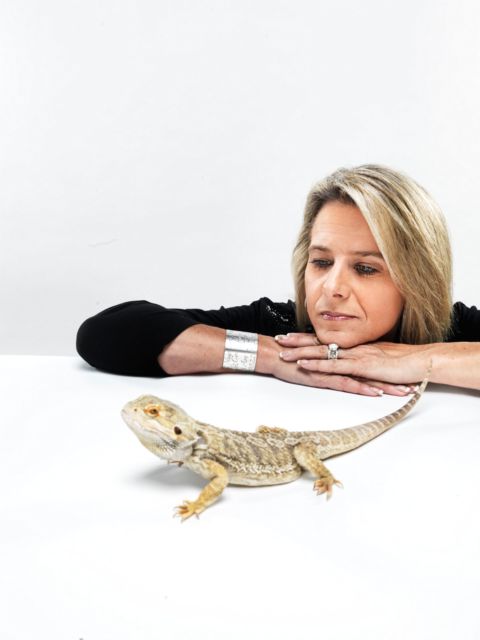
Clinical psychologist and phobia expert Robin Zasio helps people with phobias through exposure therapy. Photo courtesy of Animal Planet
"When you have a phobia, you’re talking about a level of anxiety that is so powerful that it begins to interfere with your life; and it actually begins to control where you go and what you do and then it begins to affect the people that you love, too, because they become limited as well," explained Zasio, who works with people to help them overcome their phobias through exposure therapy.
What Zasio does at the Anxiety Treatment Center of Sacramento is address the phobia through a behavioral treatment, which is designed to have people confront their fears in a very systematic and controlled manner.
"By going into that situation repeatedly, the brain stops sending that fear signal because it’s become desensitized to that environment," said Zasio.
While the success rate of exposure therapy depends on various factors, Zasio said that motivation is a big factor.
Asked if all phobias can be cured, Zasio said it's a Catch-22.
"Somebody has to be very motivated to do the therapy, so I think it’s more dependent on two factors. One is you have to really be able to read your client and know how far to push them at any given moment. And two, if they’re motivated and they really want to overcome it, then as long as you have an expert therapist who knows how to do the treatment, they can be cured. But again, there are individual differences that we always have to take into consideration," she said.
Exposure therapy
In the first episode of “My Extreme Animal Phobia,” Marvin's fear of pit bulls was significantly reduced.
"Marvin is doing amazing. I wouldn’t say he has a fear of pit bulls; he just has an awareness of them. But if he's walking down a sidewalk or down the street or he's in a park, he will not avoid them," said Zasio, adding that after exposure therapy, there is a need for relapse prevention. People are encouraged to continue to come in contact with their feared animal, to remind the part of the brain that signals danger that there's still no danger.
"For some they have to kind of keep it up for some time until it just doesn’t bother them anymore, and for others once they overcome it, it’s just done," said Zasio, adding that after exposure therapy, Jackie could walk freely without giving it a second thought if she sees something fluttering or flying.

With exposure therapy, people can eventually come into contact with the animals they fear. Photo courtesy of Animal Planet
Under exposure therapy, a hierarchy is developed by listing triggers associated with the fear itself. For instance, if someone is afraid of dogs, the hierarchy could include a puppy, tail, bark, growl, claw, and attack. These are rated according to fear levels on a scale of zero to ten.
"What we do is we rate those words and those pictures on that scale of zero to ten and then we have them literally sit and look at those words until their anxiety level goes to a zero. That’s what we call the desensitization, meaning they’ve had so much contact with it, that it no longer bothers them and then they can move on to the next word," explained Zasio.
After words, there are pictures, sounds, and videos before actually coming close to the animal and eventually coming in direct contact with the animal.
Zasio emphasizes that it's very important to conduct exposure therapy in a controlled environment. At the same time, it is possible for someone to undergo treatment at home.
"If they can just start with those words and do them in their home and then work their way up, certainly it’s quite possible that they could overcome their animal phobia," said Zasio.
“My Extreme Animal Phobia” specifically targets those with phobias, and Zasio said it can also help others who have been suffering in silence.
"I think that a lot of people are living in silence because they’re embarrassed. They’re ashamed to be afraid of a cat or a dog, a fish, and this sounds so silly, especially because how often do you come in contact with fish unless you’re in the water," said Zasio, noting that estimates of those with animal phobias range from 3 percent to 28 of the population.
"I think that some of the objectives are to really show the condition as to how real it is and how very high functioning people can have great fears and it can really impact their life. I think the show really illustrates that on continuum of just all these humans that no matter what our functioning level is, is that we can have fear and that it can be overcome," said Zasio. –KG, GMA News
"My Extreme Animal Phobia" airs on Animal Planet every Tuesday at 11 p.m. and encores every Saturday at 4 p.m.

