

 GMA Brandtalk
 Tracking
 Archives

ADVERTISEMENT
Filtered By: Lifestyle
Lifestyle
Things could get better for schizophrenia patients
+
Make this your preferred source to get more updates from this publisher on Google.
John Nash, Jr, winner of the 1994 Nobel Prize for Economics for his pioneering work in game theory along with two other thinkers, was diagnosed with paranoid schizophrenia. His autobiographical sketch given to the Nobel Foundation talks about it at some length. “The mental disturbances originated in the early months of 1959 at a time when [my wife] Alicia happened to be pregnant,” he writes. “And as a consequence I resigned my position as a faculty member at M.I.T. and, ultimately, after spending 50 days under 'observation' at the McLean Hospital [in Belmont, Massacheusetts], travelled to Europe and attempted to gain status there as a refugee.” 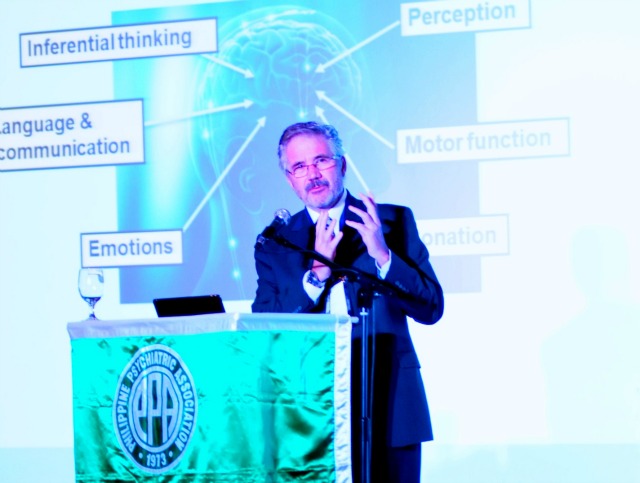
South African psychiatrist Dr. Robin Emsley said the symptoms of schizophrenia usually kick in at a critical time in a person's life. Philippine Psychiatric Association
Nash was hospitalized over the next nine years after returning to the US. He has managed to survive the illness, still working on mathematics even in his 80s. Much of his struggle with schizophrenia was documented in both Sylvia Nasar's book “A Beautiful Mind” and the loose film adaptation starring Russell Crowe. He is proof that things could get better for schizophrenia patients, although his path is not exactly what Dr. Robin Emsley has in mind.
Emsley, a South African clinical researcher and psychiatrist, recently addressed a continuing education event of the Philippine Psychiatric Association here in Manila. Here, he discussed how schizophrenia develops, how it could be treated, and how new drugs could make things better for patients.
Emsley cited the hypothesis that schizophrenia arises from a failure of our capacity to tell if something is important or unusual. This capacity is called salience. Such a failure comes along with a heightened release of dopamine, one of several chemicals that transmit signals from the brain. (Drugs such as crystal meth or shabu, among others, can cause this heightened release.)
The symptoms of schizophrenia usually kick in at a critical time in a person's life, which is the time between adolescence and adulthood. “The point is that when patients come to us [psychiatrists] with an acute psychotic episode, it is at the end-stage of a 20-year process [from birth] leading up to it,” Emsley said.
Early intervention is helpful, he said, because patients can respond better to treatment. However, it is also a most difficult time, because patients are also at high risk of suicide, disengagement, and relapse (after initial treatment).
Keeping the medication going, Emsley said, is one challenge. It is the key to ensuring patients get better.
It is also a matter of how the medicine is delivered. In one study he cited, one in three persons who take oral medication as part of their treatment were less likely to see psychotic symptoms disappear within six months. That is considered, he says, to be the definition of “recovery.” This is likely because they fail to take their medicine.
If these medicines are discontinued, though, the risks are grave. Emsley said, “There are many consequences [of a relapse]: self-harm and harm to others, jeopardizing personal relationships, harming employment and educational prospects, diminishing personal autonomy and contributing to [social] stigma.”
In other words, when things get worse for people with schizophrenia, it becomes far more challenging.
While the film did portray John Nash taking newer anti-psychotic drugs available at that time, Nash has doubts about the effectiveness of such medicines. In a transcript of a 2002 interview available on the US Public Broadcasting Service site, Nash said, “On a short-term basis I would be taking the drugs and I would reach a level of acceptance. But not just because of the drugs....The drugs I think can be overrated. All of the drugs now continue to have some bad side effects.”
Nash's recovery was, in his view, partly a matter of mental will. But for other persons with schizophrenia, Emsley notes that it is a challenge to even get them to take their medication—often pills that would not be taken at all. “Sometimes even the best informational approaches do not work,” he said.
The key is to offer a treatment that was effective and long-lasting. This could be offered by long-term injectible anti-psychotic drugs, he suggested. He pointed out that in studies where these drugs, known as LADs, were administered to patients, the chances of recovery were higher.
Would these have helped John Nash? He would say that it is possible to recover and, as Dr. Emsley would say, have a better quality of life, without them.
“Statistically it is not so rare for persons to come out of real mental illness and become normal thinkers again,” Nash said in another excerpt from the 2002 interview. “Records of this go back, before any type of medical treatment, any type of drug treatment.”
At the same time, the drugs have evolved, and perhaps approaches that would not require popping pills too often might be more helpful.
But if there is one thing both Nash and Emsley agree upon, it is the role of social support networks—family, friends, and other communities—that is important in helping people with any mental illness get better. Mental illness can affect other people. And if others could help one get better, it will be the best outcome for everyone. –KG, GMA News

