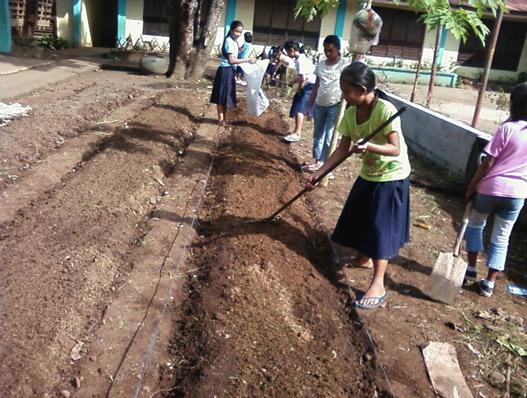
Students care for organic vegetable plots at San Isidro Elementary School in Pontevedra, Negros Occidental. The school is an IPNAP-OMG! beneficiary. Photo from ipnap.org.ph
Education is a key component in curbing poverty. However, without proper nutrition, children cannot possibly function properly and pursue their studies well. A roundtable discussion organized by the Infant and Pediatric Nutrition Association of the Philippines (IPNAP) in July in celebration of the Nutrition Month shed light on the need for stakeholders to combine efforts in providing children the basic need of nutrition. “IPNAP believes that a multi-sectoral approach is needed to fight malnutrition, one where industry, government, NGOs or civil society work together to educate, and to improve policy and nutrition programs,” said IPNAP executive director Alex Castro. The event gathered experts from different sectors: the Department of Science and Technology's Food and Nutrition Research Institute (FNRI) director Dr. Mario V. Capanzana; Philippine Women’s University’s School Of Nutrition dean Dr. Leonora Panlasigui; and non-government organization Kabisig ng Kalahi president Victoria Wieneke. Coming from different fields, each speaker laid out the problems regarding nutrition in the country, as well as existing programs being implemented by each sector.
Breastfeeding high, yet malnutrition persists Capanzana’s presentation was on the results of the latest FNRI survey. “There is commendable increase in breastfeeding rates, very near the World Health Organization goal in 2025, which is 50 percent and we are already at 46.7 percent,” he said. However, the latest FNRI showed that there is a growing problem in stunting and underweight among infants and young children, particularly those between the ages of 0-5. “What is alarming — and we need to look at this very closely — is the stunting rate. You’ll note that at one year old, the proportion of stunted children increased to 34 percent from about 16.2 percent [at] 6 to 11 months. Something needs to be investigated along this area,” Capanzana said.
Why is this the case? According to Capanzana, different sectors he termed “champions” have been successfully addressing malnutrition: an exclusive breast-feeding policy by the international community and Department of Health targets children from ages 0-6 months; feeding programs by the Department of Social Welfare and Development targets the 3-6 age range; and a feeding program spear-headed by the Department of Education is aimed at children 6-12 years old. No one seems to be filling the gap covering the 6 months-3 years range. It is a vulnerable stage which, he said, if not addressed properly could cause irreversible damage to a child. “This is the point where we need to intervene,” said Capanzana.
Mothers' health Panlasigui added an important insight to the discussion: the mothers have to be healthy too. Otherwise, breastfeeding will not guarantee the health of the child. “If the pregnant woman is healthy, then even the composition of her milk might not be healthy as well,” she said. She emphasized the need to promote nutritional education among mothers.
Feeding programs and models Wieneke spoke in behalf of the NGO sector, sharing how a humble program she started in 2001 became a bigger and nobler project through partnerships with private corporations such as Jollibee and Mead-Johnson. Starting with 10 communities in Abra, Rizal and Camarines Sur, her flagship program is a six-month daily supplementary feeding of nutritious hot meals from a specially designed cycle menu, targeting the most malnourished children in selected communities. “This, for me, is nation-building at its most basic form and at its best,” she said. Wieneke related how, in 2001, she was dismayed by seeing feeding programs limited to serving watery lugaw and banana-cue. FNRI's own response has been to develop an “extrusion technology” model that seeks creative alternatives for complementary food for babies ages 6- 36 months. Called DOST HITS or High Impact Technology Solutions, the model uses extrusion cooking (a method of creating prepared foods quickly) to create low-cost, ready-to-cook, yet nutritious baby foods. This program is similar to the US Food Aid Program’s P.L. 480 or Food for Peace. But once this is phased out, said Capanzana, DOST HITS will take its place. Capanzana cited examples of the program’s food like Big Mo Rice Mongo-Curls, Big Mo Rice Mongo Sesame Blend and Rice Mongo Instant Blend, all with 100 k/cal per energy or at least 4 grams of protein per serving, which is the World Health Organization standard. “It’s like junk food, without the junk,” Capanzana added.
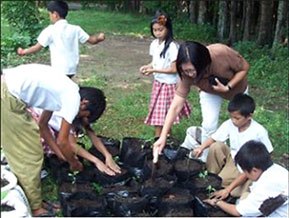
Schoolchildren transplant tomato seedlings for plastic bag mulching, supervised by their principal, at IPNAP-OMG! beneficiary F. Gonzaga Elementary School in Bacolod City. Photo from ipnap.org.ph
Community project IPNAP programs coordinator Joey Montalvo discussed IPNAP’s participation in the Department of Education’s “Oh My Gulay” (OMG!) project. OMG! is a simple community initiative to encourage more people to plant vegetables, as well as to instill in them the value of eating vegetables. Under the program, 40 schools were adopted under the supervision of DepEd and private sectors. The DepEd chose the schools that had the highest incidence of malnutrition. “The program involved an orientation for students, teachers, parents, and community officials on the importance of the nutritional value of vegetables and the methods in using bio-intensive gardening,” Montalvo said. It may be a simple project, but conducted large-scale, it may help alleviate malnutrition in the country. However, as Montalvo and Castro reiterate, it would take a lot to solve the problem nationwide. “That’s why it’s important to hold forums like this. The sectors have to work together. And as IPNAP, we focus on relationship-building and collaboration among different sectors,” Montalvo said.
— BM, GMA News 

 GMA Brandtalk
 Tracking
 Archives


