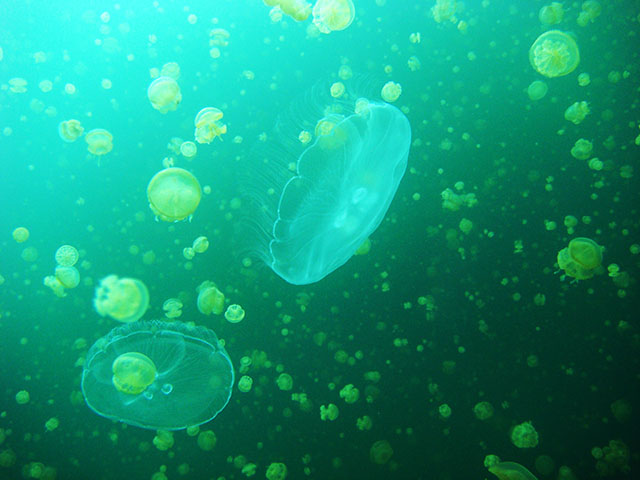
An unlikely item to pack for the beach is vinegar, in case of jellyfish stings. However, not all jellyfish stings are dangerous.Reuters file photo
When you say beach preparations, most people just think about bathing suits and sunblock. But once you hit the beach, it's best to remember that the sand and sea are no longer our territory. To the sea creatures that live here, you're the intruder. Since they're prepared with their natural defense mechanisms, such as sharp spines and poisonous stings, it's best to brush up on some first aid tips before diving in.
Jellyfish Jellyfish stings are a common problem at the beach, but not all jellyfish stings are dangerous. When stung by a jellyfish, the first thing you will feel is a stinging, itchy pain. Eventually, you will experience swelling, and uneven marks on the skin. If the jellyfish is venomous, you will experience difficulty breathing, and in some cases, dizziness. "'Yung iba dumidiretso eh, puwedeng ikamatay 'yun," Dr. Victoria Abesamis, chief of the Medical Professional Services at East Avenue Medical Center said in a 2012 report on On Call.
Immediate treatment is necessary, as jellyfish have nematocysts, or stinging cells, that release toxins that can spread through the body. If stung by jellyfish, soak the affected area in vinegar for 15 to 30 minutes. If no vinegar is available, salt water may be used. Fresh water should be avoided, however, as this can only produce more toxins, Abesamis said. Contrary to belief that urine can be used to treat jellyfish stings, Abesamis said this is not ideal. “Kasi 'yung ihi, di naman lahat ng ihi ay acidic. Dapat kasi kasing acidic ng suka o acetic acid,” she said. Marine zoologist Jappy Lim explained the jellyfish sting serves as self-defense, as well as a way to capture food. "Mapopoison at maiimmobilize. Hindi na makagalaw or makatakas 'yung maliliit na isda. So ang nangyayari, 'yung tentacles, i-ddraw nila 'yung fish sa mouth ng jellyfish para kainin," Lim said. Of 2,000 known species of jellyfish,
only 70 are poisonous or harmful. The box jellyfish is one of the most dangerous sea creatures, with venom that can kill a person within 15 minutes, Doc Ferds Recio said on an episode of Born to be Wild in 2010. Named for its cube-like shape, the box jellyfish has 15 tentacles in each corner, which can reach up to 10 feet or three meters. In Australia, the potentially lethal
Irukandji jellyfish can kill an adult within two minutes. Meanwhile, other types of jellyfish are relatively harmless, such as the jellyfish the show "Born to be Wild" encountered in Bucas Grande in Surigao del Norte. Unlike the box jellyfish, these jellyfish can be held. "Puwede mo silang ma-touch, kaya lang ang problema, masyado silang fragile. Puwede silang mamatay, madaling matanggal ang mga body parts nila," guest host Romi Garduce said in 2008.
As jellyfish are found in both shallow and deep parts of the ocean, swimmers are advised to be cautious. "If may nabalitaan kayo na maraming jellyfish sa area at gusto niyong mag swimming siguro mag-reschedule na lang kayo or you find another place kung saan puwede kayong mag swimming," Lim said. "Another is, let's say wala namang ganung report, you just want to take precautions, one, you can wear a rash guard and leggings," Lim said. "Ina-advise namin 'yung mga maliligo, especially mga bata, kasi makati, huwag ninyong hihipuin ['yung jellyfish]," Danny Abrera, provincial head of the Bureau of Fisheries and aquatic resources, said in a 24 Oras report on March 8.
In 2009, a minor died after
coming into contact with "salabay," a toxic type of jellyfish. The minor was among six youths who went swimming in a river at Sitio Luyang in Giljungan village in Cauayan town. Meanwhile, swimmers should not kill jellyfish either. "Jellyfish is part of the ecosystem. So nagbabalance din siya sa ecosystem, sa pamamagitan ng pagkain doon sa mga algae," Dr. Westly Rosario, chief of BFAR-NIFTDC said.
Stingrays Although generally docile, stingray have spines that are coated in venom, which can kill small creatures and cause excruciating pain in humans.
Attacks like the one that killed "Crocodile Hunter" Steve Irwin in 2006 are rare, according to marine experts. Irwin died after a stingray barb pierced his chest as he recorded a show off the Great Barrier Reef in Australia. Stingrays are usually shy, unobtrusive fish, but they have a serrated spine up to 10 inches long on their tails, which they can lash when stepped on or otherwise frightened, a
previous report said. Few people have died from the poison, but the spines can badly tear flesh and the wounds are prone to infections, including tetanus, the report said.
Stonefish Known as the most venomous fish in the world, the stonefish is so dangerous that, according to Thinkquest, the Australian Aborigines have a
dance ritual to warn children against stepping on the sneaky fish. Despite having 13 spines, these fish are hard to detect, as they lie camouflaged on the seabed. Its venomous spines protect it by shooting poison in reaction to pressure, causing muscle weakness, temporary paralysis, and shock. Untreated, stonefish venom can lead to death. According to the Australian Venom Research Unit, even footwear cannot protect humans from the its tough spines. "The result of stonefish envenomation is immediate and excruciating pain, but a delayed effect may be tissue damage,"
AVRU warns. If stung by stonefish, immerse the affected area in warm water. AVRU warns against pressure-immobilization first aid, which may increase the severity of local pain. Analgesia or topical anaesthetic agents may also be used. "Stonefish antivenom reduces the pain and the likelihood of tissue damage," AVRU said.
Antivenom is required when there are more than mild to moderate local pain or systemic symptoms, according to AVRU.
Sea urchins Sometimes called the "hedgehog of the sea," sea urchins have prickly spines that serve as its protection. Apart from its spines, sea urchins have pedicellariae - three-jawed pincers which serve as backup defense, as well as cleaning the sea urchin's body of small animals, as explained on
the Animal Planet website. The spines, which are often poisonous, are a common cause of injury to unsuspecting swimmers. What looks like a clump of rocks or seaweed could actually be a sea urchin in disguise. Thanks to its tiny tube feet, which are able to extend and grip objects on the ocean floor, the sea urchin disguises itself by arranging objects to cover their bodies, Animal Planet explained. The sharp spines can cause puncture wounds, which can be painful and cause inflammation. Symptoms include tiredness, weakness, muscle ache, shock, respiratory failure, and paralysis, according to health advice and information website
NHS Direct Wales. Although rare, severe injuries from sea urchins may cause death. To treat a sea urchin sting, immerse the affected area in hot water. You can use tweezers to remove large spines. To remove pedicellariae, apply shaving cream on the area, and use a razor blade to gently scrape pedicellariae out, NHS Direct said. Finally, scrub the wound with soap and water, and then rinse with fresh water.
Sea snakes Small and shy, sea snakes have short fangs which cannot cause much damage in terms of wounds. However, their bite, although painless, is enough to get poison into the blood, according to ThinkQuest's
database of posionous plants and animals. Symptoms appear half an hour after being bitten. A victim may feel stiffness, muscle aches and spasm of the jaw, pain in the bitten limb. "The powerful neurotoxins contained in the venom cause blurred vision, drowsiness and respiratory paralysis," ThinkQuest said. To treat a sea snake bike, antivenin, tiger snake antivenin or even polyvalent antivenin may be used.
Fire corals Fire corals might sound pretty, but as the name suggests, if you get too close to these sea creatures, you'll get burned. "Brushing up against fire coral causes a lot of pain. Tiny barbs in the coral get launched into anything that touches fire coral and they cause a short term intense burning," an
article on Shedd Aquarium's website said. Described as a white-tipped, mustard colored animal, the fire coral adapts its form depending on its habitat. "In areas where the current isn’t very fast, it will grow into thin branches that form a lattice. If the current is somewhat strong, it will be found as thick staghorn-like branches or thick columns," Shedd Aquarium said. Fire coral polyps contain nematocysts inside their cells. These stinging barbs are used for protection and feeding. According to the
eMedicineHealth website, fire coral cuts and stings symptoms include an immediate burning sensation, a red rash, lymph gland swelling, and in rare cases, nausea and vomiting. The treatment for fire coral cuts is the same as the treatment for other coral cuts. Rinse the cut with seawater, not fresh water, which will only increase pain. Applying vinegar or isopropyl alcohol can inactivate the venom. To remove neumatocysts, use tweezers or tape. Avoid moving the affected area, as this may cause the venom to spread. Applying hydrocortisone cream can help soothe itching, but watch out for signs of infection. Consult a doctor for further treatment, especially when the affected area develops pus or a large blister with red streaks.
— BM, GMA News 

 GMA Brandtalk
 Tracking
 Archives


