

 GMA Brandtalk
 Tracking
 Archives

ADVERTISEMENT
Filtered By: Lifestyle
Lifestyle
UNICEF: Mothers should continue to breastfeed in disasters, emergencies
+
Make this your preferred source to get more updates from this publisher on Google.
The Philippines is the second most disaster-prone country in Asia, hit by several calamities a year that take hundreds of lives and cause thousands to suffer. Just last week, heavy monsoon rains and floods battered the country for four consecutive days.
Among the most vulnerable victims of these calamities are babies. In the mistaken belief that they are helping out their children, some mothers switch to infant formula in times of scarce resources, assuming that stress or inadequate nutrition from the calamity can hinder their ability to breastfeed successfully.
This is a "widespread misconception," said United Nations Children's Fund (UNICEF) Philippines' country representative Tomoo Hozumi.
 Continue breastfeeding
In a recent press conference, Hozumi stressed that during emergencies or disasters, mothers should continue to breastfeed their infants.
"During emergencies, majority of mothers can continue to breastfeed with appropriate support," he said.
Hozumi said that using infant formula opens up the risk of contaminating the baby's fomula with dirty water.
"During emergency times, the chances [increase] of getting infected with diarrhea and as a result, falling into malnutrition," he said.
For her part, media personality and UNICEF Special Advocate for Children Daphne Oseña-Paez said that from birth until six months, children would not need water or supplements other than breast milk.
Mothers should keep this in mind especially in times of emergency or if they are in a disadvantaged area.
"They don't need water. You won't need to expose your child to danger. Mothers' milk is complete, it's pure, it's free, and it's perfect," she added. "That is the message that we advocate in UNICEF."
Food, not infant formula, in relief packs
Hozumi said relief packs for calamity victims should not contain infant formula, but instead provide food for mothers, who need the nourishment the most.
"Help mothers get nutrition, not give infant formula to babies," he said. "Under that circumstances, during emergencies, majority of mothers can continue to breastfeed with appropriate support."
"Unfortunately...during emergencies, it's actually understandable, it's only human reaction—bringing food, including breast milk substitute, and that's not good," he added. "Food is important; using breast milk substitute during emergency situations is a prescription for disaster. It leads to higher instances of diarrhea, among others."
Oseña-Paez said support from the community is also vital to provide an environment where mothers can breastfeed safely, and to help women who have difficulty breastfeeding. She recalled visiting places recently struck by calamities where the community conducted lactation massages on mothers who have difficulty in producing breast milk.
"The culture of support for mothers—this includes the husband, mother-in-law, the community at large—I've seen that in Sarangani and Taguig," she said. "Every breastfeeding mother needs support, there should be a culture of support."
Milk banks
Oseña-Paez also stressed that women may call "milk banks" that deliver breast milk to mothers who are having difficulty in producing milk.
"During Typhoon Sendong, we facilitated a delivery from the PGH [Philippine General Hospital] of precious liquid," she noted. She added that other establishments with human milk banks are Fabella Hospital and Gata de Leche, whose milk "can be brought to depressed areas."
Hozumi added: "Those mothers who cannot produce breast milk whatever the reason, they are [only a] small number, and there are ways to help them also, in a controlled manner, not in distributing infant formula."
Exclusive breastfeeding for the first 6 months
Oseña-Paez was approached by UNICEF in 2010 to advocate breastfeeding.
"I didn't really know the bigger issues of breastfeeding at that time, but I thought it was the best choice," she said. "As a mom, it gave me a very beautiful bond with my child; it was something that I knew that came naturally."
"Then I met with UNICEF and found that not only was it a beautiful bond between mother and child, it really is an issue of health, it gives your child the best start in life. It's a health issue," she added.
Oseña-Paez, who renewed her contract as Special Advocate for Children for UNICEF Philippines last week, also stressed the importance of exclusive breastfeeding for infants from birth up to six months.
"Breast milk during the initial six months of life gives all the nutrients that the infant requires at that point in time," Hozumi said. "And in addition, it gives immunity to protect them from common illnesses like diarrhea and respiratory infections."
After six months, he added, "it becomes necessary for children, babies to be introduced to what we call supplementary feeding. In addition to breastfeeding, there should be a supplementary food."
Slight improvement
 In the Philipines, the breastfeeding rate has improved slightly, but "not as much as what we want it to be," said Hozumi.
In 2003, only 30 percent of infants were exclusively breastfed up to six months of age. In 2008, the percentage rose to 36 percent.
However, the average length of time has declined from 5.6 months in 2003 to 4.9 months in 2008.
"Average during of breast feeding in 2003, something like 5.6 months. But in 2008, it was reduced to 4.9 months," said Hozumi.
The Philippines passed the Milk Code, a law promoting breastfeeding and discouraging mothers from giving milk formula to their newborn babies, in 1986. The law was revised in 2010 to add a provision requiring private and public establishments to set up breastfeeding stations.
"Philippines has that, that's very good, but at the same time, it's the enforcement, implementation, that is something that still needs to be improved," said Hozumi.
"Breastfeeding is not often highlighted in the news, therefore, there is not much awareness in breastfeeding as much as there should be," he stressed.
He cited that many mothers in the Philippines are working, but most work places are not "baby-friendly."
"Perhaps you can think of your own work place. How baby-friendly are your own workplaces? For instance, how easy or difficult is it to breastfeed, to continue to breastfeed in the work place? That's another issue," he said. — BM, GMA News
Among the most vulnerable victims of these calamities are babies. In the mistaken belief that they are helping out their children, some mothers switch to infant formula in times of scarce resources, assuming that stress or inadequate nutrition from the calamity can hinder their ability to breastfeed successfully.
This is a "widespread misconception," said United Nations Children's Fund (UNICEF) Philippines' country representative Tomoo Hozumi.
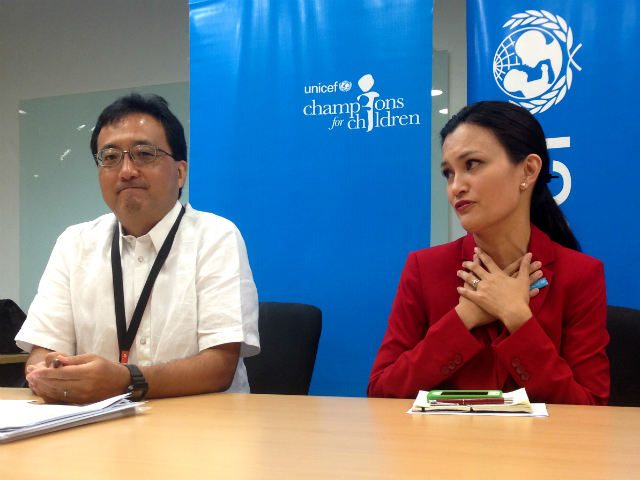
UNICEF Special Advocate for Children Daphne Oseña-Paez (with UNICEF Philippines' country representative Tomoo Hozumi) recalls one of her visits to disaster-struck areas in the Philippines. Amanda Fernandez
In a recent press conference, Hozumi stressed that during emergencies or disasters, mothers should continue to breastfeed their infants.
"During emergencies, majority of mothers can continue to breastfeed with appropriate support," he said.
Hozumi said that using infant formula opens up the risk of contaminating the baby's fomula with dirty water.
"During emergency times, the chances [increase] of getting infected with diarrhea and as a result, falling into malnutrition," he said.
For her part, media personality and UNICEF Special Advocate for Children Daphne Oseña-Paez said that from birth until six months, children would not need water or supplements other than breast milk.
Mothers should keep this in mind especially in times of emergency or if they are in a disadvantaged area.
"They don't need water. You won't need to expose your child to danger. Mothers' milk is complete, it's pure, it's free, and it's perfect," she added. "That is the message that we advocate in UNICEF."
Food, not infant formula, in relief packs
Hozumi said relief packs for calamity victims should not contain infant formula, but instead provide food for mothers, who need the nourishment the most.
"Help mothers get nutrition, not give infant formula to babies," he said. "Under that circumstances, during emergencies, majority of mothers can continue to breastfeed with appropriate support."
"Unfortunately...during emergencies, it's actually understandable, it's only human reaction—bringing food, including breast milk substitute, and that's not good," he added. "Food is important; using breast milk substitute during emergency situations is a prescription for disaster. It leads to higher instances of diarrhea, among others."
Oseña-Paez said support from the community is also vital to provide an environment where mothers can breastfeed safely, and to help women who have difficulty breastfeeding. She recalled visiting places recently struck by calamities where the community conducted lactation massages on mothers who have difficulty in producing breast milk.
"The culture of support for mothers—this includes the husband, mother-in-law, the community at large—I've seen that in Sarangani and Taguig," she said. "Every breastfeeding mother needs support, there should be a culture of support."
Milk banks
Oseña-Paez also stressed that women may call "milk banks" that deliver breast milk to mothers who are having difficulty in producing milk.
"During Typhoon Sendong, we facilitated a delivery from the PGH [Philippine General Hospital] of precious liquid," she noted. She added that other establishments with human milk banks are Fabella Hospital and Gata de Leche, whose milk "can be brought to depressed areas."
Hozumi added: "Those mothers who cannot produce breast milk whatever the reason, they are [only a] small number, and there are ways to help them also, in a controlled manner, not in distributing infant formula."
Exclusive breastfeeding for the first 6 months
Oseña-Paez was approached by UNICEF in 2010 to advocate breastfeeding.
"I didn't really know the bigger issues of breastfeeding at that time, but I thought it was the best choice," she said. "As a mom, it gave me a very beautiful bond with my child; it was something that I knew that came naturally."
"Then I met with UNICEF and found that not only was it a beautiful bond between mother and child, it really is an issue of health, it gives your child the best start in life. It's a health issue," she added.
Oseña-Paez, who renewed her contract as Special Advocate for Children for UNICEF Philippines last week, also stressed the importance of exclusive breastfeeding for infants from birth up to six months.
"Breast milk during the initial six months of life gives all the nutrients that the infant requires at that point in time," Hozumi said. "And in addition, it gives immunity to protect them from common illnesses like diarrhea and respiratory infections."
After six months, he added, "it becomes necessary for children, babies to be introduced to what we call supplementary feeding. In addition to breastfeeding, there should be a supplementary food."
Slight improvement
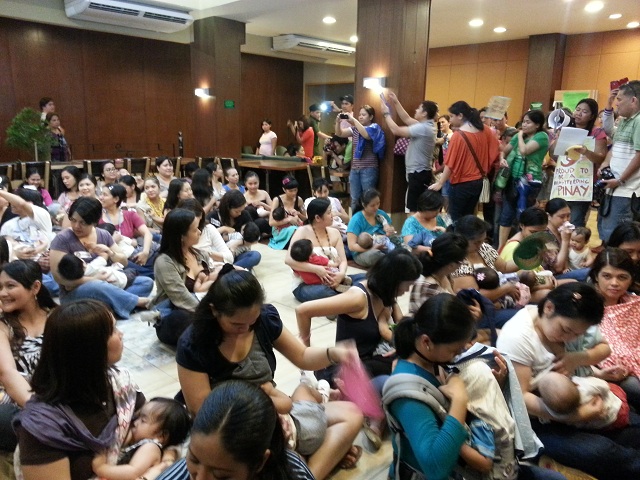
Earlier this month, hundreds of breastfeeding moms gathered in four cities to promote breastfeeding and the upholding of the Milk Code. Barbara Marchadesch
In 2003, only 30 percent of infants were exclusively breastfed up to six months of age. In 2008, the percentage rose to 36 percent.
However, the average length of time has declined from 5.6 months in 2003 to 4.9 months in 2008.
"Average during of breast feeding in 2003, something like 5.6 months. But in 2008, it was reduced to 4.9 months," said Hozumi.
The Philippines passed the Milk Code, a law promoting breastfeeding and discouraging mothers from giving milk formula to their newborn babies, in 1986. The law was revised in 2010 to add a provision requiring private and public establishments to set up breastfeeding stations.
"Philippines has that, that's very good, but at the same time, it's the enforcement, implementation, that is something that still needs to be improved," said Hozumi.
"Breastfeeding is not often highlighted in the news, therefore, there is not much awareness in breastfeeding as much as there should be," he stressed.
He cited that many mothers in the Philippines are working, but most work places are not "baby-friendly."
"Perhaps you can think of your own work place. How baby-friendly are your own workplaces? For instance, how easy or difficult is it to breastfeed, to continue to breastfeed in the work place? That's another issue," he said. — BM, GMA News

