

 GMA Brandtalk
 Tracking
 Archives

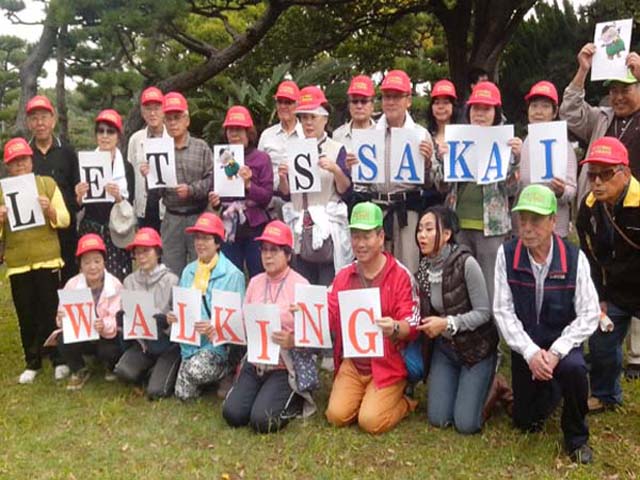
Thursday morning with the elderly Ohama Park Walking Group of Sakai
SAKAI CITY, Japan – Osamu Okada treads the trail with a smile and a casual gait. Looking at him, it’s hard to believe that the retired salesman is already 80 years old—and that he’s climbing a mountain.
Granted, Sotetsu-yama is hardly a mountain by world standards; but here in Japan, it is categorized as such. At only 6.84 meters above sea level, it is officially recognized as Japan’s lowest mountain and an important landmark in this sprawling city in the heart of the Osaka prefecture. But despite its miniature size, Sotetsu-yama (Mount Sotetsu) still boasts of a rolling landscape, lush greenery, and ample shade.
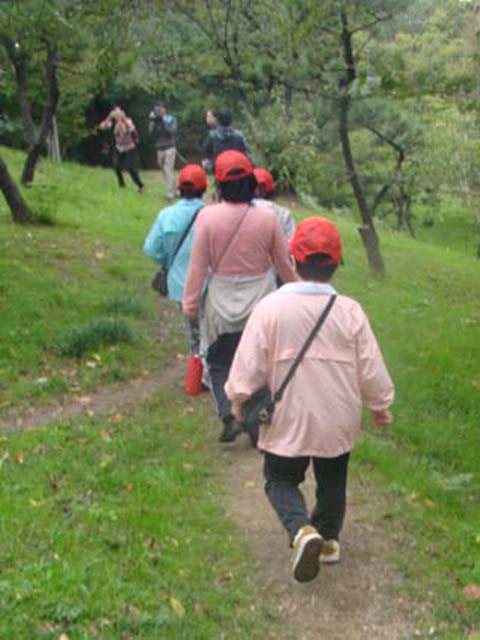
Ahead and behind Okada are some 15 of Sakai city’s elderly residents, some walking in pairs, others in groups of three or four, all chatting and laughing as they gingerly navigate their way toward a certain meeting point.
It’s a slightly drizzly and bitterly cold Thursday morning, but for the members of the Ohama Koen Walking no Kai (Ohama Park Walking Group), it’s walk-to-the-mountain weather, creaking joints be damned.
Two reasons, twice a week
“We do this two times a week,” Okada, through a translator, told visiting journalists for this year’s Sakai ASEAN Week. “We do it Monday and Thursday mornings.”
Okada, who has been a member of the Ohama Koen Walking no Kai for 12 years, is the current leader of the group, which according to him has between 25 to 35 mostly female members, the oldest being 86 years old.
“We do this for two things,” Okada said. “To socialize and be healthy.” Which is essentially a repetition of what could be the group’s motto, as emblazoned on their uniform orange cap: “Come let us gather and be healthy.”
“I feel good,” said Satoyama Hideko, 73, one of the day’s elderly mountain climbers. “This is what I do now that all my grandkids are grownups.”
Japan's age problem
In a larger context, however, the existence of the Ohama Koen Walking no Kai—one of 16 other similar elderly groups—in Sakai is much more than elderly people just wanting to keep fit and remain busy after retirement. It is connected to the problem that has been hounding Japan for the past several years now: in Japan, there are too many old people and not enough government money to support them.
In fact, a Japan Times report on Sept. 16, 2013 said, based on the latest figures from Japan’s Internal Affairs and Communications Ministry, the number of people aged 65 years old (the new retirement age among the Japanese, up from 60) and above has reached a “record-high” of 31.86 million people, or about a quarter of the country’s population—an alarming number, considering that Japan is also facing a dwindling labor force due to its declining birth rate.
As of January 2013, 24 percent or 189,380 of Sakai's population of 842,539 citizens are aged 65 years and above, while those 15 years and below were comparatively lower, 22.5 percent or 119,700.
These numbers mean “it is very important for us to have healthy old people,” says Prof. Hisanori Kato, vice chief director of the non-profit organization Sakai International Interchange Association.

“It means that the government needs money to pay medical expenses for the citizens of Japan,” Kato explained. “If elderly people are unhealthy and need to pay more medical bills, the government needs more tax for that purpose.”
But “more tax” is almost impossible in a society with a continuously decreasing labor force.
According to Toshihiro Menju, managing director of the Japan Center for International Exchange, it is estimated that between 2005 and 2025, the Japanese labor force—ages 15 to 64—will decrease by approximately 14 million, while citizens aged 75 and above will increase by 10 million.
"The economic, civil, and societal implications for such a dramatic and sudden demographic change are unprecedented," Menju said in his article “Accepting Immigrants: Japan’s Last Opportunity for Economic Revival.”
'We can handle ourselves quite well'
Despite this national dilemma, Okada says the government had no hand in establishing Ohama Koen Walking no Kai. In fact, except for the free consultations and checkups offered by Sakai’s Office of Health, the government gives “no physical support” to the group. As a group, Okada and the rest are pretty much on their own.
The drizzle has stopped when Okada and the others reach their destination—a clearing where a marker announcing the historical significance of the mountain stands. Despite the long walk, they all look happy, even resplendent in their brightly colored caps, vests, and jogging pants, as they gamely grant interviews and photo requests from the visiting journalists.
It’s as if they’re telling the government, Don’t worry about us. As long as we have this mountain and each other, we can handle ourselves quite well. — VC, GMA News
The media tour for the 2013 Sakai ASEAN Week was organized and sponsored by the city government of Sakai in cooperation with several private groups.

