

 GMA Brandtalk
 Tracking
 Archives

ADVERTISEMENT
Filtered By: Lifestyle
Lifestyle
Azkals’ fame tapped to push HIV testing among Filipino youth
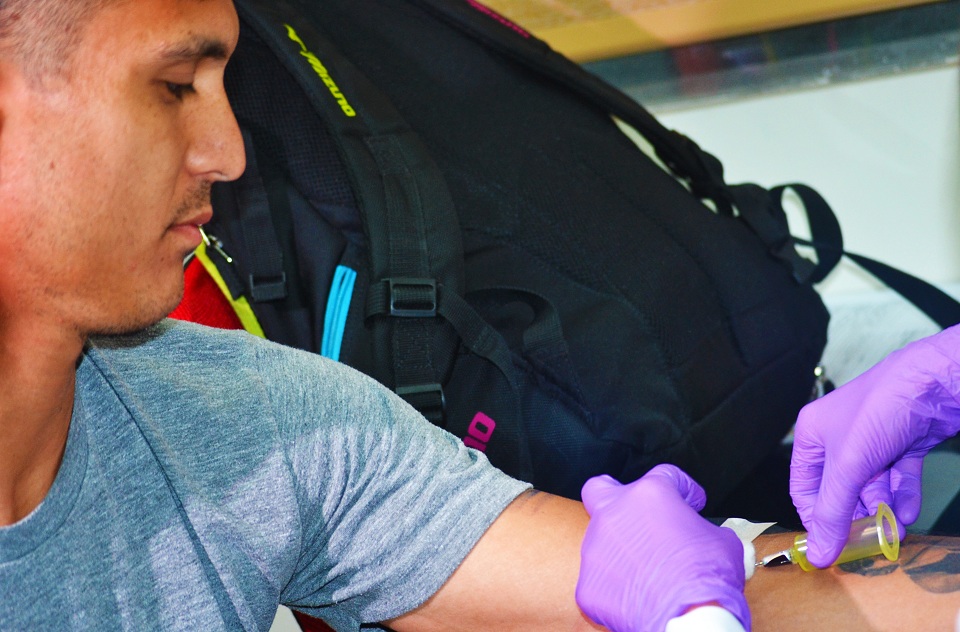
Azkals forward Nate Burkey undergoes HIV testing to encourage other young men to do the same. Photo by John Michael Concepcion
Burkey is at the forefront of an innovative health campaign that taps football’s popularity to reach out to sexually active young Filipinos, notably males, to convince them to learn their HIV status via free and confidential testing.
The 29-year-old Filipino-American football player was recently appointed the first “Philippine Ambassador” for Protect the Goal (PTG), a global HIV education, information, awareness, and prevention drive.
The PTG campaign targets as many young men as possible from diverse backgrounds to highlight the importance of submitting themselves to voluntary HIV testing and counseling.
"The thing that excites me most is being able to help my kababayans in a very positive way," Burkey said in a recent interview with reporters on his new role.
His initial act after being appointed PTG ambassador was to undergo the free and confidential HIV testing process at the newly opened “The Love Yourself Anglo” (TLY Anglo) center in Mandaluyong.
Burkey hopes that young Filipino men and women will follow his example.
“I’ve been tested before, I got tested [again] today. If you haven’t been tested, that’s the one thing I would recommend,” he said. “Regardless of the results, we now have a wonderful community here that can counsel and help you in any way possible.”
“This isn’t a virus to be scared of. My advice to everyone is to move forward in the direction we’re going, to jump on board with us, and to get the goal that we want to achieve,” he added.
Burkey was referring to the PTG objectives and the Joint United Nations Program on HIV and AIDS (UNAIDS) targets of “zero new HIV infections, zero discrimination, and zero AIDS-related deaths” in the Philippines.
HIV, or the human immunodeficiency virus, infects cells of the immune system. In the process, the virus destroys or impairs the cells’ capacity to fight infection and diseases, leading to a general and progressive deterioration of the immune system called “immune deficiency.”
AIDS, or the acquired immunodeficiency syndrome, refers to the most advanced stages of HIV infection. AIDS is also characterized by the occurrence of any of more than 20 opportunistic infections or HIV-related cancers.
At-risk population
For its Philippine edition, which runs until December 2014, the PTG specifically focuses on the Filipino youth because they are one of the populations most at risk of HIV infection.
Health statistics gathered beginning 1984 estimate that 71 percent of new infections in the Philippines were among young people. However, two-thirds of the high-risk young people are not aware of their HIV status.
Dr. Rossana Ditangco, chief of the AIDS Research Group of the Research Institute of Tropical Medicine (RITM), an agency under the Department of Health (DOH), said the Philippines has an estimated 14 new HIV infections per day, or one person getting infected with HIV every two hours.
Ditangco said the trend was noticed as early as 2007. “Every year we are seeing a very rapid rise in the number of new cases being diagnosed,” she said.
The Philippine HIV and AIDS Registry of the DOH-National Epidemiology Center reported 495 new HIV infections in May, 44 of which have progressed into full-blown AIDS.
Of the 495 cases, 96 percent or 473 were males. The median age of the 495 cases was 28 years, with the age range recorded at 17-69 years. The 20-29 year age group has the most number of cases, with 57 percent.
The top two modes of HIV transmission were sexual contact (465 cases) and needle-sharing among injecting drug users (30 cases), the registry said.
The group of males having sex with other males cornered 85 percent of the 495 cases, making it the most predominant type of sexual transmission.
Given these demographic, the Philippines' national football team has been chosen by the Asian Football Confederation (AFC) to be one of the national teams in Asia to work with the UNAIDS in the PTG anti-HIV drive.
The Philippine PTG combines the influence and expertise of UNAIDS, the Asian Development Bank, the AIDS Research Group of the RITM-DOH, the Azkals and the advocacy group The Love Yourself (TLY).
Like the Indonesian, Thai, and Myanmar national football teams participating in the regional PTG, the Azkals, notably Burkey, will help mobilize Filipino football fans across the country to communicate key messages, drumbeating calls for an end to discrimination against people living with HIV and for greater access to HIV treatment.
The international PTG campaign was launched in 2010 during the Fédération Internationale de Football Association (FIFA) World Cup in South Africa. In 2013, the PTG was re-launched to channel public attention to the FIFA World Cup in Brazil.
Lawyer Edwin B. Gastanes, general secretary of the Philippine Football Federation, said Azkals players are “fully committed” to the PTG campaign on HIV awareness and prevention.
“We are using the power of sports like football. We wish to encourage all Filipino men and women to lead a healthy life, to engage in sports, to love yourself or to love themselves. And understand the risks associated with HIV/AIDS,” Gastanes said in a separate interview.
The Philippine Football Federation competition will be used as education and information opportunities to make announcements before the match, during the half-time match, and after the match.
“We will request the members of the Azkals to encourage the Filipino youth to protect themselves and to protect the goal. This is one way that sports, football in particular, can help in the combating the HIV/AIDS problems,” Gastanes said.
“If you love yourself, you will not engage in risky behaviors. If you love yourself, you do not want your friends and family members to engage in risky behaviors,” he added.
'Dramatic' surge in HIV cases
Teresita Marie Bagasao, UNAIDS country director, said the “dramatic” surge in new HIV cases in the Philippines should be “a source of concern for all Filipinos.” The new cases are found among the youth who are educated and who are in their most productive years, she added.
“We encourage everyone to understand the HIV/AIDS issues, not to discriminate against people living with HIV/AIDS,” said Bagasao.
Ronnievinn Pagtakhan, TLY president, said that with the opening of the Mandaluyong Anglo hub, his group “aims to upscale the HIV screening services in the Philippines, specifically in Metro Manila.” “We would like Anglo to be more than a clinic. This will be a community center.”
Pagtakhan said both the Manila and Mandaluyong TLY centers offer free HIV testing and counseling services to all, no appointment needed, and walk-ins are welcomed.
The centers, administered by TLY in partnership with RITM-DOH, are open from 12:00 noon to 7:00 p.m. from Wednesdays to Sundays, he said.
Part of the funds to support the new Mandaluyong facility comes from the RITM-DOH, a grant from the Global Fund through the DOH, the Positive Action Foundation Philippines, and donations from private citizens and contributions from TLY. — BM, GMA News
For inquiries and information, visit www.loveyourself.ph, or email help@loveyourself.ph or info@loveyourself.ph.

