

 GMA Brandtalk
 Tracking
 Archives

Psychiatrists tell all: The 411 on suicide prevention
Suicide is a public health issue, not a crime.
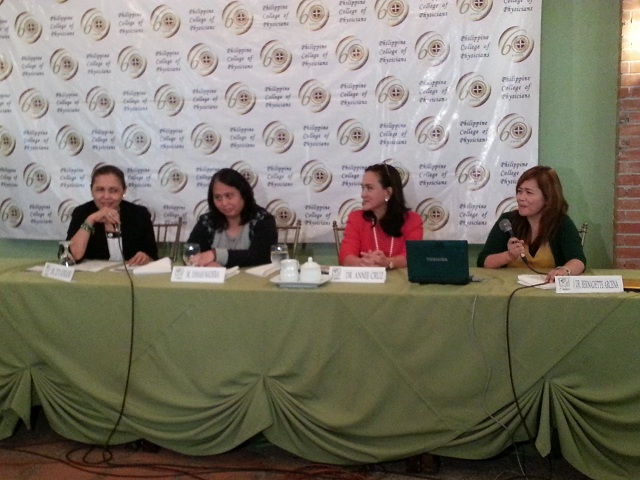
This is a point that psychiatrists Dinah Nadera, Bernadette Arcena, Annie Cruz, and Zita Soriano couldn't stress enough during the “Health Forum on Suicides and the Role of Media” on Tuesday.
The forum discussed four topics: the Philippine experience on suicide, suicide prevention, the media's role in suicides, and the re-launching of the SISA Media Awards in November.
Stats, local and int'l
Suicide is the third leading cause of death among those aged 15 to 44 years, taking about 900,000 lives annually worldwide. Nadera stated that about 60 percent of all suicide deaths are among young adults, making it one of the factors of economic loss. Among the risk factors, depression is the most frequent.
“Someone dies of suicide every 40 seconds,” she said. “And for nearly every suicide death, ten to 20 persons attempt suicide. With the youth, 430 people aged 10 to 24 die every day through interpersonal violence.”
However, she stressed that the magnitude of attempted suicides is not clearly known for each individual country.
Even so, about 85 percent of all suicides occur in developing countries. More than half that number take place in the Western Pacific and Southeast Asian regions. The home is the most common venue for the deed, with public places as a close second.
But what about in the Philippines?
“In Asia, we have one of the lowest suicide rates. Pero di mo pwedeng ipagpantay sa ibang bansa kasi iba yung situation nila. What we need to look at is our own rates—tumataas ba sila o bumaba? Yun ang importante,” said Arcena.
And what the Philippine Psychiatric Association has found is that 'our own rates' have been on the rise for three decades, between the period of 1975 to 2005. Notable is how the rates peak around the ages of 15 to 24 for both males and females and again for males at the ages of 65 and above. Meanwhile, the mean age for fatal suicides is 33.85 and the sex ratio is the same for men and women.
One other trend being looked into is how the rates peak at around summertime in the Philippines, close to Lenten season. But the psychiatrists emphasized that it is dangerous to speculate on the reasons with so little data available.
Nadera explained that “Suicides are not regularly recorded in institutions and there is no national suicide prevention program in the Philippines.” Therefore, Philippine data on suicides has been cobbled together by examining the death registry, case records review of deaths, emergency room consultations, anthropological studies, and school-based surveys.
“What data there is is under the Violence and Injuries Prevention program of the DOH,” said Nadera. “The case records review is done via police reports. And when suicide is printed on an NSO certificate, it means they saw the death as a possible suicide event after they were seen by a physician—other than that, they are recorded as dead on arrival.”
And according to a global school-based health survey conducted in 2011, out of school youth and public school kids are more at risk.
“Walang pinipiling economic status ang depression,” Arcena said. “Depression is a factor, but not a single factor—there are higher-risk factors. One very important risk factor is the lack of access to professional health. That is why depression is rising in poor countries, like ours, with poor mental healthcare systems.”
“Close friends are one protective factor,” said Nadera. “Not having close friends is a redaction of one preventive barrier.”
In the Philippines, four factors were seen as preventive barriers. These are:
- Spirituality
- Family support
- Peer support
- Positive experience
How to tell if someone is suicidal
“Some may not verbalize that they want to die, but there are warning signs,” said Acena. “Usually dramatic changes in mood, behavior, and appearance.”
Examples of behavioral changes include:
- Talking or writing about death/suicide
- Behaving in ways that are life threatening or dangerous
- Trying to set affairs in order, making contact with people they have not spoken to for some time or ending close relationships, giving away possessions
- Negative emotions: rage, anger, vengefulness, agitation, anxiety
- Sleep disturbance
- Acquiring habits such as tobacco, alcohol, or drug use
- Change in level of religious interest or preoccupation with afterlife
- Emotional shifts may range from:
- A sense of personal failure
- Overwhelming sadness
- A general lack of interest in anything
- Feelings of hopelessness
- Guilt
- Withdrawal or isolation
- Feeling like s/he is a burden to others
- And if the individual chooses to verbalize their feelings, it is through subtle, indirect phrases:
- “It's too late now”
- “I can't go on”
- “I have nothing to live for”
- “I'm just so tired of life”
- “No one cares about what happens to me”
- “There is nothing left to do”
- “What's the use”
- “They won't have to deal with me”
- “I'm at the end of my rope”
- “They're better off without me”
- “I just want the pain to stop”
- “Nobody gets me”
- “You don't understand”
However, there is such a thing as situational factors. Some of these are:
- The recent loss of a loved one (death or divorce)
- The individual is a survivor of a previous suicide attempt
- Loss of prestige such as a job or a business
- Serious illness (chronic pain or exhaustion with no end in sight)
- Exhaustion of resources, real or imaginary (money or credit lines)
- There is a family history of suicide
- A close friend dies of suicide
“If you want to figure out if the situation is serious, ask outright,” said Arcena. “Ask about their thoughts, intentions, and plans. Seek help once you see the warning signs—professionals will prescribe medicine and talk to the relatives. The problem with Pinoys is that there is a stigma in going to a psychiatrist.”
De-stigmatizing mental health
Jeane Goulbourn mentioned in an interview on News to Go that Filipinos tend to equate going to the psychiatrist with being crazy. Psychiatrists are trying to do away with this mentality.
Apart from trying to partner with and educate the media, the four psychiatrists revealed that they are pushing for a Mental Health Act, as the Philippines is one of the few countries that do not have one. The Mental Health Act that they have in mind is “human rights-based” and posits that suicide is a public health issue and that mental health should be covered from the grassroots. NGOs, for example, should also be handling and being trained in mental healthcare.
Nadera mentioned that the national government has two breakthrough goals. The first is mainstreaming mental health, which means integrating mental healthcare in hospitals and the like. The second is developing standards for acute psychiatric care in hospitals, which includes allocating psychiatric beds in general hospitals.
One other way of de-stigmatizing mental health is in changing the language we use to describe it.
“The correct translation for depression is 'lusog isip',” said Nadera. “We have a problem with language because we do not have an exactly equivalent word for depression—and our culture does not perceive it as a Western diagnosis sort of thing.”
With regard to language, they are trying to partner with the media in order to popularize the words. One way of doing that, Soriano said, is reviving the SISA Media Awards—named after the “Noli Me Tangere” character—in November. It will be in tangent with an international conference, the Asian Federation of Psychiatry and Mental Health Convention, and it will be the first time a psychiatric association will recognize the role of the media in health not just in the Philippines, but in the entire region.
Where the first SISA Awards in 2010 only recognized television, this year's installment will also include radio and mainstream films.
Suicide prevention for the ordinary person
There are five steps that family and friends must adhere to when dealing with a suicidal loved one.
1. Understand. Try to understand what s/he is feeling. Do not tell them how they should feel or do. “All of us can feel depressed, but there is a depression that is clinical. Let us not minimize the feelings or what the person who tells you about wanting to kill themselves or about their depression is going through,” said Cruz.
2. Listen. Apart from listening carefully, make sure you hear what they are actually saying. You don't need to have all the answers—just show them that you care. Suicidal thoughts must not be kept secret. Find out their coping mechanisms.
“Each person has different coping mechanisms, depends on what they’re going through,” said Cruz. “It’s very important to listen to what that person is saying and how they are coping with what they are going through.”
3. Express concern. Tell them you are worried and want to help. Seek help from the clergy or preferably a doctor if the individual already has a plan, the means, and the intention to carry it out. You may not be able to handle it on your own.
4. Talk frankly. It may seem counter-intuitive, but it will help to ask that person, “Are you thinking of killing yourself right now? Do you have a plan for doing it?” Suicidal people feel like they are invisible and no one hears them; asking them this is one step closer to making them feel like they aren't invisible.
“There is also a belief when you talk to this suicidal person, you are putting ideas in their heads and they won't go through with it, that they are just seeking attention. No. When you talk to them, it is a relief,” said Soriano.
5. Assess lethal intent. You need to send the best help you can, and one way to do that is to find out the minute details of the plan, if the individual confesses to having such a plan. Ask them if they thought about killing themselves at that very moment or before it, and if they have the weapon with them.
“The important things to remember are that suicide is a worldwide phenomenon, it's a public health issue hitting the youth and causing economic losses, and that it's preventable,” Nadera concluded. “We should not underestimate our capacity to help a person who is suicidal.” — BM, GMA News
For free and confidential counselling 24/7, call In Touch Community’s Crisis Line: 893-7603 (landline), 0917 800 1123 (Globe), or 0922 893 8944 (Sun). They can also be reached via email: crisisline@i-manila.com.ph.
The Natasha Goulbourn Foundation's 24/7 Hopelines are (632) 804-4673 and 09175584673.

