

 GMA Brandtalk
 Tracking
 Archives

ADVERTISEMENT
Filtered By: Lifestyle
Lifestyle
Motorcycle riders, pedestrians among top victims of road accidents in PHL –WHO
A global report on road safety by the World Health Organization said most of the deaths caused by road accidents in the Philippines involved riders of motorized two- or three-wheelers as well as pedestrians.
According to WHO's Global Status Report on Road Safety 2015, riders of motorized two- or three-wheelers make 53 percent of road deaths, followed by pedestrians with 19 percent, drivers of two-wheeled cars and light vehicles with 14 percent, and passengers of two-wheeled cars and light vehicles with 11 percent.
Deaths involving cyclists only make two percent of the total.
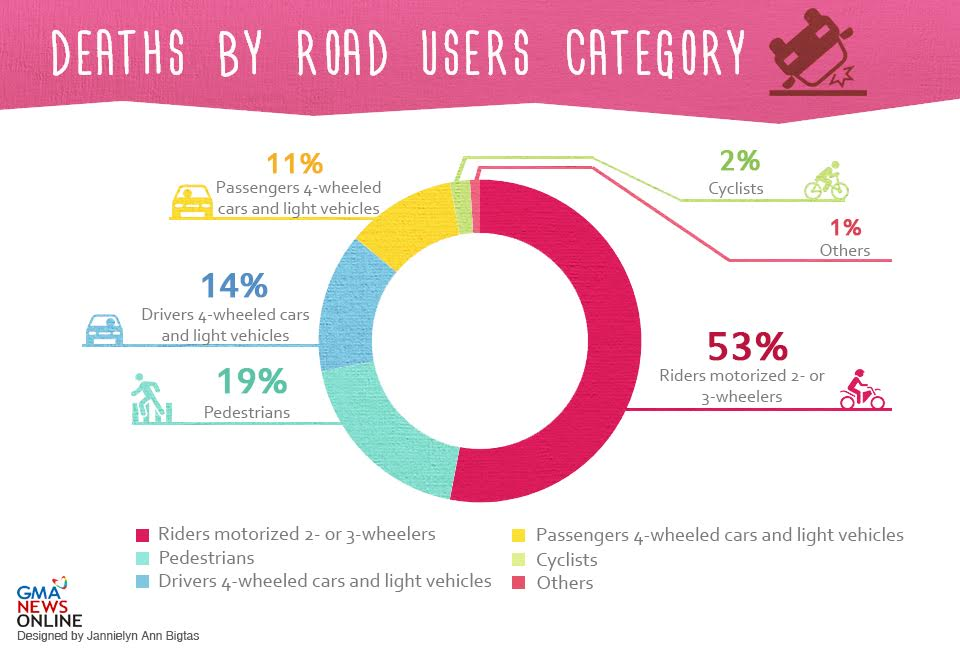
WHO obtained the data from the records of the Department Public Works and Highways (DPWH) Traffic Accident Recording and Analysis System (TARAS) in 2013.
The global report also said that only 1,513 road traffic fatalities were reported. But WHO estimated that the number should be 10,379.
Enforcement of road laws
On a scale of 0 to 10, the report also rated how the Philippine government enforces road laws. For the national speed limit law, WHO gave the country a rating of five. The same goes with the national seatbelt law, saying only 80 percent of drivers wear their seatbelt.
The Philippines got a better rate in its national motorcycle helmet law at six. WHO noted that 51 percent of riders and 87 percent of drivers wear their helmets.
WHO, meanwhile, gave the country the lowest score — one — for its national drunk-driving law. It also noted that the country has no national law on mobile phone use while driving and has a limited national restraint law.
Global status
In her foreword, WHO Director General Dr. Margaret Chan said that low and middle income countries are the hardest hit by road traffic accidents and deaths.
"Vulnerable road users – pedestrians, cyclists and motorcyclists – make up half of these fatalities," she said.
Chan added that although there is no rise in road traffic deaths globally, many countries still need to improve the implementation of their road safety measures such as speed management and laws on key behavioral risk factors for road traffic injuries.
"The SDG [Sustainable Development Goals] target of a 50% reduction in road traffic deaths and injuries by 2020 offers a powerful focus around which governments and the international community can galvanize action – the challenge now is to seize the opportunity to do so, and to turn the current plateau in road deaths into a measurable decline," she said.
"While much progress has been achieved over the past decade, the pace has been too slow," Chan added. —KBK, GMA News

