

 GMA Brandtalk
 Tracking
 Archives

Want to quit your job because it's just too hard? Psychologist Angela Duckworth has good advice

The first day of DigiCon OMNI 2020 closed with a keynote address from psychologist Angela Duckworth, author of the book "Grit" and founder and CEO of Character Lab.
While the esteemed psychologist centered on grit, Duckworth touched on a subject, super relevant in workplaces these days: quitting.
Plenty employees wave the white flag, saying their work is simply too hard, too demanding, and that they're burning out.
But Duckworth on Monday made a case for perseverance at work.
Sharing an anecdote about a swimmer who eventually became an Olympian after his father didn't allow him to quit the sport when he was falling behind at age 11, Duckworth pointed out a very obvious thing that many professionals might be able to relate to: "On a very bad day, we want to quit what we're doing."
But it's exactly on our bad days that we might want to shift our mindset, she said. "When you're challenged and when you're failing, having a growth mindset becomes the most helpful," Duckworth said.
Pointing to the mindset theory of psychologist Carol S. Dweck, Ph.D, Duckworth explained there are two types of mindsets: a Growth Mindset, which is having the belief that your talents and your intelligence can be developed. "That people really are a work in progress," Duckworth said.
And then there is the Fixed Mindset, where one believes that intelligence is static and you can't really change yourself.
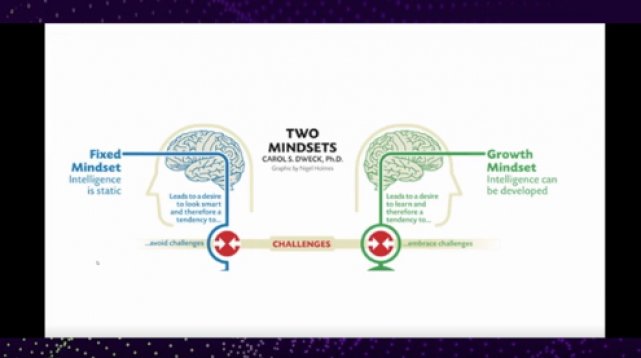
"When you're winning, your mindset doesn't really matter. But it's when you're challenged and when things aren't working out that having a growth mindset becomes extremely helpful," Duckworth says.
Changing your mind is just one of her suggestions in developing grit, which Duckworth defines as "sustained passion and perseverance for especially long-term goals."
One way to think of grit, she said, is simply finishing what you start.
You may be in careers for which you have a talent for. Perhaps you became a graphic designer because you're good at drawing. Or you became a copywriter because you're good with words, but there's the caveat: Grit isn't the same as talent, and according to Duckworth, talent is not enough.
"Talent counts but effort counts twice," she continued explaining that for talent to become an achievement, you first need to apply effort turn it into skill. And then you need to apply effort to skill to turn it into achievement.
Angela Duckworth, CEO and Founder, Character Lab talks about passion and growing your grit. #IMMAPDigiConOMNI #DigiConOMNI2020 pic.twitter.com/usDZpl9AVD
— DigiConPH (@digiconph) October 5, 2020
This is why, together with changing your mindset, deliberate practice is also essential in developing grit. "Break down what you want to master into smaller practice and then practice that smaller part with absolute concentration. And then get feedback," Duckworth advised.
Getting feedback, having the support of another person, and when you can, cultivating a work culture that embraces the idea that we are all works in progress, are very important in developing grit and not quitting. "Sometimes we really need another to help us get through those bad days," Duckworth said.
She adds it's also important to develop your interests because "interest is the seed of passion."
"Ask yourself, are you really interested in your work? Could you develop this interest further?"
Finally, in developing grit, it's important to cultivate purpose. "This is different from seeking pleasure, because pleasure is not related to grit," Duckworth said. Maybe you need to kindle that interest and have a more profound sense of purpose in your work.
So before quitting, remember you might just be having a bad day. And bad days, Duckworth says, are never a good time to quit.
Perhaps you just need to rest?
Digicon OMNI 2020 is an ongoing five-day conference that delves on technology, business, and marketing. For the first time, the conference is held virtually. — LA, GMA News

